Castration: Cut that produces the subject

Wersja PL: Kastracja: Cięcie, które produkuje podmiot
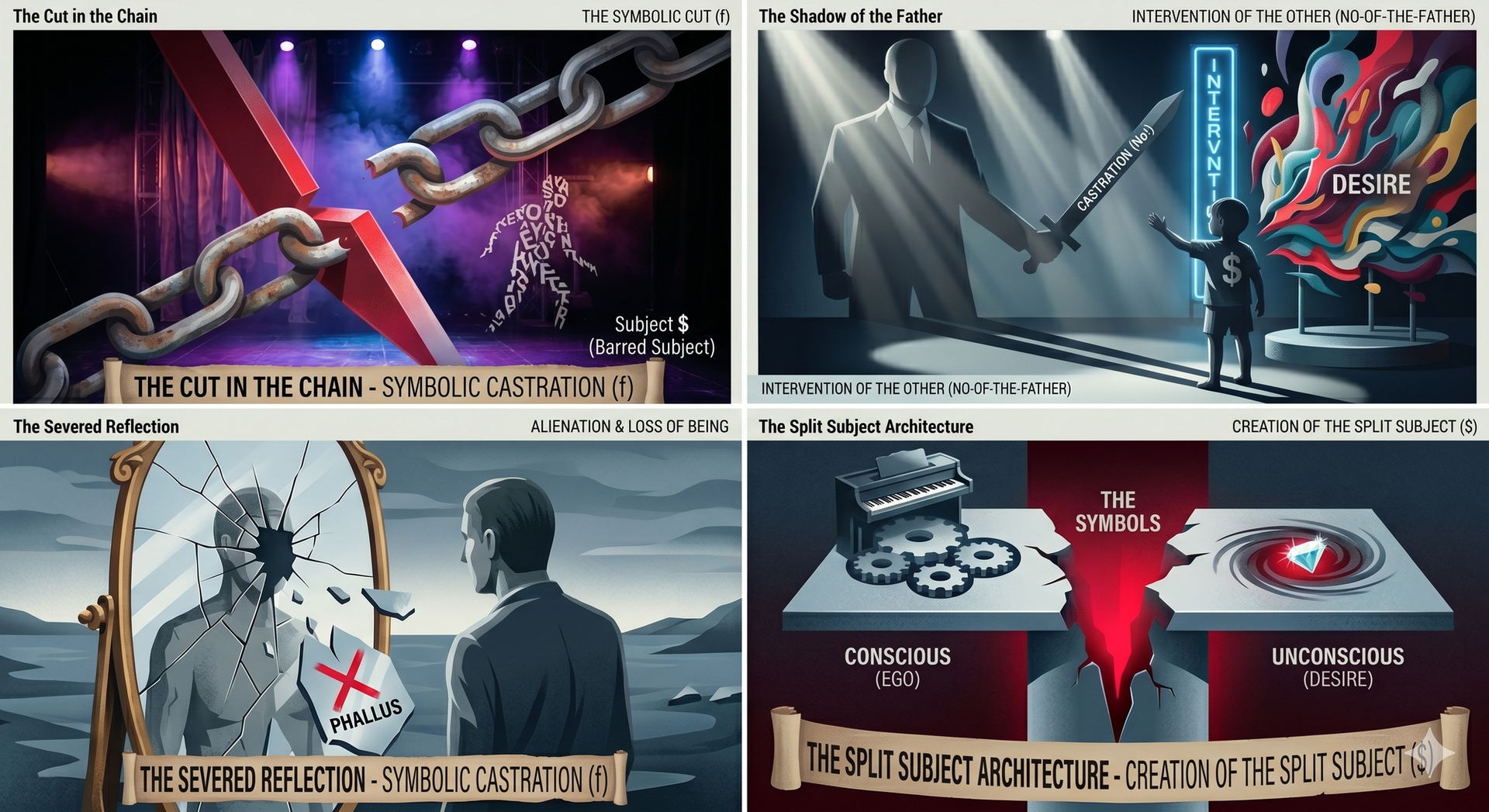
W przypadku odbiorców dobrze obeznanych z orientacją freudowsko-lakanowską możemy pominąć wstępne „metafory anatomiczne” i przejść bezpośrednio do strukturalnej, topologicznej rzeczywistości tego pojęcia: kastracja to pierwotna operacja Porządku Symbolicznego na Realnym ciała. Nie jest to wydarzenie, które przydarza się podmiotowi; to strukturalne cięcie, które podmiot produkuje.
Od mitu freudowskiego do struktury lakanowskiej
Tam, gdzie Freud polegał na micie zakotwiczonym filogenetycznie – groźbie fizycznego pozbawienia narządu, za którą stoi pierwotny ojciec – Lacan formalizuje kastrację jako nieuchronną alienację językową. Aby wejść w Porządek Symboliczny, podmiot musi podporządkować się Imieniu-Ojca (Nom-du-Père), które funkcjonuje jako metafora fundamentalna.
Metafora ta zastępuje enigmatyczne pragnienie Matki prawem, nakładając znaczące na chaotyczne Realne popędu (rozkoszy/jouissance).
Freud: Lęk przed fizyczną stratą - -> Wyparcie - ->Neuroza
Lacan: Wejście w język - ->Kastracja / Cięcie - -> Podmiot Rozszczepiony ($)
Konsekwencja tej operacji jest dwukrotna:
- Podmiot zostaje rozszczepiony ($): Podmiot ulega alienacji przez same znaczące, które go reprezentują. Jak zauważył Lacan w swojej słynnej formule: znaczące reprezentuje podmiot dla innego znaczącego. W tej reprezentacji bezpośredni byt podmiotu zostaje uśmiercony.
- Fallus zostaje odczepiony: Fallus (Phi) zostaje podniesiony z rangi organu do rangi znaczącego pragnienia. Kastracja to uświadomienie sobie, że nikt fallusa nie ma i nikt fallusem nie jest. Zarówno Matka, jak i Podmiot są naznaczeni strukturalnym brakiem (-phi).
Obiekt a jako reszta z cięcia
Kastracja jest zasadniczo operacją ekstrakcji (wyciągnięcia). Symboliczne cięcie nie dokonuje czystego podziału, lecz pozostawia skrawek. Tą pozostałością po strukturalnym ścięciu jest obiekt małe a (objet petit a) – utracony obiekt-przyczyna pragnienia.
„Cięcie jest tym, co ujawnia strukturę podmiotu jako brak”.
— Jacques Lacan, Seminarium X: Lęk
Kiedy Porządek Symboliczny wcina się w realne ciało, pozostawia po sobie strefy erogenne – krawędzie ciała (usta, odbyt, krawędź oka, anatomiczną szczelinę ucha). Obiekt a to mityczny fragment rozkoszy oddany językowi, odczepiony od ciała, a jednak topologicznie z nim związany.
Podmiot spędza swoje istnienie na krążeniu wokół tego braku za pośrednictwem popędu, próbując traktować różne przyziemne obiekty (pierś, głos, spojrzenie, fekalia) jako substytuty tej pierwotnej straty.
Topologia cięcia (Seminarium XIV i dalej)
W swoich późniejszych seminariach, w szczególności w Seminarium XIV (Logika fantazmatu) oraz w pracach nad powierzchniami topologicznymi (wstęga Möbiusa, butelka Kleina, cross-cap), Lacan przechodzi od lingwistycznego ujęcia cięcia do ujęcia czysto geometrycznego.
Na zwykłej, dwustronnej kartce papieru cięcie dzieli powierzchnię na dwa odrębne kawałki. Jednak na wstędze Möbiusa ciągłe, zamknięte cięcie wzdłuż linii środkowej nie dzieli powierzchni na dwie niezależne połowy; zamiast tego przekształca wstęgę w jedną, dłuższą pętlę z dwoma pełnymi skrętami.
Oto dokładna topologiczna definicja lakanowskiego cięcia:
- Jest to wykluczenie wewnętrzne (ekstymność / extimité).
- Cięcie tworzy granicę między Podmiotem ($) a obiektem a, a mimo to pozostają one strukturalnie ciągłe.
- Podmiot nie znajduje się po jednej stronie języka, a obiekt po drugiej; raczej to samo cięcie jest miejscem ich podziału.
Akt analityczny: Operowanie cięciem
W klinice analityk nie działa jako spójne „ego” oferujące interpretacje, które zszywają narrację pacjenta. Takie działanie wzmacniałoby jedynie wyobrażeniową iluzję całości (ego jako symptom). Zamiast tego analityk zajmuje strukturalną pozycję obiektu a i ucieleśnia funkcję cięcia.
Objawia się to ostro w skandowaniu sesji – czyli w sesjach o zmiennym czasie trwania. Przez niespodziewane przecięcie sesji na konkretnym znaczącym, analityk przerywa wyobrażeniową metonimię mowy pacjenta (jego niekończące się „bla-bla-bla”).
Kliniczne cięcie zawiesza znaczące w stanie metaforycznego zawieszenia. Zmusza ono podmiot do konfrontacji z brakiem w Innym, destabilizując fantazmat fundamentalny ($<>a) i wymuszając konfrontację z Realnym własnego pragnienia.
Bibliografia i lektury uzupełniające
Freud, Sigmund – Poza zasadą przyjemności (1920) oraz Zarys psychoanalizy (1940)
- Nacisk na: Ewolucję pojęcia kastracji u Freuda. Teksty te pokazują przejście od lęku przed realną utratą organu do wprowadzenia popędu śmierci i rozszczepienia ego w procesie obrony, co stało się bezpośrednim fundamentem pod lakanowskie ujęcie podmiotu rozszczepionego ($\$$).
Lacan, Jacques – Seminarium, Księga IV: Relacja z obiektem (1956-1957)
- Nacisk na: Kluczowe, wczesne rozróżnienie między kastracją (która dotyczy braku symbolicznego w Realnemu i wiąże się z Fallusem), frustracją (brak wyobrażeniowy w Realnemu) a frustracją/wykluczeniem. Tekst niezbędny, by zrozumieć, jak Lacan oczyszcza kastrację z biologizmu.
Lacan, Jacques – Seminarium, Księga X: Lęk (1962-1963)
- Nacisk na: To tutaj pada fundamentalna formuła: „Cięcie ujawnia strukturę podmiotu jako brak”. Lacan szczegółowo opisuje tu kastrację jako operację oddzielenia (ekstrakcji) obiektu a (jako głosu, spojrzenia, piersi, fekaliów) od porządku ciała.
Lacan, Jacques – Seminarium, Księga XIV: Logika fantazmatu (1966-1967)
- Nacisk na: Geometryzację cięcia. Sesje z tego seminarium precyzują matematyczne i topologiczne właściwości cięcia na cross-capie i wstędze Möbiusa, dowodząc, że cięcie nie rozdziela podmiotu i obiektu a, lecz konstytuuje ich strukturalną ciągłość (ekstymność).
For an audience well-versed in the Freudian-Lacanian orientation, we can bypass the introductory "anatomical metaphors" and speak directly to the structural, topological reality of the concept: castration is the primary operation of the symbolic order upon the real of the body.
It is not an event that happens to a subject; it is the structural cut that produces the subject.
From the Freudian Myth to the Lacanian Structure
Where Freud relied on a phylogenetically anchored myth—the threat of physical deprivation backed by the primordial father—Lacan formalizes castration as an inevitable linguistic alienation. To enter the Symbolic, the subject must submit to the Name-of-the-Father (Nom-du-Père), which functions as the fundamental metaphor.
This metaphor replaces the enigmatic desire of the Mother with a law, laminating a signifier over the chaotic real of the drive (jouissance).
Freud: Fear of physical loss --> Repression - -> Neurosis
Lacan: Entry into Language - -> Castration/Cut - -> Split Subject ($)
The consequence of this operation is twofold:
- The Subject is Split ($): The subject is alienated by the very signifiers that represent them. As Lacan famously noted, a signifier represents a subject for another signifier. In this representation, the subject's unmediated being is killed.
- The Phallus is Detached: The Phallus (Phi) is elevated from an organ to the signifier of desire. Castration is the realization that no one has the phallus, and no one is the phallus. Both the Mother and the Subject are marked by a structural lack (- phi).
Object a as the Remnant of the Cut
Castration is fundamentally an operation of extraction. The symbolic cut does not cleanly divide without leaving a scrap. This leftover of the structural shearing is object small a (objet petit a), the lost object-cause of desire.
"The cut is that which reveals the structure of the subject as a lack."
— Jacques Lacan, Seminar X: Anxiety
When the symbolic order cuts into the real body, it leaves behind erogenous zones—the rims of the body (the lips, the anus, the rim of the eye, the anatomical slit of the ear). Object a is the mythic piece of jouissance surrendered to language, detached from the body yet topologically bound to it.
The subject spends their existence circling this lack via the drive, attempting to treat various mundane objects (the breast, the voice, the gaze, the feces) as stand-ins for this primordial loss.
The Topology of the Cut (Seminar XIV and Beyond)
In his later seminars, particularly Seminar XIV (The Logic of Fantasy) and his work on topological surfaces (the Möbius strip, the Klein bottle, the cross-cap), Lacan shifts from a linguistic view of the cut to a purely geometric one.
On a standard, two-sided piece of paper, a cut separates the surface into two distinct pieces. However, on a Möbius strip, a continuous closed cut along the center line does not divide the surface into two independent halves; instead, it transforms the strip into a single, longer loop with two full twists.
This is the exact topological definition of the Lacanian cut:
- It is an internal exclusion (extimacy).
- The cut creates the boundary between the Subject ($) and object a, yet they remain structurally continuous.
- The subject is not on one side of language and the object on the other; rather, the cut is the locus of their division.
The Analyst’s Act: Operating the Cut
In the clinic, the analyst does not act as a cohesive "ego" offering interpretations that sew the patient's narrative together. To do so would reinforce the imaginary illusion of wholeness (the ego as a symptom). Instead, the analyst occupies the structural position of object a and embodies the function of the cut.
This manifests sharply in the scansion of the session—the variable-length session. By cutting the session unexpectedly on a specific signifier, the analyst breaks the imaginary metonymy of the patient's speech (their endless "bla-bla-bla").
The clinical cut drops the signifier into a state of metaphoric suspension. It forces the subject to confront the lack in the Other, destabilizing the fundamental fantasy ($<>a) and compelling a confrontation with the real of their desire.
Bibliography & Further Reading
Freud, Sigmund – Beyond the Pleasure Principle (1920) & An Outline of Psychoanalysis (1940)
- Focus: The evolution of the concept of castration in Freud's work. These texts trace the transition from the fear of a literal, physical loss of an organ to the introduction of the death drive and the splitting of the ego in the defensive process, which served as the direct foundation for the Lacanian conception of the split subject ($).
Lacan, Jacques – The Seminar of Jacques Lacan, Book IV: The Relation to the Object (1956-1957)
- Focus: The crucial, early distinction between castration (which concerns a symbolic lack in the Real and is bound to the Phallus), frustration (an imaginary lack in the Real), and privation. This text is indispensable for understanding how Lacan strips castration of its biological reductionism.
Lacan, Jacques – The Seminar of Jacques Lacan, Book X: Anxiety (1962-1963)
- Focus: This is where the fundamental formula is stated: "The cut reveals the structure of the subject as a lack." Here, Lacan meticulously outlines castration as an operation of separating (extracting) objet a (in the forms of the voice, the gaze, the breast, and the feces) from the order of the body.
Lacan, Jacques – The Seminar of Jacques Lacan, Book XIV: The Logic of Fantasy (1966-1967)
- Focus: The geometrization of the cut. The sessions of this seminar specify the mathematical and topological properties of the cut on the cross-cap and the Möbius strip, proving that the cut does not separate the subject and objet a, but rather constitutes their structural continuity (extimacy).
Written by
Subscribe for FREE to our Audience
Enter your email to access commenting, receive memos, logs, dispatches, and unfiltered fragments directly from the Theater.











Member discussion