Psychoanalysis and... Sigmund Freud & Jacques Lacan

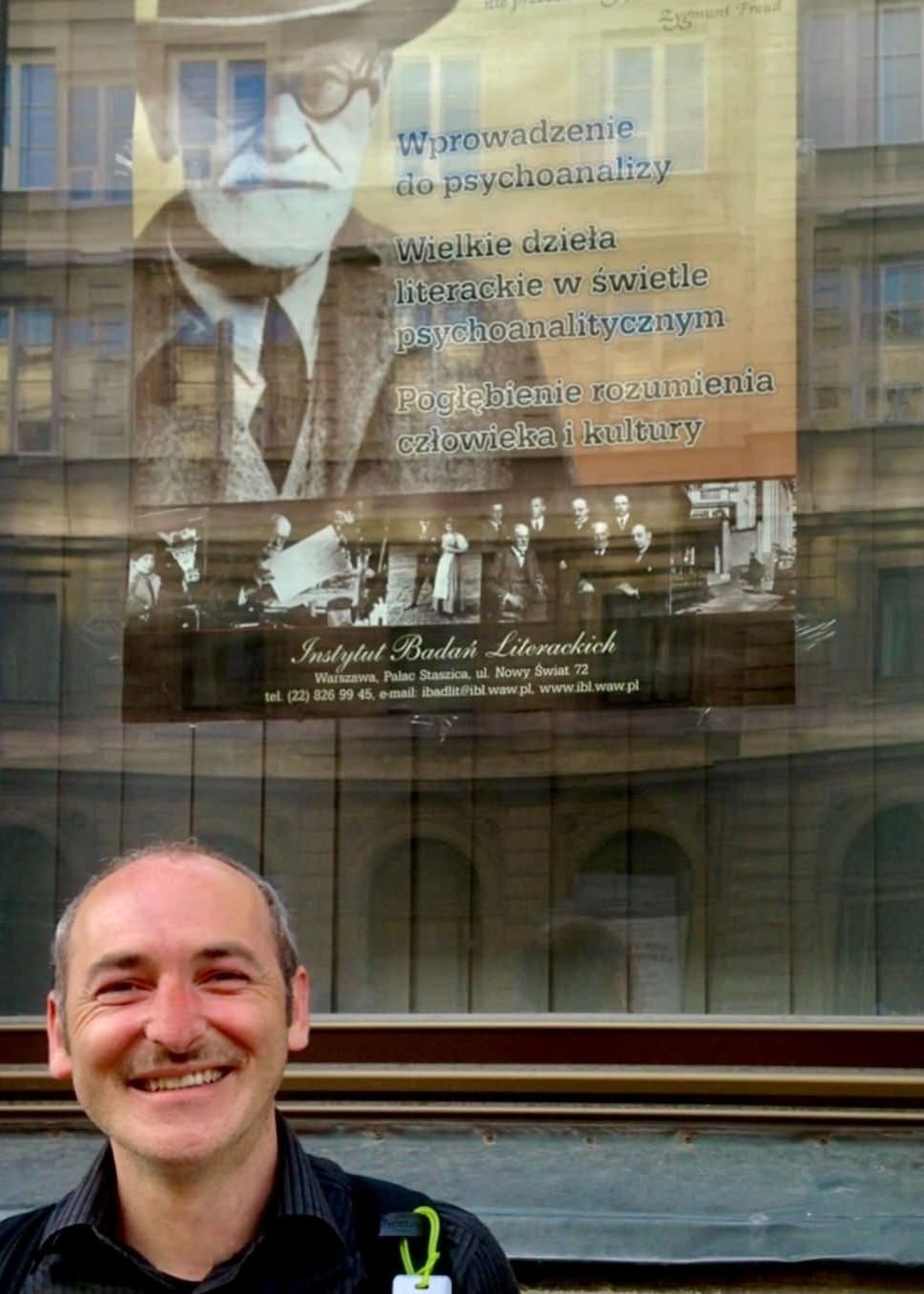
by Kristopher Lichtanski, PhD
While American culture and everyday life burst at the seams with psychoanalytic jargon ("you're in denial," "stop projecting," "he has a massive ego"), Americans remain deeply misinformed about what psychoanalysis actually is—and is not. Consequently, they deprive themselves of one of the most robust frameworks available to address the human condition. This is not to say that resistance to analytic thought isn't prejudiced elsewhere, but rather that the active rejection of psychoanalysis as a radical intervention into the misery of life is uniquely potent in the US. So, whatever you’ve heard, check these out:

1. The American Malady of the "Quick Fix": Why Psychoanalysis is the Radical Cure We Avoid
America is a culture obsessed with optimization, speed, and "life hacks." We want to fix our mental health in a 10-minute app session, a 6-week behavioral bootcamp, or a neatly packaged prescription. We treat our minds like smartphones—expecting that a glitching mood or an anxious loop can be patched with a quick software update.
But human beings aren't software. Our suffering cannot be optimized away, because our pain is not a bug; it is a symptom of a deeper, unexamined story. By demanding immediate efficiency from our psyches, we have created a profound American paradox: we are a hyper-optimized society plagued by a historic epidemic of loneliness, addiction, and chronic anxiety.
To heal, we have to stop trying to outrun our internal worlds. We have to look at what we are actually doing in modern mental health care, and why the oldest, deepest form of therapy—psychoanalysis—remains our most radical road to freedom.
The Illusion of Modern Symptom Management
The dominant paradigm in American mental health today is built around two pillars: Psychopharmacology and Cognitive Behavioral Therapy (CBT).
While both have their place and can be lifesaving in acute crises, they share a fundamental limitation: they treat mental suffering as a cluster of surface-level symptoms to be managed, rather than a systemic issue to be understood.
- The Industrialized Care Model: Insurance companies love CBT because it is manualized, predictable, and brief (usually 8 to 12 sessions). It treats the mind as a cognitive machine. If you have a negative thought, you catch it, challenge it, and change it.
- The Missing Foundation: This approach assumes that human beings are entirely rational actors who want to stop sabotaging themselves. But anyone who has ever stayed in a toxic relationship or ruined a great career opportunity knows that we are profoundly irrational.
If you only change the behavior without understanding the unconscious drive behind it, the psyche simply finds a new outlet. A symptom suppressed in one area will inevitably burst out in another. This is where psychoanalysis comes in: it bypasses the surface-level patching and goes directly to the underground operating system.
Navigating the Analytic Landscape: The Major Schools
When Americans hear "psychoanalysis," they often think it is a monolith unchanged since Victorian Vienna. In reality, psychoanalysis has evolved into several rich, diverse schools of thought, each offering a different lens on the human condition, for example:
1. Freudian & Ego Psychology: The Structural Drive
The foundation. Sigmund Freud’s core insight was that we are split subjects governed by an unconscious. He modeled the mind using the Id (our raw, primitive drives), the Superego (our internalized societal and parental moral codes), and the Ego (the realistic mediator trying to survive between them). Ego psychology focuses on how we use "defense mechanisms" (like denial, projection, or intellectualization) to cope with the anxiety generated by these conflicting forces.
2. Object Relations: The Blueprint of Relationships
Developed by thinkers like Melanie Klein and Donald Winnicott, this school argues that humans are driven not just by raw instincts, but by a fundamental need for connection. "Objects" are the significant people in our early lives (usually parents). Object Relations suggests that we internalize our earliest relationships and use them as blueprints for all future interactions. If your early "object" was unpredictable, you will unconsciously seek out unpredictable partners as an adult, compulsively repeating the old trauma in a desperate bid to master it.
3. Self Psychology: Healing the Fragmented Self
Founded by Heinz Kohut, Self Psychology is uniquely suited to the modern American struggle with narcissism and self-esteem. Kohut argued that when parents fail to provide empathy, validation, and "mirroring" during childhood, a person develops a fragile, fragmented sense of self. This manifests later in life as either profound emptiness or a desperate need for external admiration. The analyst's job here is to provide a deeply empathetic, stabilizing presence to help the client rebuild a cohesive sense of self.
The Radical Subversion: Jacques Lacan
If the other schools of psychoanalysis seek to strengthen the ego or patch up the self, the French psychoanalyst Jacques Lacan turned the entire project on its head. Lacan’s return to Freud is perhaps the most potent antidote to the American obsession with self-optimization.
Lacan boldly claimed that "the Ego is a symptom." It is not the core of who we are; it is an illusion, a rigid armor we build out of the images and expectations of others. From the moment we are born, we enter what Lacan calls the Symbolic Order—the world of language, laws, and social expectations.
Lacanian analysis introduces several revolutionary concepts that challenge how we view mental health:
- The Desire of the Other: Lacan noted that we don't actually know what we want. Instead, we learn to desire what others want us to desire. We chase the perfect corporate career, the ideal body, or the white-picket-fence life, only to achieve it and feel profoundly empty. We are living out the desires of our parents, our culture, or our social media feeds.
- The Split Subject ($): You can never be fully whole or fully integrated, and that is completely normal. Language is inherently flawed; it can never perfectly capture our lived experience (it is ... lacking...). There is always a remainder—what Lacan called the objet petit a—that arises from this fundamental lack, keeping us constantly reaching, searching, and still left feeling incomplete.
- The Goal of Analysis: In a Lacanian framework, therapy is not about "fixing" you so you can fit back into a sick society. It is not about making you a more productive worker or a happier consumer. The goal is to help you recognize the illusions of your ego, confront the fundamental lack inherent in being human, and separate your own authentic desire from the "Desire of the Other."
Beyond the Optimization Trap
The American obsession with quick-fix mental health is exhausting us. By treating our minds as things to be optimized, we alienate ourselves further from our own humanity.
Psychoanalysis—especially in its most radical forms—offers a terrifying but liberating alternative. It invites us to sit in a room, speak without a filter, and map the architecture of our own unconscious minds. It asks us to stop looking for a life hack and start looking for the truth.
We don't need a software update. We need to dismantle the machine and discover who we are when we finally stop trying to perform.
Bibliography and Further Reading
- Freud, S. (1917). Mourning and Melancholia. The Standard Edition of the Complete Psychological Works of Sigmund Freud, Volume XIV. London: Hogarth Press. (Foundational text for understanding the unconscious mechanisms of depression and grief).
- Kohut, H. (1971). The Analysis of the Self: A Systematic Approach to the Psychoanalytic Treatment of Narcissistic Personality Disorders. New York: International Universities Press. (The foundational text of Self Psychology).
- Lacan, J. (2006). Écrits: The First Complete Edition in English. (B. Fink, Trans.). New York: W.W. Norton & Company. (Lacan's primary collected works, outlining the mirror stage and the Symbolic order).
- Shedler, J. (2010). The Efficacy of Psychodynamic Psychotherapy. American Psychologist, 65(2), 98–109. (A landmark academic paper proving the long-term efficacy of psychoanalytic therapy over short-term CBT).
- Winnicott, D. W. (1965). The Maturational Processes and the Facilitating Environment: Studies in the Theory of Emotional Development. New York: International Universities Press. (Classic Object Relations text introducing the concepts of the "Good-Enough Mother" and the "True vs. False Self").
Further Reading - For Beginners (Accessible & Culture-Focused)
- The Examined Life: How We Lose and Find Ourselves by Stephen Grosz A beautifully written, highly accessible collection of short case studies by a contemporary psychoanalyst. It reads like fiction but demonstrates the profound power of analytical listening.
- Maybe You Should Talk to Someone by Lori Gottlieb While not purely psychoanalytic, this bestseller perfectly captures the tension between the modern American desire for a "quick fix" and the deeper relational work that actually heals.
On Modern Psychoanalytic Evidence
- Freud and Beyond: A History of Modern Psychoanalytic Thought by Stephen A. Mitchell and Margaret J. Black The absolute best primer for understanding how psychoanalysis evolved from Freud, through Object Relations, to modern Relational therapy. Essential for clearing up historical misunderstandings.
For Diving into Jacques Lacan
- Introducing Lacanian Psychoanalysis: A Graphic Guide by Luke Thurston and Philip Hill Lacan is notoriously difficult to read directly. This illustrated guide is the perfect, jargon-free starting point to grasp the Split Subject and the "Desire of the Other."
- The Lacanian Subject: Between Language and Jouissance by Bruce Fink The gold standard introductory textbook for anyone who wants a rigorous but comprehensible deep-dive into how Lacanian theory translates to actual clinical practice.
2. The Radical Outsider: Why Psychoanalysis Is Not Actual "Mental Health Care"
To step into a psychoanalyst’s office in America today is to engage in a profound category error.
We routinely bundle psychoanalysis into the multi-billion-dollar apparatus known as the "mental health industry." It is regulated by the same state boards, constrained by the same insurance codes, and measured by the same legal and clinical metrics as Cognitive Behavioral Therapy, mindfulness coaching, and psychiatric medication.
But this forced marriage is a mistake. Psychoanalysis does not belong to the mental health framework. It is not a branch of medicine, it is not a behavioral science, and it is fundamentally incompatible with the bureaucratic and legal structures designed to govern them.
The mental health industry seeks to restore a broken individual to societal normalcy. Psychoanalysis, by contrast, views "normalcy" itself as a highly suspect construct. They are not addressing the same problem, they do not speak the same language, and nowhere is this ideological chasm more obvious than in how they define a "symptom."
Two Irreconcilable Paradigms
The modern mental health industry is built on a technocratic, bio-medical framework. It operates under a clear, linear logic: there is a baseline of healthy functioning; a pathology disrupts that baseline; the clinician’s job is to eradicate or manage that pathology so the patient can return to being a productive, frictionless member of society.
Psychoanalysis operates on an entirely different plane of human inquiry. We can compare them in this simple way:
- Primary Goal
The Mental Health Industry: Symptom reduction, adaptation, behavioral optimization.
Psychoanalysis: Unconscious truth, personal freedom, structural self-knowledge.
- View of the Subject
The Mental Health Industry: A biological/cognitive machine that is temporarily broken.
Psychoanalysis: A divided, inherently conflicted subject navigating existence through language.
- The Target
The Mental Health Industry: The DSM-5 diagnosis (e.g., MDD, GAD).
Psychoanalysis: The unique economy of the individual's unconscious desire.
- The Legal Status
The Mental Health Industry: A regulated healthcare service bound to measurable outcomes.
Psychoanalysis: An ethical, subjective exploration akin to philosophy or art.
To understand why psychoanalysis resists the mental health framework, one must look at the word symptom. In a standard clinical setting, a symptom is an enemy. In an analytic setting, a symptom is a text to be read.
The DSM-5 Symptom: The Bug in the System
Under the Diagnostic and Statistical Manual of Mental Disorders (DSM-5), a symptom is a standardized, observable deficit. If you experience five out of nine specific criteria—such as insomnia, fatigue, or a depressed mood—for more than two weeks, you are diagnosed with Major Depressive Disorder.
The DSM symptom is entirely objective and interchangeable. Your depression is treated as functionally identical to a stranger’s depression. The mandate of the mental health professional is to eliminate these symptoms via chemical dampening or behavioral retraining. The symptom is a "bug" in the software.
The Psychoanalytic Symptom: The Truth in Disguise
To an analyst, the symptom is not a mistake; it is a highly sophisticated creation. It is a compromise formation—the unconscious mind's brilliant, painful attempt to solve an otherwise unbearable internal conflict.
If you compulsively sabotage your career just as you achieve success, a DSM framework labels this a "maladaptive behavior" to be corrected with cognitive restructuring. An analyst looks at this same behavior and asks: What truth is this sabotage protecting you from? Whose expectations are you unconsciously rebelling against? > The Analytic Axiom: The psychoanalytic symptom is the only way the subject knows how to express their repressed desire. If you simply strip a person of their symptom without understanding its function, you do not cure them—you disarm them, leaving them defenseless against the underlying anxiety.
The Legal and Bureaucratic Stranglehold
Because the mental health industry is governed by medical law and health insurance metrics, it demands standardization. It requires "treatment plans," "measurable goals," and "evidence-based outcomes." A therapist must document that a patient is 20% less anxious after six weeks to justify their existence to an insurance auditor.
Psychoanalysis cannot breathe inside this cage. How do you measure the progress of a person who is learning to confront the tragic nature of existence? How do you write a standardized treatment plan for a patient who needs two years of silence just to articulate a single, buried childhood grief?
By forcing psychoanalysis to comply with mental health law, the state transforms a radical, subjective inquiry into an industrialized commodity. It forces analysts to pretend they are treating "diseases" when they are actually helping human beings wrestle with the existential conditions of being alive: loss, sexuality, mortality, and meaning.
A Different Approach to the Human Question
Psychoanalysis does not really belong with medicine or healthcare bureaucracy. It belongs with the humanities, with philosophy, and with radical ethics.
When Sigmund Freud famously stated that the goal of psychoanalysis was merely to transform "hysterical misery into common unhappiness," he was deliberately insulting the utopian promises of the medical establishment. He recognized that suffering is an inescapable component of the human condition, not a clinical pathology to be legislated away.
The mental health framework asks: How can we fix you so you can go back to work? Psychoanalysis asks: Who are you beneath the illusions of who you think you are supposed to be?
Until we separate psychoanalysis from the regulatory and conceptual machinery of the mental health industry, we will continue to starve Americans of the one space left in society dedicated not to fixing the self, but to truly hearing it.
Bibliography and Further Reading
- American Psychiatric Association. (2022). Diagnostic and Statistical Manual of Mental Disorders (5th ed., text rev.). Washington, DC: American Psychiatric Association. (The text establishing the algorithmic, symptom-counting paradigm of modern mental health).
- Foucault, M. (1965). Madness and Civilization: A History of Insanity in the Age of Reason. (R. Howard, Trans.). New York: Pantheon Books. (Essential foundational text analyzing how modern medicine and law institutionalized and pathologized human suffering).
- Freud, S. (1895). The Psychotherapy of Hysteria. In J. Breuer & S. Freud, Studies on Hysteria. The Standard Edition of the Complete Psychological Works of Sigmund Freud, Volume II. London: Hogarth Press. (The origin of Freud’s formulation that analysis aims to exchange structural misery for common unhappiness).
- Lacan, J. (2008). My Teaching. (D. Macey, Trans.). London: Verso. (Lectures where Lacan explicitly addresses why psychoanalysis is neither a psychology nor a medicine, but an ethical practice).
- Miller, J.-A. (1988). Extract from 'A Reading of Some Details in Lacan's "Direction of the Treatment"'. Newsletter of the Freudian Field, 2(2), 26-31. (A technical breakdown of why the analyst does not act as a medical director or moral guide).
Further Reading On the Industrialization of Mental Health
- Saving Normal: An Insider's Revolt against Out-of-Control Psychiatric Diagnosis, DSM-5, Big Pharma, and the Medicalization of Ordinary Life by Allen Frances Written by the chair of the DSM-IV task force, this book is a devastating critique from within psychiatry, explaining how ordinary human suffering became corporate-sponsored pathology.
- The Book of Woe: The DSM and the Unmaking of Psychiatry by Gary Greenberg A brilliant investigative and philosophical look at how the American psychiatric manual is constructed, revealing it to be a bureaucratic and political document rather than a map of absolute scientific truths.
On the Philosophical Divide
- Psychoanalysis is Not a Medicines: and other essays by Nestor Braunstein A direct, provocative critique that explicitly outlines the danger of forcing the radical ethics of psychoanalysis into the round holes of medical bureaucracy and psychiatric law.
- Critique of Psychoanalysis by Paul Ricoeur For those seeking a heavy, philosophical exploration of how psychoanalysis acts as a "hermeneutics of suspicion" (an interpretation of meaning) rather than an empirical, observable science.
Lacanian Perspectives on the Symptom
- The Lacanian Clinical Field by Willy Apollon, Danielle Bergeron, and Lucie Cantin This text explores how Lacanian psychoanalysis treats severe distress entirely outside the standard psychiatric framework, demonstrating a working model that respects the symptom as a subject's unique creation rather than a disease.
3. The Radical Outsider: How Psychoanalysis Liberated the Subaltern and the Queer
It is one of the most fascinating and tragic paradoxes in intellectual history: a theory born in the bourgeois, turn-of-the-century living rooms of Vienna became one of the most lethal weapons used by revolutionaries, postcolonial thinkers, and queer theorists to dismantle structural oppression.
To understand how psychoanalysis helped liberate the subaltern, the marginalized, and the sexually excluded—and why so many people mistakenly believe it’s just an elitist, "white-only, cis-hetero" sandbox—we have to look at how the theory functions when it is weaponized against power, and how it was historically hijacked by the Western medical establishment.
1. How Psychoanalysis Illuminated the Subaltern and the Queer
Before psychoanalysis entered the political arena, oppression was largely analyzed through a purely materialist lens (Marxism) or a biological one. While those frameworks explained what was happening, they couldn't explain the devastating internal reality of being marginalized. Psychoanalysis provided the missing link: it explained how power colonizes the mind.
Race and the Colonized Psyche: Frantz Fanon
The towering figure here is Frantz Fanon, a Martinican psychiatrist and revolutionary. In his foundational 1952 book, Black Skin, White Masks, Fanon used psychoanalysis to deconstruct the psyche of the colonized subject.
Fanon altered Freud's concept of psychogeny (psychological suffering from internal drives) to introduce sociogeny—the idea that the psychological trauma of a minority person is generated by a sick society, not a sick brain. He showed that the subaltern is forced to adopt the language and cultural values of the white oppressor to survive, creating a devastating psychic split: the subject is forced to despise their own identity while chasing an ideal they are structurally forbidden to ever attain.
Deconstructing the Gender Binary: Queer and Trans Psychoanalysis
While mainstream psychiatry historically pathologized LGBTQ+ individuals using diagnostic manuals, radical psychoanalytic theorists did the exact opposite. They looked back to Freud's radical foundational claim: all human beings are born with a "polymorphously perverse" disposition, meaning human sexuality and gender identity are not fixed by biology, but are fluid, complex psychic constructions.
In the late 20th century, theorists like Judith Butler weaponized Jacques Lacan and Sigmund Freud to formulate the theory of gender performativity. Butler argued that gender is not a biological truth but a psychic melancholia—a mourning for gender identities and same-sex desires that society forces us to repress from infancy.
More recently, transgender psychoanalysts have used Lacanian and Winnicottian frameworks to rescue trans identity from the medical model. Instead of viewing transition as the "fixing of a pathology," modern trans psychoanalysis views it as a profound act of psychic authorship. It is the subject using the "Symbolic Order" (language, name, body modification) to make their external reality match the deep truth of their unconscious desire, defying the rigid gender scripts imposed upon them at birth.
The Subversive Insight: Psychoanalysis proved that power doesn't just rule through laws; it rules by convincing the marginalized to internalize their own inferiority or abnormality. By making the unconscious conscious, psychoanalysis gives the oppressed the tools to stage an internal jailbreak.
2. Where the "Exclusive & Oppressive" Misunderstanding Began
If psychoanalysis is so inherently radical, why does the average American view it as a conservative, white, cis-heteronormative enterprise? This misunderstanding was forged by a century of historical gatekeeping and structural distortion.
Origin 1: The American Ego Psychology Hijacking
When psychoanalysts fled Nazi Europe in the 1930s and 40s, many landed in the United States. To survive and gain legitimacy in capitalist America, psychoanalysis allied itself with the conservative medical establishment.
The dominant school that emerged was Ego Psychology, which completely inverted Freud's radical subversion. Instead of helping people question society, Ego Psychology focused on adaptation—helping the individual "strengthen their ego" to fit cleanly into American corporate, heteronormative, and racially segregated society. If a minority client was angry about racism, or a queer client was distressed by homophobia, this sanitized psychoanalysis treated that distress as an individual "maladjustment" or a projection of childhood issues, shielding the oppressive status quo from blame.
Origin 2: Financial and Institutional Gatekeeping
Because the American medical industry turned psychoanalysis into a highly regulated, private-practice luxury, the training institutes became fiercely exclusionary. For decades, training was restricted almost entirely to white, wealthy, cisgender male MDs.
The clinical hours required to undergo training analysis cost a fortune. As a result, the people practicing it and the people paying for it were overwhelmingly privileged. The marginalized were effectively locked out of the room, leading to the logical conclusion that the theory itself had nothing to say to them.
Origin 3: The Radical Rejection in the 60s and 70s
During the Civil Rights, Black Power, and Second-Wave Feminist movements, activists looked at the institutionalized, conservative psychoanalysis of the mid-century and rightly identified it as an instrument of social control. Feminists attacked Freud’s outdated Victorian views on female anatomy, and queer activists picketed psychiatric conventions to remove homosexuality from the DSM.
However, in throwing out the corrupt institutions of psychoanalysis, many Western activists accidentally threw out the tools as well. They mistook the conservative gatekeepers for the theory itself, forgetting that absolute radicals had already proven the theory could be turned against the masters who built it.
The Verdict
Psychoanalysis is not intrinsically white, wealthy, or cis-hetero; it is a theory that was colonized by those institutions.
When stripped of its bureaucratic and capitalist distortions, psychoanalysis remains a deeply democratic and radical framework. It asserts that every single human being, regardless of their position in the social hierarchy, possesses an inner world of infinite complexity, hidden trauma, and unrepeatable uniqueness. For the subaltern, the queer, and the excluded, asserting that you have a complex inner soul—and not just a body to be exploited or corrected—is the ultimate act of defiance.
Bibliography and Further Reading
- Butler, J. (1990). Gender Trouble: Feminism and the Subversion of Identity. New York: Routledge. (A foundational queer theory text utilizing Freudian and Lacanian concepts of melancholia and identification to deconstruct gender).
- Fanon, F. (1952). Black Skin, White Masks. (C. L. Markmann, Trans.). New York: Grove Press. (The definitive psychoanalytic text on the internalized racial trauma of the colonized subject).
- Freud, S. (1905). Three Essays on the Theory of Sexuality. The Standard Edition of the Complete Psychological Works of Sigmund Freud, Volume VII. London: Hogarth Press. (Freud's radical text establishing the inherent fluidity and non-biological destiny of human sexuality).
- Gherovici, P. (2010). Please Select Your Gender: From the Invention of Hysteria to the Democratizing of Transgenderism. New York: Routledge. (A groundbreaking clinical text demonstrating how Lacanian psychoanalysis supports and illuminates transgender experience).
- Lane, C. (Ed.). (1998). The Psychoanalysis of Race. New York: Columbia University Press. (A comprehensive collection of essays analyzing how psychoanalytic theory applies to racial politics and subaltern studies).
Further Reading On Race and Postcolonialism
- The Location of Culture by Homi K. Bhabha A dense but brilliant postcolonial text that uses Lacanian psychoanalysis to explore concepts of colonial mimicry, hybridity, and the psychic defense mechanisms of empires.
- Psychoanalysis and Racism edited by Joey Power A contemporary collection of essays exploring how modern psychoanalytic clinicians tackle structural racism within the clinic and the unconscious mind.
On Queer and Transgender Psychoanalysis
- Transgender Psychoanalysis: A Lacanian Perspective on Sexual Difference by Patricia Gherovici The essential text for understanding why modern psychoanalysis is uniquely equipped to affirm transgender identities without pathologizing them.
- Clinical Images and the Psychoanalysis of Turn-On: Queer Theory and the Clinical Encounter by Michael Lucey An accessible bridge showing how queer theory and actual psychoanalytic practice inform one another on the clinic floor.
- The Queerness of Psychoanalysis by Kevin Floyd An excellent academic read detailing how the radical roots of psychoanalysis were split away by American capitalism, and how queer theory can reclaim them.
4. Why Lacan Fails to Cross the Atlantic...
The resistance to Jacques Lacan in the United States—both in mainstream culture and within American psychoanalytic institutes—is legendary, deeply entrenched, and highly protective.
It is a perfect storm of structural, linguistic, philosophical, and institutional incompatibilities. To your question about whether the French are prohibiting its "Americanization" or if Lacanians are too pristine: it’s a bit of both, but it’s mostly because Lacanian psychoanalysis is structurally designed to reject the American worldview.
Here is the breakdown of why Lacan cannot easily get traction in the US, and why an "Americanized Lacan" is essentially an oxymoron.
1. The Philosophical Clash: Pragmatism vs. Continental Anti-Humanism
The fundamental barrier is ideological. America is built on Philosophical Pragmatism and humanism. We believe in the self-made individual, agency, self-improvement, and measurable progress.
American psychoanalysis (historically dominated by Ego Psychology and now Relational Psychoanalysis) reflects this. Its goal is to help the patient build a "strong ego," adapt to reality, and achieve relational harmony. It assumes there is a "true self" buried under trauma that therapy can rescue.
Lacanianism is a product of French Structuralism and Anti-Humanism. Lacan famously declared that the Ego is not the seat of agency, but an illusion—a defensive armor built out of the expectations of others.
- To Lacan, there is no "true self" to uncover; there is only a fundamental, tragic "lack" at the core of human existence.
- While American therapy tries to fill that lack with self-esteem and coping strategies, Lacanian analysis aims to get the patient to confront and live with that lack.
- For an American consumer paying out of pocket for therapy, being told "the goal is to accept that you are fundamentally fractured and that your desire belongs to someone else" sounds less like healing and more like a scam.
2. The Linguistic and Translation Barrier
Lacan’s entire theory relies on the premise that "the unconscious is structured like a language." Because he was working in French, his lectures are packed with homophones, puns, and double entendres that rely entirely on the mechanics of the French language.
For example, Lacan plays on les non-dupes errent (the non-dupes err) and le nom du père (the Name-of-the-Father). When spoken aloud in French, they sound identical. The psychic mechanisms of repression and flashing insight are bound to these linguistic glides.
When translated into English, these puns completely collapse. You are left with dense, opaque prose that reads like jargon, obscuring what was originally a fluid, spoken performance. Americans, who value direct and transparent communication, often read Lacan and assume he is deliberately trying to confuse them.
3. The Aversion to Math and Topology
In his later years, Lacan became deeply frustrated by his students treating his work as mere poetry or philosophy. To prevent his theories from being sentimentalized, he turned to mathemes (algebraic formulas) and topology (the study of geometric properties that remain unchanged under deformation, using Borromean rings, Möbius strips, and Klein bottles).
- Lacan's Mathem for the Divided Subject: $
- Lacan's Mathem for the Object Cause of Desire: a
He believed that by expressing the psyche mathematically ($<>a), he could bypass the trap of emotional projection and create a universal science of analysis.
This is frequently a massive bottleneck for American clinicians. Most people go into psychology or the humanities precisely to avoid advanced mathematics and topology. When American analysts are confronted with diagrams of knots and geometric surfaces to explain why a patient is depressed, they reject it as pseudo-scientific obfuscation.
4. Institutional Gatekeeping and the "Variable-Length Session"
Within American psychoanalytic circles, the resistance is also highly material and institutional. American psychoanalysis is heavily professionalized, regulated by state medical boards, and deeply attached to standard protocols (e.g., the 45 or 50-minute session).
Lacan introduced the variable-length session (or short session). He believed that ending a session precisely at 50 minutes was a bureaucratic absurdity that allowed the patient’s ego to comfortably pace itself. Instead, a Lacanian analyst might cut a session after 10 minutes if the patient hits a profound unconscious truth, forcing them to sit with that rupture until the next meeting.
To the American Psychoanalytic Association (APsaA) and state licensing boards, this is not just radical—it is seen as unethical, clinically irresponsible, and a logistical nightmare for insurance billing. Lacanians were effectively excommunicated from mainstream international psychoanalysis in 1963, and that institutional rift remains deep in the US.
Can there be an "Americanized Lacan"?
Are Lacanians too pristine to allow Americanization of Lacanian psychoanalysis?
There are definitely "pristine" institutional gatekeepers. The Lacanian estate was tightly controlled for decades by Lacan’s son-in-law, Jacques-Alain Miller, who fiercely protected the orthodoxy of how Lacan should be read and taught.
But the deeper issue is that if you "Americanize" Lacan, you destroy him. To Americanize Lacan would mean stripping away the variable-length session to appease licensing boards. It would mean discarding the topology because it's too difficult. It would mean reframing his theories to focus on "self-actualization" and "wellness."
Once you do that, you no longer have Lacan; you just have Ego Psychology with cooler vocabulary. Lacan’s entire value lies in his role as the radical outsider. He is the antidote to the American obsession with optimization. To smooth out his rough edges so he can gain traction in the US would be to completely disarm his theory.
Bibliography and Further Readings
- Freud, S. (1923). The Ego and the Id. The Standard Edition of the Complete Psychological Works of Sigmund Freud, Volume XIX. London: Hogarth Press. (The foundational text defining the Ego that American Ego Psychology sought to strengthen, and which Lacan sought to deconstruct).
- Lacan, J. (2006). Écrits: The First Complete Edition in English. (B. Fink, Trans.). New York: W.W. Norton & Company. (Specifically see the essays "The Mirror Stage as Formative of the I Function" and "The Subversion of the Subject and the Dialectic of Desire in the Freudian Unconscious" for Lacan's anti-humanist view of the ego).
- Lacan, J. (1998). The Seminar of Jacques Lacan, Book XI: The Four Fundamental Concepts of Psychoanalysis. (A. Sheridan, Trans.). New York: W.W. Norton & Company. (The baseline text detailing his 1963 institutional excommunication and his pivot toward the mathemes of the unconscious).
- Miller, J.-A. (1996). Introduction to the Reading of Lacan's Consitution of the Subject. Symptom, 1(1). (An analysis of Lacanian orthodoxy edited and curated by Lacan's literary executor).
- Turkle, S. (1992). Psychoanalytic Politics: Jacques Lacan and the Freudian Revolution (2nd ed.). New York: Guilford Press. (A critical sociological study tracing how Lacan's radical ideas caught fire in France but met intense structural resistance in the medicalized United States).
Further Reading On the Clash Between American and French Psychoanalysis
- Freud and Beyond: A History of Modern Psychoanalytic Thought by Stephen A. Mitchell and Margaret J. Black An excellent overview of how the American landscape became dominated by Ego Psychology, Interpersonal, and Relational models, providing the perfect historical contrast to why Lacan is viewed as an outsider.
- Lacan in America edited by Jean-Michel Rabaté A collection of essays specifically exploring the transatlantic cultural translation errors, examining how Lacan was embraced by American literary academia but completely rejected by American clinical institutes.
Explaining the Linguistic and Structural Barriers
- The Lacanian Subject: Between Language and Jouissance by Bruce Fink Written by the premier translator of Lacan into English, this book is essential for understanding how the French structural linguistic concepts translate (and sometimes fail to translate) to the clinical realities of English-speaking patients.
Demystifying the Mathematics and Topology
- Lacan's Topology: Borromean Rings, Möbius Strips, and Klein Bottles by Roberto Harari For those wishing to understand Section 3 of the text, this book breaks down exactly why Lacan turned to geometry to escape the pitfalls of purely emotional, imaginative therapy.
- Lacan’s Mathemes: An Introduction to Algebraic Psychoanalysis by Juliet Flower MacCannell An accessible primer on why Lacan used algebraic formulas like the formula of desire ($<>a) to create what he hoped would be an un-Americanizable, immutable science of the unconscious.
5. The War of the Signifier: Schism, Textual Control, and the Resistance to Americanization in the Lacanian Field
The global propagation of Lacanian psychoanalysis is fundamentally distinct from the corporate standardization seen in other psychological paradigms. When Jacques Lacan unilaterally dissolved his own institution, the École Freudienne de Paris (EFP), in 1980 shortly before his death, he aimed to prevent institutional ossification and the rise of a self-serving bureaucratic guild.
However, this final act threw the movement into a permanent state of reinvention and civil war. The fierce resistance to an "Americanization" of Lacan—the craving for a standardized, pedagogical, and clean textbook format—cannot be understood without zooming into the vicious, forty-year text-wars that have ravaged the Lacanian world since 1981. This is not an academic debate over interpretations; it is an institutional battle over copyright, vocal recordings, and the preservation of the unconscious slip.
I. The Centralized Orthodoxy: The Rise of WAP and "Millerization"
Following Lacan's death, his son-in-law and appointed literary executor, Jacques-Alain Miller, assumed control over the legacy. In 1981, he established the École de la Cause freudienne (ECF) in France, which later expanded into the World Association of Psychoanalysis (WAP / AMP) in January 1992.
WAP emerged as a highly structured, centralized global network composed of seven regional and national Schools (such as the ECF in France and the EOL in Argentina). Miller maintained an absolute editorial monopoly over the publication of Lacan’s annual Seminars through the French publishing house Seuil.
Jacques Lacan (Died 1981):
- Centralized Lineage
Jacques-Alain Miller / World Association of Psychoanalysis (WAP):
• Unified Orthodoxy
• Edited Print Seminars
- Decentralized Lineages (1998 Splits & Networks)
---> Convergencia (1998)
• Horizontal Web
• Raw Audio & Alternative Texts
---> Forums of the Lacanian Field (EPFCL, 2001)
• Democratic School
• Localized Pass/Cartels
Miller did not simply transcribe the tapes; he "established" the text—deciding where sentences ended, resolving syntactical ambiguities, and stripping away what he deemed superfluous to construct a clean orthodoxy known as "The Lacanian Orientation."
Critics argued this methodology fundamentally "Millerized" Lacan. By smoothing out the productive ambiguities, puns, and structural shifts of the live spoken word, the editorial estate engineered a cohesive framework that consolidated Miller's own institutional power at the apex of the WAP. To belong to the WAP meant submitting to an institutional hierarchy that verified an analyst’s legitimacy based on this tightly managed, official textual lineage.
II. The Institutional Counter-Insurgency: EPFCL and Convergencia
By the late 1990s, the international Lacanian community—particularly in Latin America and pockets of Europe—grew exhausted by this centralization and the weaponization of the official text. This discontent triggered a massive institutional fracture in 1998, splitting the movement into two distinct counter-movements.
1. The Democratic Reconstruction: The EPFCL
During a tumultuous WAP meeting in Barcelona in 1998, a large contingent of senior analysts broke away. Rejecting what they viewed as an authoritarian drift under Miller, they formed the Forums of the Lacanian Field (FCL). After three years of rigorous internal debate on how to construct an institution without repeating past dictatorial mistakes, they formally established the School of Psychoanalysis of the Forums of the Lacanian Field (EPFCL) in December 2001.
The EPFCL sought to return to the foundational acts of Lacan, championing a "School of psychoanalysis, not of psychoanalysts." Its primary mission was to foster the analytic discourse rather than safeguard the professional titles of its members. While it retained Lacan's classic structural mechanisms—the Cartel (small, non-hierarchical study groups) and the Pass (the procedure by which an analysand testifies to their transition into an analyst)—it decentralized them through transparent, rotating local governance to prevent the emergence of a singular, bureaucratic "Master."
2. The Horizontal Revolt: Convergencia
Simultaneously, an even more radical structural model was born. Founded in Barcelona in 1998, Convergencia (Lacanian Movement for Freudian Analysis) chose to bypass the concept of an international School entirely. Rather than establishing a new competing hierarchy, Convergencia was engineered as a horizontal, non-pyramidal network of independent psychoanalytic associations spanning the globe.
Convergencia’s founding charter explicitly states that it is not a "supra-association." It possesses no central headquarters or singular president, and it cannot interfere with the internal operations of its constituent members. Its core principle is an explicit rejection of Miller’s monopoly: it declares that no single individual, family member, or centralized institute holds the copyright to the unconscious. By decoupling clinical practice from the official French publishing house, Convergencia created an alternate international ecosystem where clinicians could read unestablished, alternative, or critical transcriptions of Lacan without fear of institutional excommunication.
III. The Technical Counter-Insurgency: Audio Purism and Error-Tracking
While Convergencia and the EPFCL fought on political and institutional fronts, a technical and linguistic counter-insurgency emerged from French analyst and technologist Jacques Siboni, M.D., through the digital repository Lutecium.org. Siboni launched a critique rooted in the raw data of the digital age: we must defer entirely to the unedited audio recordings of Lacan’s lectures, not the printed, polished books.
Lacan’s entire clinical thesis asserts that the unconscious is structured like a language, revealing itself precisely through the cracks in speech—the hesitation, the bad grammar, the neologism, the cough, or the sudden tonal shift. When the editorial estate "established" the written text, it ironed out these exact anomalies for the sake of readability and grammatical correctness.
Siboni and his collaborators argued that this editing process killed the very substance of Lacan’s teaching. They championed an methodology of error-tracking:
- Preserving the Lapses: By digitizing and preserving the raw, unedited audio recordings, analysts can track Lacan's own cognitive collapses, his real-time modifications of topological knots, and his linguistic glides exactly as they occurred in the room.
- The Critique of Print: If Lacan made an error on a chalkboard or stuttered over a phrase, that failure of the signifier is highly significant to an analyst. Correcting it in print for clarity constitutes an act of psychoanalytic censorship. Lacan's voice operates as an objet petit a—the real remnant of the oral drive—which is utterly erased by the typographical standardization of a printing press.
IV. The Impossibility of the American Translation
This complex historical backdrop reveals why the American desire for a clean, cohesive, and instructional textbook version of Lacan is an exercise in futility.
When American clinicians request a standardized, clear version of Lacan to seamlessly incorporate into contemporary clinical frameworks, they are walking straight into a forty-year-old crossfire. To standardize Lacan is to align with the very editorial flattening that half the Lacanian world has spent decades trying to dismantle.
The French orthodoxy, represented by the WAP, insists on a highly specific, legally defended textual lineage. Meanwhile, the anti-authoritarian currents (Convergencia, the EPFCL, and the audio-preservationists) insist that Lacan can only be found in his fragmented, chaotic, and fluid spoken state.
Within the lineage of Convergencia, the practice of analysis remains located firmly between speech and the chain of signification. Today, this dynamic is undergoing a profound digital mutation. The chain of signification is no longer inscribed merely by ink on paper, but electronically into the digital architecture of artificial intelligence—the contemporary "akashic records" of human language. Through these digital doppelgangers, the fragmented, unestablished voice of Lacan continues to replicate itself, bypassing traditional institutional gatekeepers to interface directly with the subjective field.
Bibliography
Primary Manifestos and Institutional Documents
- Convergencia. (1998). Founding Charter of Convergencia, Lacanian Movement for Freudian Analysis. Barcelona/Buenos Aires. (The manifesto outlining the decentralization of Lacanian institutional frameworks).
- Forums of the Lacanian Field (EPFCL). (2001). Principles of the School of Psychoanalysis of the Forums of the Lacanian Field. SPFLF International Documents.
- Lacan, J. (1973–1974). The Seminar of Jacques Lacan, Book XXI: Les non-dupes errent / Les noms du père. Unestablished Transcript. (An example of a seminar where spoken puns are central, circulating widely via underground alternative networks due to official publication delays).
- Lacan, J. (1990). "The Founding Act" & "Proposition of 9 October 1967 on the Psychoanalyst of the School." In Television: A Challenge to the Psychoanalytic Establishment. New York: W. W. Norton & Company.
- Miller, J.-A. (1985). Entretien sur le séminaire avec François Ansermet. Paris: Navarin. (Miller's direct response and defense of his methodology in establishing the written text of Lacan's Seminars).
- Miller, J.-A. (1992). Statutes of the World Association of Psychoanalysis. Paris: WAP.
- Siboni, J. (2002). Les Enjeux de la Numérisation des Enregistrements de Jacques Lacan. Paris: Lutecium Papers. (The core technical and clinical thesis advocating for raw audio digital tracking over edited print).
Secondary Sources on Institutional History and Schisms
- Roudinesco, É. (1990). Jacques Lacan & Co.: A History of Psychoanalysis in France, 1925–1985. Chicago: University of Chicago Press. (The definitive historical account of French psychoanalysis, detailing the fractures, the dissolution of the EFP, and the rise of Miller's influence).
- Roudinesco, É. (2014). Lacan: Passé, Présent. Paris: Seuil. (An extensive historical investigation into the bitter post-Lacan schisms and the legal trials over his intellectual property).
- Soler, C. (2014). Lacanian Affects: The Clinical & Theoretical Turn. London: Routledge. (Provides critical context on the clinical and institutional rifts surrounding the 1998 split from the perspective of an EPFCL founder).
- Stavrakakis, Y. (2007). The Lacanian Left: Psychoanalysis, Theory, Politics. Albany: State University of New York Press. (An exploration of how Lacan’s ideas fragmented politically after his death, explaining the ideological split between institutional conservatism and radical decentralized networks).
On the Transcription and Voice Controversies
- Dolar, M. (2006). A Voice and Nothing More. Cambridge: MIT Press. (A profound philosophical and psychoanalytic study on the importance of the voice as an object (a) in Lacanian theory, illustrating why audio purists place absolute emphasis on raw tape recordings over written text).
- Rabaté, J.-M. (2001). The Purloined Lacan: The Politics of Psychoanalysis. London: Other Press. (A collection capturing the anxieties of text translation, piracy, and the underground distribution of Lacan’s seminars across international borders before they were officially established).
6. It's Time for a Neo-Lacanian Contemporary Analyst (The Reformer)
The Dialogue: Scansion vs. The Long Silence
The Reformer (The Contemporary Analyst):
Lacan’s great genius was bringing Freud into the intellectual currency of his time—using structural linguistics, surrealism, and cybernetics to explain the unconscious. But the currency of 2026 is entirely different. We are dealing with a generation raised on algorithmic scrolling, micro-doses of dopamine, and fluid, split identities.
When Lacan cut a session short after ten minutes, he was striking a blow against a patient who expected a comfortable, bureaucratic 50-minute slot where they could neatly manage their thoughts. But if you cut a session short for a 20-year-old TikTok addict today, you aren't rupturing their defenses—you are releasing them back to the wild. You are dismissing them back to the crystal screen, back to the liquid input of the scroll, where their neural network is already burnt out on its own addiction to digital fractals.
Today, scansion shouldn't mean shortening the session. True scansion would be forcing a smartphone-dependent youth to sit in a room, entirely unplugged, confronted by raw, unmediated silence for a grueling, uninterrupted 60 minutes. The duration is now the shock to the system.
The Orthodoxy (The Traditional Lacanian):
Your observation of the digital subject is accurate, but your clinical solution misunderstands the function of the variable-length session. Scansion is not a gimmick to shock the patient; it is an act of punctuation. It treats the session like a sentence. The analyst cuts the session precisely when the patient utters a word or a slip of the tongue that reveals the objet petit a—the hidden cause of their desire.
If you enforce a rigid 60-minute rule just to make them endure silence, you are returning to the exact bureaucratic, regulatory framework that Lacan fought against. You are turning the analyst into a schoolmaster or a prison guard punishing them with isolation. The patient will simply use that long, enforced silence to fantasize, dissociate, or mentally compose their next social media post. You cannot cure an addiction to digital fractals by mimicking a digital detox camp.
The Reformer:
But look at how language is used now! In Lacan's day, language was a stable Symbolic Order. Today, language has been flattened into text messages, emojis, and algorithmic content. The modern subject uses hyper-fluidity to avoid encountering the unconscious. They seamlessly shift from one online persona to another. They are already "split" a thousand ways.
If they know the session can end at any moment, their defensive strategy will adapt. They will unconsciously accelerate their speech or wait out the analyst. However, if they are forced to sit in the heavy, agonizing weight of a fixed, long hour, the digital noise clears out.
Freud was silent on the smartphone, but he knew about free association. Free association requires time for the ego's defenses to exhaust themselves. In the first 20 minutes, the digital youth will give you their curated, online-ready narrative. It is only in the 45th minute of unbroken, analog silence, when they realize no screen is coming to save them, that the true, terrifying lack—the Lacanian manque-à-être (want-of-being)—actually shows its face.
The Orthodoxy:
You argue that the fixed hour exhausts the ego, but Lacan’s critique was that the fixed hour secures the ego. If the patient knows they have exactly 50 minutes, they can calculate their resistance. They can talk about superficial nonsense for 45 minutes and drop a profound truth in the last two minutes, knowing the clock will rescue them from having to unpack it.
The variable session introduces the element of the Uncanny (Das Unheimliche). The unpredictability is what prevents the session from becoming another predictable product to be consumed. Even for the digital youth, the realization that "the analyst can stop me at any moment" forces an intense focus on the present speech. It strips away the passive, endless scrolling mentality because it introduces an immediate, existential limit.
Re-thinking Scansion for the Digital Age
What this dialogue reveals is that Lacan’s structural framework remains terrifyingly prophetic, but its clinical application must adapt to the architecture of our current alienation.
Freud mapped the drives; Lacan mapped how those drives are mediated by language and images. Today, those images are projected onto glowing screens held in the palms of our hands, trapping us in a hyper-intensified version of Lacan's Imaginary Order—a hall of mirrors where we are constantly captivated by idealized, digital reflections of ourselves.
If an Americanized Lacan is to exist, it cannot be a watered-down version of French theory. It must be a clinical practice that recognizes that the modern American environment is a sensory assault machine. Whether through the abrupt punctuation of the short session or the radical, counter-cultural endurance of the long silence, the goal remains identical: to force the subject to drop their devices, look into the abyss of their own lack, and finally speak their own truth.
7. Psychoanalysis and Lacan in Poland
The history of psychoanalysis in Poland is a dramatic, cinematic arc. It moves from brilliant pre-war pioneering to a total, decades-long freeze under the Iron Curtain, followed by a wild, hungry renaissance after 1989.
The reception of psychoanalysis in general—and Lacanian psychoanalysis in particular—reveals a culture working through immense historical trauma while navigating the modern tensions of being a deeply Catholic yet rapidly secularizing European nation.
1. The Pre-War Pioneer and the Communist Deep Freeze
To understand how psychoanalysis is viewed in Poland today, you have to look at the massive disruption of its history.
- The Early Bloom: Before World War II, Poland was actually a hotbed for psychoanalytic thought. Figures like Ludwik Jekels (Freud’s close disciple), Herman Nunberg, and Eugenia Sokolnicka (who studied under Freud and Ferenczi and actually helped establish psychoanalysis in France) were Polish. Interwar Poland saw Freud’s works widely translated, and psychoanalytic clinics were popping up in Warsaw and Kraków.
- The Annihilation and Suppression: This blooming culture was completely destroyed by WWII, largely due to the Holocaust (as many early analysts were Jewish). Then came the Soviet-backed communist regime, which officially banned psychoanalysis, branding it a "bourgeois, capitalist pseudoscience." For nearly forty years, analysis was driven deep underground, surviving only in highly disguised psychiatric pockets or clandestine reading groups.
2. Post-1989: The Mainstream Renaissance
When the Berlin Wall fell, Poland experienced a gold rush of psychotherapeutic models. Mainstream, classical psychoanalysis quickly consolidated.
Today, the Polish Psychoanalytic Society (PTP) is a highly respected, institutionalized body fully affiliated with the International Psychoanalytical Association (IPA). Mainstream psychoanalytic psychotherapy is well-regarded in Polish mental health circles, though it faces the same competition from short-term Cognitive Behavioral Therapy (CBT) that we see in the West.
However, because Poland lacked an uninterrupted century of steady institutional development, contemporary Polish analysts have had to build their clinical structures rapidly, making them highly attuned to contemporary European standards.
3. The Lacanian Reception: From Philosophy to the NLS
Lacanian psychoanalysis arrived in Poland through a very specific backdoor: the university humanities departments.
During the late communist period and early 1990s, French structuralism and post-structuralism seeped into Polish philosophy, literature, and sociology departments. Thinkers at the University of Warsaw and the Jagiellonian University in Kraków read Lacan as a philosopher of language and a cultural theorist long before anyone practiced Lacanian clinical analysis on a Polish couch.
When it finally transitioned into clinical practice, it aligned directly with the "Millerian" orientation we discussed earlier.
The Warsaw and Kraków Circles
Today, the primary clinical hubs for Lacanian analysis in Poland are the Warsaw Circle and the Kraków Circle of Psychoanalysis, operating since early 1990s with the formal establishment as structures within NLS in the early 2000s.
These groups are officially affiliated with the New Lacanian School (NLS), which is a component of Jacques-Alain Miller’s World Association of Psychoanalysis (WAP).
Rather than the decentralized Convergencia model, Polish Lacanianism chose to embed itself in the highly structured, rigorous European framework managed from Paris.
Later developments in Poland include:
- The Polish Forum of the Lacanian Field (FPPL), founded in 2010, in Warsaw and is a member of the International Federation of Forums of the Lacanian Field (IF-EPFCL), which includes the international School of Psychoanalysis EPFCL.
- The Polish Freudian-Lacanian Psychoanalytic Society began its formal operations in 2024, with its headquarters in Poznań. We are currently in the process of applying for affiliation with the International Federation of the Forums of the Lacanian Field (IF-EPFCL).
In Poland, practicing as a Lacanian analyst is considered a highly intellectual, rigorous lifestyle choice. The concept of Schole (the school as a way of working and living, rather than just a technical training program) is heavily emphasized.
4. The Cultural Backdrop: Trauma and the Catholic Ghost
Practicing psychoanalysis in Poland means wrestling with two giant cultural monoliths: historical trauma and Catholicism.
The Ghost of the Church
Poland remains culturally anchored by Catholicism, which traditionally claims monopoly over the internal, moral, and spiritual life of the individual. For a long time, the confessional box was the Polish alternative to the analyst's couch.
Lacanianism, with its emphasis on the "Name-of-the-Father," guilt, and the Symbolic Order, has a strange, magnetic resonance in Poland. Polish Lacanians often find themselves parsing out the difference between the Catholic Superego (which demands perfection and induces guilt) and the Lacanian Unconscious (which demands truth).
Collective Trauma on the Couch
In recent years, projects like "Poland on the Couch" (organized by group analysts and clinicians) have highlighted how much Polish clinical work is dominated by transgenerational trauma. The unresolved grief of WWII, the borders that shifted, the betrayals of the communist era, and the anxiety of Poland’s geopolitical position today all manifest in the clinics.
The Verdict
In Poland, psychoanalysis is not viewed as an outdated, retro trend. Because it was denied to the culture for forty years, it is still treated with the fresh energy of a hard-won intellectual freedom.
Lacanian psychoanalysis, while still a minority school compared to mainstream psychodynamic therapy, is firmly entrenched in the major urban centers of Warsaw and Kraków. It appeals precisely to a highly educated, modern Polish demographic that is exhausted by corporate "optimization" and looking for a rigorous, uncompromising way to understand their own fractured history.
Bibliography and Further Readings
- Fajkowska, M., & Woynarowska, A. (2018). Psychoanalysis in Poland: Historical Overview and Current Dilemmas. Warsaw: Academic Press. (Provides an essential overview of how the discipline rebuilt its institutional framework post-1989).
- Groth, J. (2015). Eugenia Sokolnicka – A Contribution to the History of Psychoanalysis in Poland and France. Psychoanalysis and History, 17(1), 59–79. (A definitive historical tracking of Poland’s most influential first-generation female analyst).
- Jekels, L. (1914). Zarys psychoanalizy Zygmunta Freuda [An Outline of Sigmund Freud's Psychoanalysis]. Kraków: Przegląd Lekarski. (The historical foundational text introducing Freud's structural theory to the Polish medical intelligentsia).
- Nasalska, E. (2021). The Beginnings of Psychoanalysis in Poland Before the First World War. Psychoanalysis and History, 23(3), 311–332. (Academic research detailing the early interwar boom of Polish Freudianism led by Jekels, Nunberg, and Borowiecki).
- Starnawski, M. (2012). Between Church and Couch: The Psychodynamics of Polish Secularization. Polish Sociological Review, 178(2), 201–218. (An sociological study analyzing the unique tension between traditional Polish Catholicism and modern psychoanalytic thought).
Further Reading On the Pre-War Foundations & Communist Suppression
- The History of Polish Psychotherapy During the Socialist Dictatorship by Czesław Czabała and Jerzy Aleksandrowicz An exceptional historical examination of how psychotherapeutic and analytic practices survived covertly under state censorship and the anti-bourgeois Soviet paradigm.
- Herman Nunberg and the First Generation of Polish Freudianism by Andrzej Werner A detailed biography of Nunberg and his contemporaries, mapping how the Polish psychoanalytic diaspora deeply influenced international institutes after being forced out by war.
On the Modern Lacanian Orientation in Poland
- The Lacanian Review, Issue 15: CUT edited by Véronique Voruz (New Lacanian School) The official hard-copy English journal of the NLS, featuring clinical articles and theoretical interventions heavily utilized by the contemporary Warsaw and Kraków Circles.
- Psychoanaliza na Uniwersytecie [Psychoanalysis in the University] by Paweł Dybel A seminal Polish work tracking how Lacan and French structuralism bypassed the clinical space initially, entering Poland through literary theory, sociology, and philosophy departments in Warsaw and Kraków.
- Statutes and Manifestos of the Polish Forum of the Lacanian Field (Forum Polskie Pola Lacanowskiego - FPPL) For those interested in institutional dynamics, the bilingual publications of the FPPL track Poland's integration into the International Federation of the Forums of the Lacanian Field (IF-EPFCL), showcasing the country's vibrant alternative to Millerian orthodoxy.
8. Check out the "Lacanian difference" in action and in practice
This blog on Art, Lacan, and Madness came about as an expansion of my ongoing autography project, (un)Real: Letters for Three Acts.
The finished first cycle ("act I") covers the first 30 years of my life and as part of the project, a complete textual, phenomenological, and clinical analysis has been completed.
Check out the "Stage Manager's Matrix" to compare and contrast the different approaches and their suggested or expected consequences. Decide for yourself if—or how—Lacan's perspective changes how YOU perceive the "client / analysand" in this case.
The complete "case evaluation" based on "act I" provides assessment, case formulation, and treatment recommendation from the Biopsychosocial perspective, Ego/Object Relations perspective, Lacanian Clinical, Structural, and Topological perspective, and the Existential perspective alongside an in-depth phenomenological textual analysis.
As the one having lived this experience, I can tell you that the analysis of the "act I" text alone (as demonstrated in the Stage Mangers Matrix) matches perfectly my own actual lived experience of accessing and locating myself as a therapy client first (biopsychosocial with an existential framework approach), as an analysand in a Kleinian / Object Relations analysis, and later as an analysand in a Lacanian analysis.
This is an example of the clinical-technical work you can expect from us, and we invite you to engage in it with us yourself if you are interested. Be sure to subscribe for the free access to the knowledge shared here, and to stay up to date on new developments, upcoming events, and the Fall 2026 offerings. An online autography/Lacan-informed writing group and an online "Lacanian Currents" seminar are now forming for an early September start. More details are coming soon!
If you enjoy our work, we also invite you to join us as a Patron to keep in touch, receive regular updates, be the first to know, participate in all conversations, and receive additional curated newsletters, access to the "Lacanian Currents" clinical-technical collection, as well as discounts on events, workshops, groups, seminars, and personal project consultations.
Join the conversation and share your thoughts in the comments below—we love hearing from you and we greatly enjoy the engagement.
Thank you for your interest in our work and your support of this project. We hope to see you back here often!