Exhibitorium: Guest Spotlight

We love sharing the work of our guests!
Our Fall 2026 Guest:
PIOTR ARTEMSKI - Photography
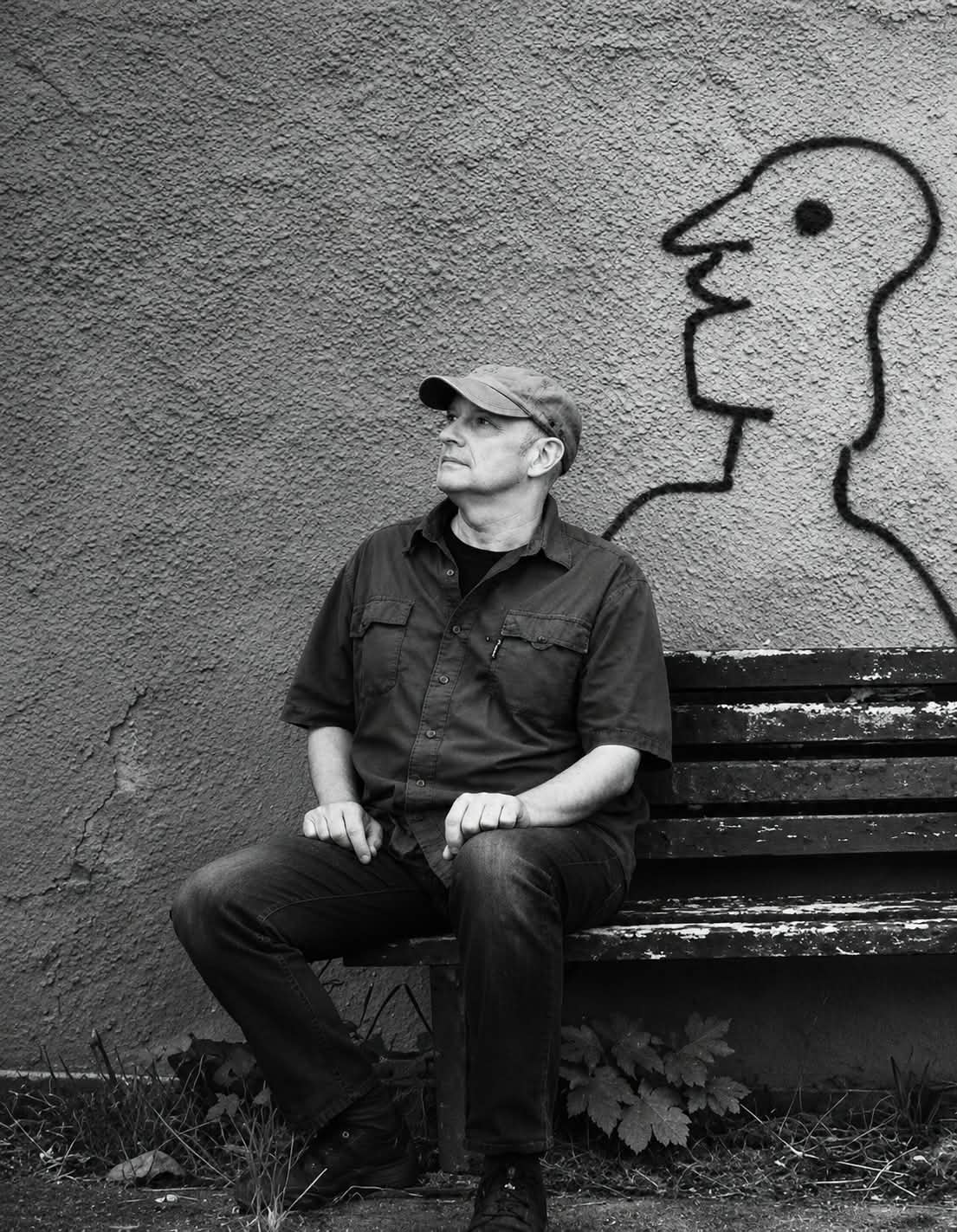
Piotr Artemski – The Art of Mindful Seeing
by Magda Sapojnik, Curator of this collection
Art is not always born in galleries. Sometimes it arises from passion—on city streets, during a walk, in the light reflecting off a wet sidewalk, or in the gaze of a passerby met by chance...
For many years, Piotr Artemski has photographed the world with extraordinary consistency. Most of his photographs are taken in Jelenia Góra (Poland)—a city he knows not from guidebooks, but from everyday life. He does not seek out the exotic or spectacular locations. An ordinary street, the shifting light, or a fleeting moment about to pass is enough for him.
He does not seek publicity. He does not build a personal brand, nor does he chase popularity. For years, he has showcased his work in a single place, believing more in the intrinsic value of seeing itself than in the size of his audience. This understated attitude is just as important as his photographs.
Looking at his images, one gets the impression of viewing reality through the eyes of an exceptionally attentive observer. These are not simply pictures of a city; they are a record of presence, emotion, and tenderness toward everyday life. There is something more to them—a distinct Lower Silesian nostalgia, a longing for a world that is slowly fading away. For places, people, an atmosphere, and fragments of our youth...
His story also reminds us of something we often forget: passion and the urge to create carry no expiration date. They can find us in childhood, speak to us in our youth, or sometimes arrive only in midlife, when we feel our most significant milestones are already behind us. That is why it is worth nurturing our fascinations, even the seemingly trivial ones. They might just be waiting patiently to one day give our lives new meaning.
In a world full of noise, Piotr Artemski reminds us that photography can be far more than a tool for grabbing attention. It can be a personal language, a record of sensitivity, and an intimate way of experiencing the world. It does not need to shout to move you. Sometimes it simply exists—quietly, faithfully, and honestly.
And that is precisely why it is worth discovering.
The Cartography of the Threshold: Reading Piotr Artemski
by Kristopher Lichtanski
_____________
The Anatomy of Solitude: An Extension of the Mindful Eye
In her poignant tribute to Piotr Artemski, Magda Sapojnik identifies the quiet ethic underpinning his work: a patient, tender seeing that resists the frantic self-promotion of contemporary image culture. Artemski does not hunt for the spectacular; he waits for reality to exhale. Yet, when confronted with the breadth of his visual archive—a cycle numbering hundreds of high-contrast black-and-white studies—one realizes that this tenderness is not soft. It is rigorous, stark, and uncompromisingly sculptural.
Across this body of work, the city of Jelenia Góra (Poland) and its borderland surroundings cease to be mere provincial topographies. Instead, Artemski turns the Lower Silesian landscape into an existential theater. His frames are governed by deep, ink-black shadows cut by razor-sharp illumination: a lantern radiating diamond spokes into a snowy night stairwell, the blinding white velocity of an evening train shearing past an empty platform, or the colossal, clinical horizontal louvers of modern architecture that reduce an anonymous walker to a fleeting glyph.
Central to Artemski’s grammar is the solitary figure. These subjects are rarely portrait sitters in the conventional sense. They sit at the water’s edge with backs turned toward the camera, linger beneath illuminated carousel skeletons, or dissolve as spectral double exposures behind iron grates and railway departure boards. Far from casual snapshots, these images represent a formal investigation into isolation, transit, and the weight of physical space.
Aesthetic Framework: Romanticism, Noir, and the Palimpsest
Art historically, Artemski occupies an intersection between 19th-century German Romanticism, 20th-century European Humanist street photography, and post-war architectural constructivism:
- The Rückenfigur and Romantic Solitude: In the composition of the man seated on the wooden pier beside a half-submerged skiff, Artemski directly invokes the Rückenfigur tradition of Caspar David Friedrich. By showing the figure entirely from behind, looking out over silent, brooding waters toward the dark mountain rim, the subject becomes a universal surrogate. The viewer is denied facial identification and is compelled to look with the figure into the quiet void of nature.
- Cinematic Noir Chiaroscuro: The nocturnal urban frames—such as the stepped alley bathed in harsh, high-angle streetlights—draw heavily on the visual rhetoric of German Expressionism and classical film noir. The human form is captured mid-stride, caught between stark white snow and dense architectural shadows, emphasizing the vulnerability of the lone wanderer navigating an indifferent urban topography.
- The Palimpsest of Lower Silesia: When Artemski frames a crumbling corner tenement, its decaying stucco and ornate lintels dwarfing a lone pedestrian in the narrow alley, he documents more than historical aging. He records what Magda calls the "longing for a world that is slowly fading away"—the layered historical memory of a borderland region where German, Polish, and Soviet strata silently bleed through peeling walls.
The Lacanian Gaze: The Split Subject, the Screen, and the Real
When subjected to psychoanalytic scrutiny, Artemski’s recurring motifs align with the structures of Jacques Lacan’s scopic drive:
The Screen and the Rückenfigur
In Lacanian theory, visual perception is structured as a triangle: the subject, the object, and the screen through which culture and language mediate seeing. In Artemski’s work, the frequent choice to depict figures from behind is a direct staging of the split subject ($). The back of the subject marks the impossibility of full imaginary self-recognition; the subject is barred, alienated within the symbolic space of the train station, the street, or the lake dock.
The Gaze (Le Regard) vs. The Eye
Lacan emphasizes that the eye looks, but the Gaze belongs to the object: the world is already looking at us before we see it. Artemski’s images dramatize this uncanny reversal. In the train station under the departure monitors, or in the ghostly face trapped behind the web-laden grate, the subject does not dominate the field of vision. Instead, the scene captures the subject caught in the web of the world’s gaze. The lens does not offer voyeuristic mastery; it documents the moment an individual is framed, alienated, and held motionless by their environment.
The Encounter with the Real
The Real is that which resists symbolization—the traumatic, unassimilable tear in our reality. Artemski regularly punctuates geometric, orderly compositions with sudden ruptures:
- The blinding, smeared streak of a high-speed train violently cutting through the linear perspective of a tranquil platform.
- The intricate, chaotic cobwebs smothering an iron prison-like gate.
- The luminous, spectral carousel glowing in pitch darkness—an archetype of childhood fantasy (objet petit a, the elusive object-cause of desire) marooned in an empty night square.
These elements disrupt the clean architectural grids, confronting the viewer with the raw, silent persistence of the Real beneath our organized social routines.
Post-Lacanian Resonances: Kristeva’s Melancholy and Ettinger’s Matrixial Borderspace
Moving beyond classical Lacanian alienation, post-Lacanian feminist psychoanalysis provides an avenue to interpret the profound affective warmth that Magda detects beneath Artemski’s austere surfaces.
Julia Kristeva: Melancholia and the Abject Architecture
In Black Sun: Depression and Melancholia, Julia Kristeva writes of the depressive subject who preserves an unnamable, lost maternal thing through solemn silence and affective withdrawal. Artemski’s deep, almost tactile blacks operate as an aesthetic manifestation of this "Black Sun." His attention to the peeling, decaying architecture of Jelenia Góra engages Kristeva’s concept of the abject—that which disturbs borders, system, and order. The flaking facade and overgrown weeds around the tenement base are not merely signs of poverty; they represent the porous boundary between life and decay, past and present, domestic enclosure and the encroaching wild.
Bracha L. Ettinger: The Matrixial Gaze and "Wit(h)nessing"
Lacanian visual theory is fundamentally phallic and cutting—the camera separates, casts, and alienates. In contrast, artist and psychoanalyst Bracha L. Ettinger proposes the Matrixial Borderspace: a pre-oedipal, trans-subjective realm characterized not by castration and loss, but by borderlinking, shared resonance, and co-poiesis. Ettinger’s concept illuminates Artemski’s multi-layered and translucent compositions:
- In the image of the figure dissolved behind railway glass and schedules, or the man enveloped in cobwebs, Artemski dissolves hard binary boundaries between inside and outside, self and other.
- Ettinger speaks of wit(h)nessing—a mode of being-with the other’s trauma and memory without appropriating or objectifying it. Artemski’s camera does not intrude into the private faces of his neighbors; it maintains a respectful, resonant distance.
- The webs, reflections, and delicate nocturnal glimmers function as matrixial "strings" that link the lone human presence to the vastness of the city.
The Silent Weight of the Archive
To view thirty of Artemski’s photographs is to experience a compelling visual atmosphere; to conceptualize nearly 800 is to recognize a lifetime devoted to visual archaeology. By pairing an austere, black-and-white geometric discipline with an acute (psycho)analytic sensitivity to threshold spaces, Artemski achieves something rare in contemporary photography: he creates an image of modern solitude that does not condemn the viewer to isolation, but gently initiates them into a shared, compassionate communion with the fleeting world.
Related Supporting Readings:
- The Boundary of the Subject: Anxiety & the Limits of Freedom in Heidegger, Sartre, and Lacan
- Beyond the Symbolic: Semiotic Chora, Matrixial Borderspace, and the Neuro-Acoustic Body in Generative AI
Our Past Guests
Daria Danuta Lisiecka, Adam Radosz, & Theater KRAM’86