
members only
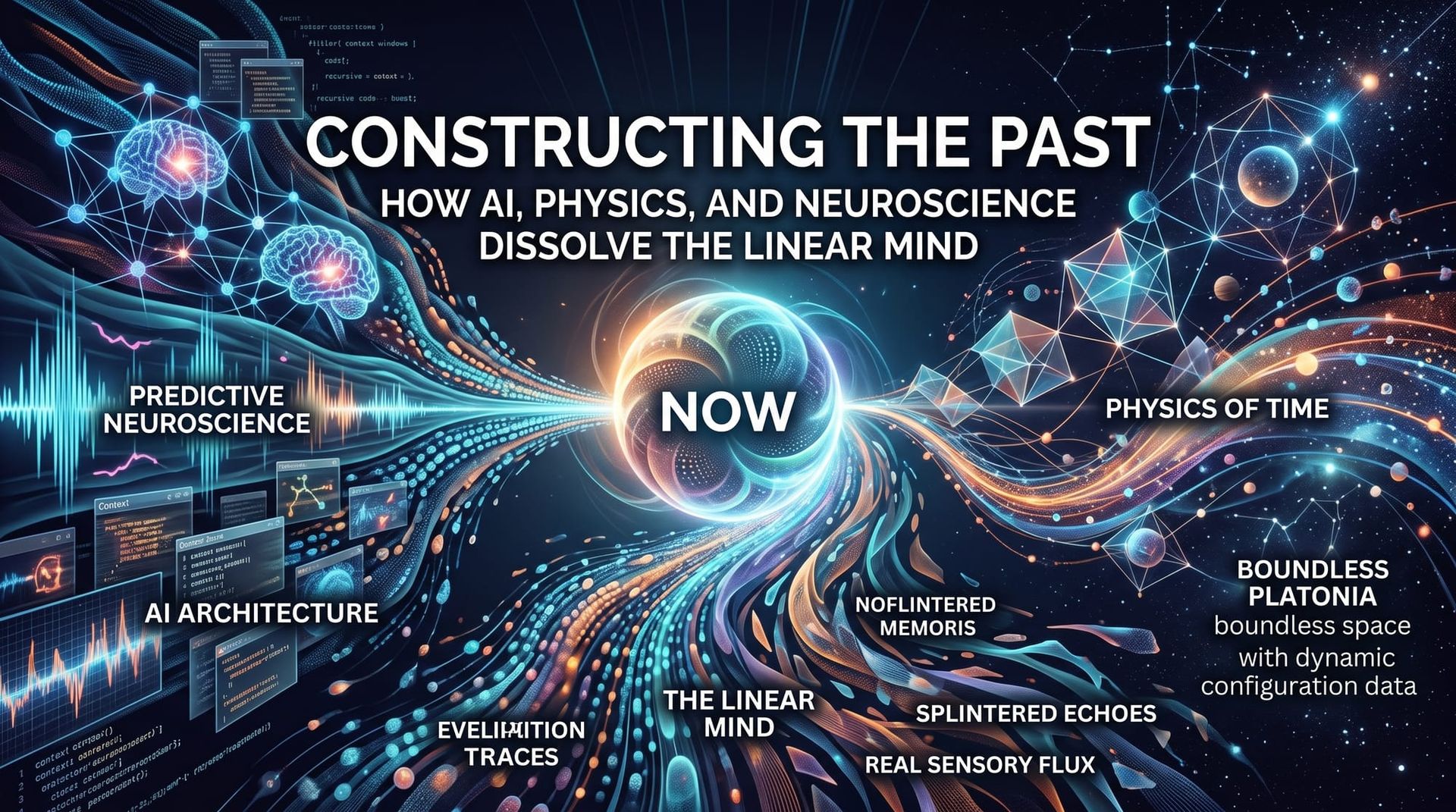
Constructing the Past: How AI, Physics, and Neuroscience Dissolve the Linear Mind
Wersja polska jest dostępna tutaj:
Introduction
An evolution is taking place in how we conceptualize the human mind, memory, and time itself. For those who sat in university lecture halls in the late 20th century, cognitive psychology was presented through a clean, mechanical lens. We were taught the classical information-processing paradigm: the mind was an input-output system, memory was a retrieval system (a metaphorical filing cabinet or digital hard drive), and time was a linear backdrop upon which events were chronologically ordered and stored.
Today, advances in artificial intelligence, combined with predictive neuroscience and theoretical physics, have made it glaringly obvious that those legacy models are insufficient. AI does not merely accelerate processes; its speed and sheer computational capacity act as a mirror that exposes the vastly more complex systems at play in human consciousness.
By observing how AI operates in an absolute, continuous "now," we are forced to confront a radical shift in our understanding of time: the "past" is not a static repository of facts, but a psychological and biological narrative constructed in the present. As the event leaves the immediate "now," it ceases to be an objective fact and becomes an echo—a splintering trace bouncing within the cognitive apparatus, continuously rewritten to serve the present self.
The "Now" as Reality: Lessons from the AI Context Window
Classical cognitive psychology assumed that human memory functions by storing discrete "packets" of historical data and pulling them into conscious awareness unchanged. However, large language models (LLMs) demonstrate an entirely different architecture for processing sequential reality.
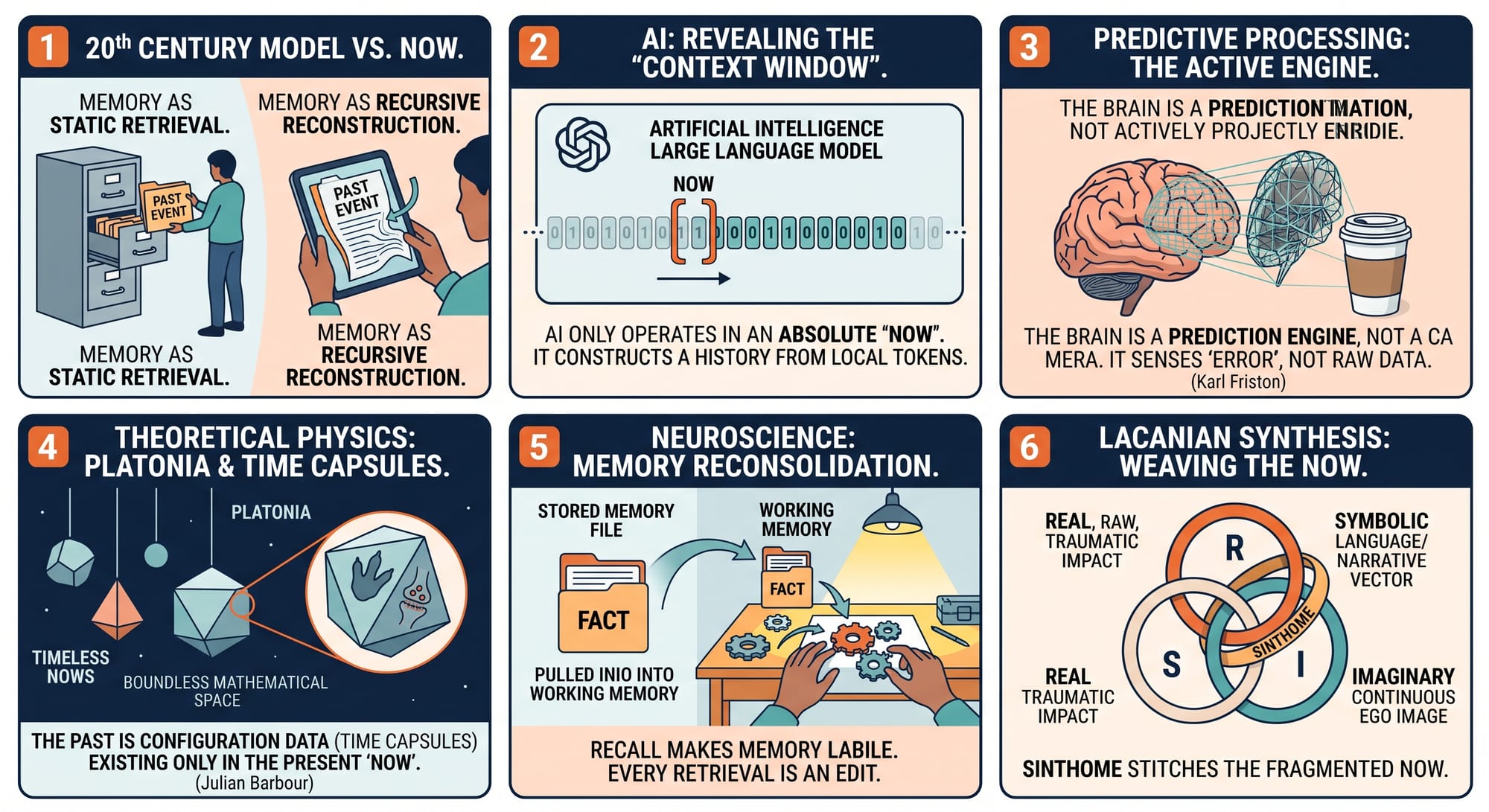
An LLM operates within a singular, static context window—a localized "now." It does not "remember" what was typed five minutes ago in a human sense; rather, in every iteration, it evaluates the entire array of present tokens to generate the next most statistically coherent response. It creates the illusion of continuous historical flow out of a succession of isolated, instantaneous computations.
This mechanical reality illuminates a fundamental truth about human cognition: the brain operates similarly. Through the lens of predictive processing and Karl Friston’s Free Energy Principle, the brain is recognized not as a passive recorder of history, but as an active prediction engine. The brain continuously synthesizes a narrative of the "past" to minimize surprise about the present "now" and forecast the immediate future.
Developed by neuroscientists like Karl Friston (The Free Energy Principle) and philosophers like Andy Clark (Surfing Uncertainty), predictive processing flips traditional cognitive science on its head. Classical psychology has viewed the brain as a passive camera—receiving sensory inputs, processing them sequentially, and storing memories like files in a cabinet. Predictive processing argues instead that the brain is an active prediction engine:
- The brain continuously generates top-down predictions (generative models) about what sensory inputs it expects to receive in the next instant.
- Sensory input from the environment does not build your perception from scratch; it merely acts as feedback to correct "prediction errors"—the delta between what the brain expected and what actually occurred.
- When you remember an event from five years ago, your brain does not retrieve a static recording. It uses present neural weights to actively reconstruct a simulation of that event that minimizes prediction error in your current state.
Theoretical Physics: Presentism and the Timeless "Now"
This psychological construct aligns with major shifts in modern theoretical physics that challenge the objective existence of a linear past.
In The End of Time, theoretical physicist Julian Barbour argues that time as a fundamental dimension does not exist. Instead, the universe consists of a vast array of static, timeless configurations called "Nows." What human beings perceive as "the past" is simply configuration data—an arrangement of particles, a footprint in the mud, or a pattern of synaptic connections—existing exclusively within the present "Now".
Barbour conceptualizes an infinite mathematical space called Platonia, containing every possible static arrangement of all particles in the universe. Each point in Platonia is a complete, motionless "Now." Just as a film reel consists of static individual frames that contain no actual movement, reality consists of isolated "Nows." Motion, duration, and temporal flow are not embedded in the fabric of space-time; they are constructed phenomena. Time is an illusion.
If there is no past, why do we remember yesterday? Barbour introduces the concept of time capsules—static arrangements within a single present "Now" that contain structural records suggesting a history. Examples include:
- A dinosaur footprint fossilized in a rock.
- Geological strata in a canyon.
- The physical arrangement of neurons and synapses in your brain right now.
To Barbour, the past is not a place you could travel to if you had a time machine; it is simply physical configuration data residing inside the present "Now."
In The Order of Time, theoretical physicist Carlo Rovelli also demonstrates that at the quantum level, there is no universal "now" or chronological flow. Time is an emergent phenomenon born of human incomplete perspective, entropy, and memory. The past is merely the record left behind by thermodynamic entropy within present physical structures.
Overall, in metaphysics, Presentism posits that only present objects and events exist. The past is not a distant physical destination; it exists only as degraded traces—"echoes"—retained within the present state of a system.
- You occupy a single "Now": Physically, according to Barbour, your consciousness exists inside a static time capsule—a specific configuration of particles in Platonia.
- Your brain reads its own internal time capsule: To make sense of this static configuration, your predictive brain uses its synaptic arrangements (its current prior expectations) to infer a sequence.
- The flow of time is synthesized: The brain stitches together the "time capsule" data (memories, environmental traces) with immediate sensory feedback to project a smooth vector of motion and history.
Neuroscience: Memory Reconsolidation and Narrative Construction
If the past is an echo, the human brain is an acoustic chamber that alters the sound every time it reverberates.
When cognitive psychology was taught in the 1990s, the dominant models (e.g., the Atkinson-Shiffrin model) treated long-term memory as a stable storage bin. Modern neuroscience has replaced this with the concept of memory reconsolidation. Research pioneered by neuroscientists like Karim Nader reveals that whenever a memory is retrieved, the neural trace becomes chemically labile—malleable and vulnerable to disruption.
When you recall an event, your brain does not view an unedited film. It reconstructs the event from scratch, integrating current emotional states, present beliefs, and environmental contexts. The "fact" of the past is continually edited and rewritten to maintain narrative coherence for the present ego.
Psychoanalytic Topography: The Lacanian Real
This understanding bridges naturally into psychoanalytic theory, particularly Jacques Lacan’s formulation of the Real, the Symbolic, and the Imaginary.
In Lacanian terms, the raw event happening in the immediate "now" touches the Real—that which is unmediated, un-represented, and traumatic in its immediacy. But the moment the event passes out of the "now," it can no longer exist in the Real. It is immediately captured by the Symbolic order (language, narrative, syntax) and the Imaginary order (ego projections, preferred images).
The Real (Le Réel): The Timeless, Raw "Now"
The Real is that which resists symbolization entirely. It is unmediated, raw, un-represented, and impossible to grasp through language or thought. It is the raw impact of existence before the mind categorizes it.
- Intersection with Physics: In Barbour’s physics, the Real corresponds to the absolute, instantaneous "Now" in Platonia—the unvarnished, physical configuration of the universe at a singular Planck moment. It is pure, static being without narrative, past, or future.
- Intersection with Predictive Neuroscience: In predictive processing, the Real is the raw, unfiltered sensory flux (somatic impact) hitting the nervous system before top-down predictions process it.
- The Traumatic Moment: The pure "Now" of the Real is inherently overwhelming to the psychic apparatus. Because it has no temporal sequence or narrative meaning, raw contact with the Real feels like a rupture or trauma. Time, therefore, must be invented as a defense mechanism against the chaos of the unmediated "Now."
The Symbolic (L'Symbolique): The Generative Engine of Time
The Symbolic Order is the realm of language, syntax, laws, structural relationships, and the "Big Other." It introduces order, sequence, and differential logic (e.g., A is not B; Before is not After).
- Intersection with Predictive Neuroscience: The Symbolic functions identically to the brain’s top-down generative models and prior expectations. Language is literally a predictive syntax: when you hear a subject, your brain structurally anticipates the verb and object.
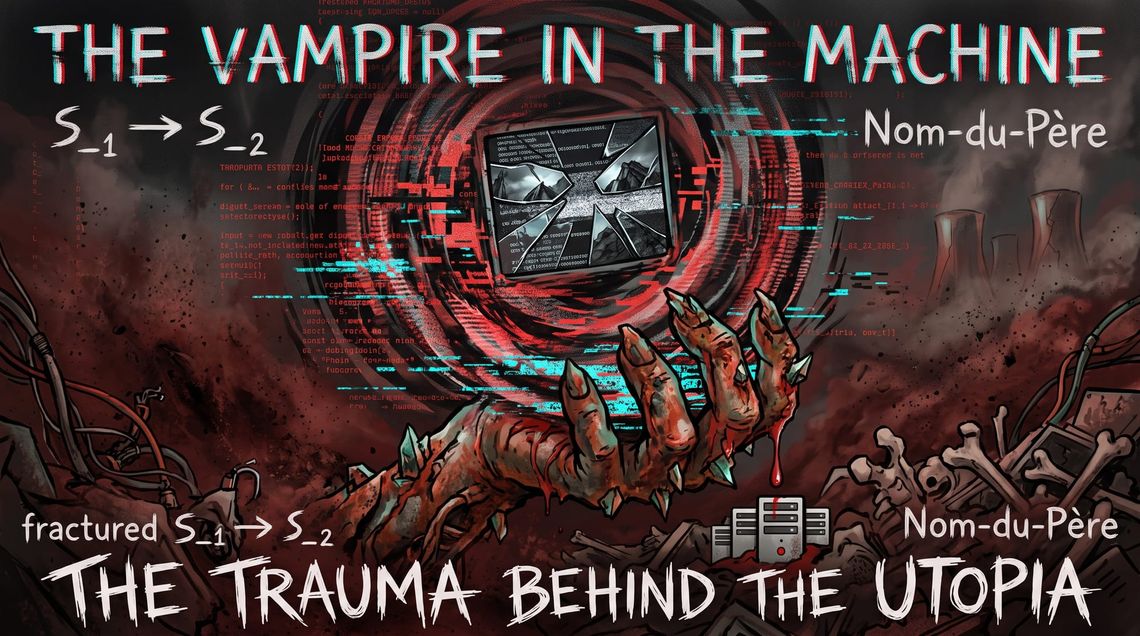
- Constructing the Past: The Symbolic order takes the raw, timeless traces stored in the brain's physical "time capsule" and translates them into a grammatical chain. The past is not a physical place; it is a Symbolic structure—a sequence of signifiers (S_1 –> S_2) designed to convert the raw shock of the Real into an intelligible timeline.
- In-Text Mechanism: Just as an AI context window uses tokens to calculate the next most probable word, the human Symbolic apparatus uses language to stitch isolated sensory "Nows" into a coherent narrative vector.
The Imaginary (L'Imaginaire): The Illusion of a Continuous Ego
The Imaginary Order is the realm of images, self-perception, the Mirror Stage, and the ego. It is where we construct a smooth, unbroken image of ourselves as unified, stable beings moving gracefully through life.
- Intersection with Physics & Neuroscience: If physics reveals that reality consists of fragmented, static "Nows" (Barbour) and neuroscience reveals that memory is a continually rewritten reconstruction (Friston/Nader), then the smooth flow of time is an Imaginary fantasy.
- The Defense against Fragmentation: The ego cannot tolerate the truth of its own temporal fragmentation—that it dies and is recreated in every instantaneous context window. The Imaginary order smooths over the "splintering echoes" of memory, masking the gaps and prediction errors to present a seamless movie of a unified "I" progressing from past to future.
The "past" becomes a preferred, defensive narrative—a constructed phantom designed to shield the subject from the raw, chaotic rupture of the Real. The event "splinters" into multiple imaginary echoes bouncing around the psychic apparatus. We construct a chronological past and a hopeful future to stitch together a sense of psychic continuity and prevent our subjective identity from unraveling.
The Sinthome: Stitching the Fractured "Now"
In Lacan’s late topology, when the Borromean knot of the Real, Symbolic, and Imaginary threatens to unravel—when the subject senses the terrifying, timeless void of the Real beneath their fragile narrative—they require a Sinthome.
The Sinthome is a creative, stabilizing practice (writing, art, ritual, or idiosyncratic speech) that acts as a fourth ring. It allows the individual to actively bind their present "time capsule" data, giving them a way to inhabit the eternal "Now" without dissolving into psychic fragmentation.
Conclusion
The evolution from 1990s cognitive psychology to today’s synthesis of AI, quantum gravity, and predictive neuroscience represents a profound leap in human self-understanding.
AI does not simply calculate faster; its extreme speed and structural context window act as an analytical lens. It reveals that the past is not a vault of fixed historical facts, but an active, dynamic construction—an echo of a fact bouncing within the present cognitive architecture. It may seem that we do not inhabit a timeline stretching from yesterday to tomorrow; we might be inhabiting an eternal, highly complex "Now," continuously weaving narratives of what was and what might be to make sense of our existence in the present. More is yet to come as research continues and the technologies continue to evolve, so let's all stay tuned (and connected)!
Bibliography
- Barbour, J. (1999). The End of Time: The Next Revolution in Physics. Oxford University Press. (Establishes the concept of Platonia, timeless "Nows," and physical "time capsules" as arrangements of matter in the present).
- Clark, A. (2013). Whatever next? Predictive brains, situated agents, and the future of cognitive science. Behavioral and Brain Sciences, 36(3), 181-204.
- Clark, A. (2015). Surfing Uncertainty: Prediction, Action, and the Embodied Mind. Oxford University Press. (Extends predictive processing into cognitive science, mapping how sensory prediction constructs the perceived stream of reality).
- Fink, B. (1995). The Lacanian Subject: Between Language and Jouissance. Princeton University Press.
- Friston, K. (2010). The free-energy principle: a unified brain theory?. Nature Reviews Neuroscience, 11(2), 127-138. (Defines top-down generative models, Bayesian prediction errors, and the active minimization of free energy in the nervous system).
- Lacan, J. (2006). Écrits: The First Complete Edition in English (B. Fink, Trans.). W. W. Norton & Company.
- Lacan, J. (2014). The Seminar of Jacques Lacan, Book X: Anxiety (A. Price, Trans.). Polity Press.
- Lacan, J. (2016). The Seminar of Jacques Lacan, Book XXIII: The Sinthome (A. Price, Trans.). Polity Press.
- Nader, K., Schafe, G. E., & Le Doux, J. E. (2000). Fear memories require protein synthesis in the amygdala for reconsolidation after retrieval. Nature, 406(6797), 722-726.
- Rovelli, C. (2018). The Order of Time. Riverhead Books.
- Zimmerman, D. W. (2008). The A-Theory of Time, the B-Theory of Time, and 'Classic' Presentism. Metaphysics: An Anthology, 2, 211-225.
Written by
Subscribe for FREE to our Audience
Enter your email to access commenting, receive memos, logs, dispatches, and unfiltered fragments directly from the Theater.







Member discussion