CZERWONA WSTĄŻKA | Red Ribbon

SCENA / SCENE
- Ta scena jest uwieńczona utworem muzycznym ze słowami "wybawionymi" z tejże sceny. Posłuchajcie jej (w wersji polskiej lub angielskiej) albo przed albo po przeczytaniu sceny poniżej.
- This scene is capped off by a piece of music featuring lyrics "freed" from the scene itself. Listen to it (English or Polish version) either before or after reading the scene below.
Wersja polska:
English version:
ENG Version: Red Ribbon
SCENE
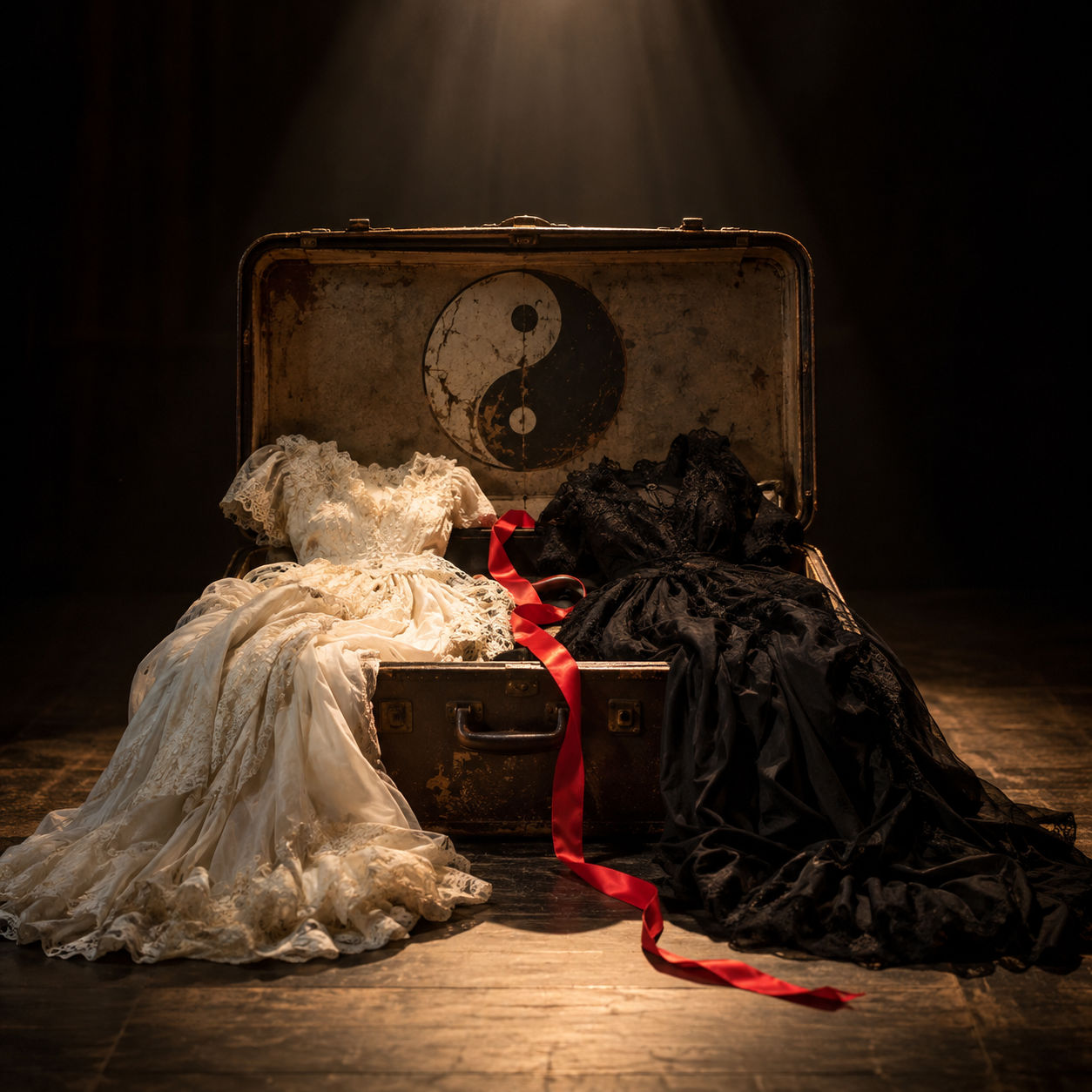
THE YIN–YANG SUITCASE
(Nothing happens on stage for a long time. The protagonist sits motionless—as if terrified of what comes next. Finally, she pulls the last suitcase toward herself.)
This one is the heaviest.
Even though there’s almost nothing inside.
(She sets it upright. Hand-painted on the lid is a yin-yang symbol. The paint is cracked.)
Someone tried to simplify the universe.
Black.
White.
Love.
Death.
Woman.
Night.
As if life were a fast-food drive-thru of philosophy.
(She smiles briefly.)
But people only paint symbols
where they run out of words.
(She opens the suitcase.)
Two dresses inside.
One white.
The other black.
And suddenly you realize…
a woman’s entire life so often fit right between those two colors.
(She pulls out the white dress. The fabric trembles slightly.)
A wedding gown.
The lace is already yellowed with age.
Look at this…
how tiny the waist is.
Women used to be taught
to take up as little space as possible.
At home.
At the table.
In history.
(She looks at the dress as if it were a body.)
The saddest thing about wedding dresses is
that they’re tailored for the future,
only to become a costume from the past almost overnight.
After a few years, they hang in the closet like a ghost
no one has the courage to throw away.
(She sets it down gently and picks up the black one.)
And this one…
Who knows?
For a ball?
The opera?
A funeral?
The coffin?
(Silence.)
Though maybe that’s what makes it so elegant:
a dress that works for everything.
Because balls and funerals aren’t so different, are they?
People put on uncomfortable clothes.
Fake their emotions.
Dance or weep just a little too loudly.
And everyone frantically checks
if they’re still young.
(She spreads the black dress wide.)
Beautiful.
So beautiful
it’s almost suspicious.
These are the dresses worn by women
who already know too much.
(Pause.)
Sometimes I think
a woman’s life used to be pure costume theater.
First, a girl in Communion white.
Then the bride.
Then the mother in an apron.
Then the widow in black.
And through it all, only her face grows quieter and quieter.
(She sits between the two dresses.)
White.
Black.
Yet real life always happens in the in-between.
In that grey space
where you betray,
forgive,
give birth,
get bored,
fall ill,
crave touch…
and suddenly realize
that the loneliest nights are the ones spent right beside someone else.
(A long silence.)
You know…
maybe that’s why this suitcase has a yin and yang.
Because near the end of life, someone realized
that a wedding and a funeral
are really the exact same ceremony.
It’s just that at one end of the room,
the music is playing right in front of you…
and at the other,
you’re hearing it fade far into the distance.
(She moves to close the suitcase, then pauses—her hand stopping in midair.)
Wait. There’s something else.
(Slowly, she pulls out a thin red ribbon. Crumpled. Old.)
Ah…
now things get dangerous.
Because you can throw away photographs.
Letters.
Dresses.
Even a wedding ring.
But you can’t throw away blood.
(She smooths the ribbon over her knees.)
Red.
Of course.
People have always chosen the color of blood
when they wanted to talk about love.
Or lineage.
Or guilt.
Usually, all three at once.
(Pause.)
You know what’s strange?
Through the male line—the paternal side—you get history.
Names.
Wars.
Coats of arms.
Monuments.
But through the female line…
comes silence.
Women passed life down so discreetly,
you’d think they were doing something illegal.
(She looks at the ribbon.)
The exact same blood.
Great-grandmother.
Grandmother.
Mother.
Daughter.
One long river of bodies flowing through time.
And every single one of them probably thought
she was the very first to feel such pain.
When all along…
they were all crying the exact same way.
(She smiles bitterly.)
It must be a terrifying discovery:
realizing you didn’t just inherit their eyes,
you inherited their fear.
The same way of keeping quiet.
The same evening solitude.
The same desperate need to hear someone say:
“You are enough.”
(Silence.)
Maybe that’s why mothers fix their daughters’ hair so often.
It looks like tenderness,
but really, it’s the body passing down its memory.
(She looks at the ribbon.)
A red thread.
Like those old myths
about people being bound together by an invisible cord.
Except here…
it isn’t about love.
It’s about survival.
(She wraps the ribbon around her wrist.)
Because down the female line, you don’t inherit property.
You inherit endurance.
The ability to get up in the morning, no matter what.
To cook the soup after a funeral.
To wash children’s clothes during a war.
To stay silent at the dinner table
so everyone else can go on believing
the world isn’t falling apart.
(A long silence.)
And suddenly, I understand
why this ribbon was sitting next to those two dresses.
Because between the white dress and the black dress…
stands this.
Red.
The true color of life.
WALIZKA YIN–YANG
(Na scenie długo nic się nie dzieje. Bohaterka siedzi nieruchomo. Jakby bała się następnej rzeczy. W końcu podciąga ku sobie ostatnią walizkę.)
Ta jest najcięższa.
Choć prawie nic w niej nie ma.
(Stawia ją pionowo. Na wieku namalowany ręcznie symbol yin i yang. Farba popękana.)
Ktoś próbował sobie uprościć wszechświat.
Czarne.
Białe.
Miłość.
Śmierć.
Kobieta.
Noc.
Jakby życie było chińską restauracją filozofii.
(Uśmiecha się krótko.)
Ale ludzie zawsze malują symbole tam,
gdzie kończą im się słowa.
(Otwiera walizkę.)
W środku dwie suknie.
Jedna biała.
Druga czarna.
I nagle człowiek rozumie,
że całe życie kobiety bardzo często mieściło się między tymi dwoma kolorami.
(Wyciąga białą suknię. Materiał lekko drży.)
Ślubna.
Koronka już żółta od czasu.
Proszę spojrzeć…
jaka mała talia.
Kiedyś kobiety były uczone,
żeby zajmować jak najmniej miejsca.
W domu.
Przy stole.
W historii.
(Patrzy na suknię jak na ciało.)
Najsmutniejsze w sukniach ślubnych jest to,
że są szyte dla przyszłości,
a bardzo szybko stają się kostiumem z przeszłości.
Po kilku latach wiszą w szafie jak duch,
którego nikt nie ma odwagi wyrzucić.
(Odkłada delikatnie. Bierze czarną.)
A ta…
Nie wiadomo.
Na bal?
Do opery?
Na pogrzeb?
Do trumny?
(Cisza.)
Ale może to jest właśnie najbardziej eleganckie.
Suknia,
która nadaje się na wszystko.
Bo przecież bale i pogrzeby są do siebie bardzo podobne.
Ludzie zakładają niewygodne ubrania.
Udają emocje.
Tańczą albo płaczą trochę za głośno.
I wszyscy panicznie patrzą,
czy jeszcze są młodzi.
(Rozkłada czarną suknię szeroko.)
Piękna.
Tak piękna,
że aż podejrzana.
Takie suknie zwykle zakładają kobiety,
które już wiedzą za dużo.
(Pauza.)
Czasami myślę,
że całe życie kobiety było dawniej teatrem kostiumowym.
Najpierw dziewczynka w bieli komunijnej.
Potem panna młoda.
Potem matka w fartuchu.
Potem wdowa w czerni.
I tylko twarz coraz bardziej milcząca.
(Siada między sukniami.)
Białe.
Czarne.
A przecież prawdziwe życie zawsze dzieje się pomiędzy.
W tej szarości,
gdzie człowiek zdradza,
wybacza,
rodzi,
nudzi się,
choruje,
pragnie dotyku,
i nagle orientuje się,
że najbardziej samotne noce zdarzają się obok drugiego człowieka.
(Długa cisza.)
Wie pani…
może dlatego ta walizka ma yin i yang.
Bo ktoś pod koniec życia zrozumiał,
że ślub i pogrzeb
to właściwie ta sama ceremonia.
Tylko na jednym końcu sali
gra muzyka,
a na drugim
już ją słychać bardzo daleko.
(Bohaterka chce już zamknąć walizkę. Nagle zatrzymuje rękę.)
Jeszcze coś.
(Powoli wyciąga cienką, czerwoną wstążkę. Pogniecioną. Starą.)
O…
i nagle robi się niebezpiecznie.
Bo człowiek może wyrzucić zdjęcia.
Listy.
Suknie.
Nawet obrączkę.
Ale nie może wyrzucić krwi.
(Rozprostowuje wstążkę na kolanach.)
Czerwona.
Oczywiście.
Ludzie od zawsze wybierali kolor krwi,
kiedy chcieli mówić o miłości.
Albo o rodzie.
Albo o winie.
Najczęściej o wszystkim naraz.
(Pauza.)
Wie pani, co jest dziwne?
Że po mieczu opowiada się historię.
Nazwiska.
Wojny.
Herby.
Pomniki.
A po kądzieli…
idzie cisza.
Kobiety przekazywały życie tak dyskretnie,
jakby robiły coś nielegalnego.
(Patrzy na wstążkę.)
Ta sama krew.
Prababka.
Babka.
Matka.
Córka.
Jedna długa rzeka ciał,
która płynie przez czas.
I każda z nich myślała zapewne,
że jest pierwsza w swoim bólu.
A tymczasem…
wszystkie płakały prawie tak samo.
(Uśmiecha się gorzko.)
To musi być straszne odkrycie:
zrozumieć,
że odziedziczyło się nie tylko oczy,
ale również lęki.
Ten sam sposób milczenia.
Ta sama samotność wieczorem.
Ta sama potrzeba,
żeby ktoś powiedział:
„jesteś wystarczająca.”
(Cisza.)
Może dlatego kobiety tak często poprawiają włosy swoich córek.
To wygląda jak czułość,
a naprawdę jest przekazywaniem pamięci dłoni.
(Patrzy na wstążkę.)
Czerwona nić.
Jak w tych dawnych wierzeniach,
że ludzie są ze sobą zszyci niewidzialnym włóknem.
Tylko tutaj…
nie chodzi o miłość.
Tu chodzi o przetrwanie.
(Owija sobie wstążkę wokół nadgarstka.)
Bo po kądzieli nie dziedziczy się majątku.
Dziedziczy się wytrzymałość.
Umiejętność wstawania rano mimo wszystko.
Gotowania zupy po pogrzebie.
Prania dziecięcych ubrań podczas wojny.
Milczenia przy stole,
żeby inni mogli jeszcze wierzyć,
że świat się nie rozpada.
(Długa cisza.)
I nagle rozumiem,
dlaczego ta wstążka leżała obok dwóch sukien.
Bo między białą a czarną suknią…
jest właśnie ona.
Czerwona.
Prawdziwy kolor życia.
Written by
Subscribe for FREE to our Audience
Enter your email to access commenting, receive memos, logs, dispatches, and unfiltered fragments directly from the Theater.






Member discussion