Reconstructing Meaning in the Age of Algorithmic Efficiency: Disillusionment, the Sinthome, and the Relational Sanctuary of the Talking Cure


Wersja polska jest dostępna tutaj:
The central horizon of Lacanian psychoanalysis, existential philosophy, and contemporary clinical practice converges on a single, inescapable realization: there is no pre-written cosmic script, no inherent human essence, and no functioning "Big Other" to guarantee meaning. Across the landscapes of late-capitalist technocracy, algorithmic efficiency, and structural atomization, the traditional external authorities and cultural grand narratives that once anchored human existence have collapsed. The subject is left standing before an abyss.
Yet, facing this void does not mark a dead end. Instead, it serves as the precise point where a new form of agency, relationality, and practical creation begins. By synthesizing the trajectory of Lacanian psychoanalysis with existential philosophy, Frankl’s Logotherapy, Martin Buber’s relational ontology, and the structural realities of modern clinical practice, we can map what lies on the "other side" of disillusionment: a movement from total structural breakdown to a lived, creative know-how.
Part I. The Terminal Endpoint of Lacanian Analysis
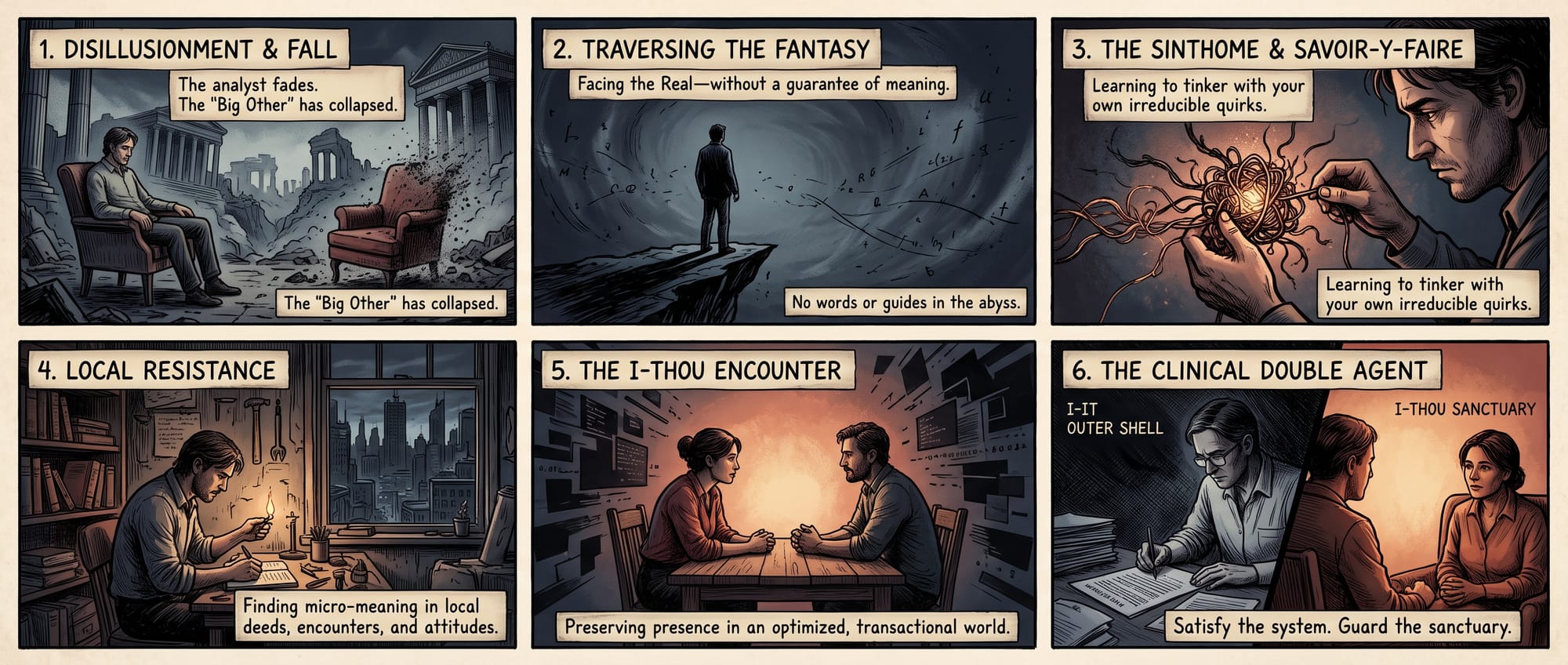
At the end of Lacanian analysis, when an analysand traverses the fundamental fantasy (traversée du fantasme), undergoes subjective destitution (destitution subjective), and drops the analyst as an abject remnant (objet petit a), they accomplish a radical shift in how they relate to the Real, their desire, and their symptom.
Rather than achieving a state of "healed" wholeness or uncovering an ultimate, hidden "truth," the individual learns to navigate the void left by the absent Big Other. What remains on the other side of this process is defined by three structural shifts:
1. Savoir-y-faire with the Sinthome
Lacan explicitly defines savoir-y-faire avec son symptôme as knowing how to deal with, handle, or do with one's symptom.
- The Object: It concerns the sinthome—the irreducible knot of singular enjoyment (jouissance) that remains after all the illusory, narrative meaning of neurosis has been stripped away.
- The Function: The goal is not to "cure" or eliminate the symptom, nor to decode it for deeper symbolic meaning. Instead, it is an inventive, practical "know-how"—analogous to a craftsman learning to work with a tricky, knotty piece of timber. You learn to inhabit, manipulate, and play with your unique mode of jouissance without suffering from it or remaining trapped by the neurotic demand to fix it.
2. The Shift from Desire to the Drive (Trieb)
Before analysis, desire remains tethered to fantasy—specifically the fantasy of completing a missing piece or satisfying the demands of an imagined Big Other.
- The Accomplishment: Analysis uncouples the drive from this fundamental fantasy.
- The Action: The subject achieves the capacity to enjoy their enjoyment directly (savoir jouir) without requiring the protective screen of neurotic guilt, self-sabotage, or suffering. The endless, anxious question "What does the Other want from me?" (Che vuoi?) fades because the Big Other is recognized as inherently lacking, inconsistent, and non-existent.
3. Separation from the Analyst as Abject Remnant
During analysis, the analyst occupies the place of the Subject Supposed to Know and functions as the ultimate object-cause of desire (objet a).
- The Fall: At termination, the analyst is unmasked as a necessary illusion and dropped like refuse or trash (déchet/abject).
- The Outcome: By dropping the analyst as an abject object, the subject realizes that no external authority holds the secret key to their identity or existence. The individual assumes full, ungrounded responsibility for their own existence and mode of satisfaction.
What Happens on the "Other Side" Across Lacanian Concepts:
- Traversing the Fantasy: You stop searching for a secret, underlying meaning behind your suffering.
- Subjective Destitution: You shed the rigid identity built on the expectations and demands of the Big Other.
- Analyst as Abject: You discard the illusion that anyone else holds the master key to your life.
- Savoir-Y-Faire: You gain a practical, creative knack for wielding your own sinthome.
On the other side of analysis lies an inventive freedom—a state where, cleared of fundamental illusions, you step into the capacity to act, speak, and produce from a singular point without seeking permission from a master.
Part II. Lacanian Disillusionment Versus Existentialism
Both Lacanian psychoanalysis and Existentialism start from a strikingly similar premise: existence lacks an intrinsic blueprint (see also my past post: The Boundary of the Subject: Anxiety & the Limits of Freedom in Heidegger, Sartre, and Lacan). However, they diverge fundamentally on what occurs after facing that abyss—specifically regarding agency, human freedom, and the structure of suffering.
When facing the void where no Big Other or cosmic script exists, Existentialism frames the encounter as a realization of Nothingness that serves as a launchpad for total freedom. In this view, existence precedes essence, making you the sovereign author who must invent meaning through radical choice and authentic action. Conversely, Lacanian Psychoanalysis frames the encounter as Subjective Destitution—a confrontation with the raw mechanics of the Real and your own irreducible enjoyment (sinthome). Rather than treating the void as a clean slate for sovereign self-creation, Lacanian analysis leads to a practice of bricolage (subversive tinkering), where you learn to handle the unique ways you are already structurally wired.
Core Philosophical Vector Comparisons:
- 1. The Abyss (Nothingness vs. The Real):
- 2. Creation (Sovereign Authorship vs. Bricolage):
- 3. Freedom (Radical Choice vs. Symptomatic Invention):
Structural Comparison Across Traditions:
- Core Problem: Existentialism addresses inauthenticity, bad faith, and the avoidance of death and meaninglessness. Lacanian Psychoanalysis addresses neurotic repetition and being trapped in the Big Other's demand.
- Terminal Experience: Existentialism leads to encountering Nothingness (Néant) or the Absurd. Lacanian Analysis leads to Subjective Destitution, facing the Real, and traversing the fantasy.
- Status of the Self: In Existentialism, the self is constructed continuously through authentic choice. In Lacan, ego identity crumbles, leading to acceptance of the singular knot of drives (sinthome).
- Post-End State: Existentialism concludes in radical choice and becoming the sovereign author of self-chosen meaning. Lacan concludes in savoir-y-faire, or creative tinkering with irreducible enjoyment.
- Attitude Toward the Rock: Existentialism asserts that Sisyphus must be imagined happy through a defiant embrace of purpose. Lacan asserts that you stop pretending the rock conceals a secret meaning and learn to navigate around it.
In practice, Existential therapy demands: Choose. Decide who you will be, accept the weight of mortality, and commit courageously to self-authored projects. Lacanian analysis concludes with: Separate & Play. You realize no master holds your key, stop demanding that unconscious drives conform to societal expectations, and adopt a flexible, lightweight know-how to live alongside your eccentricities.
Part III. The Deadlock of Late Capitalism: Reconstructing Meaning
This brings us to the ultimate deadlock of the contemporary subject: having mapped the machinery of desire and seen through fundamental illusions, one finds that the Big Other has collapsed into algorithmic efficiency, technocratic administration, and corporate metrics.
When the illusion is exposed, attempting to apply self-help frameworks or traditional Logotherapy as a simple patch—claiming "I just need to find a purpose"—fails because analysis has already unmasked the trick. Any grand, pre-packaged purpose is easily recognized as another ideological fiction designed to soothe anxiety or feed external systems. The path forward requires recognizing that meaning is not an object to be discovered or received from an authority; it is an act of creation carried out in the total absence of a guarantee.
1. Practical Stances for the Sinthome:
- Demystification: The Big Other is dead; algorithms and bureaucracy run the symbolic order. Practical Action: Stop looking to external structures, job titles, or platforms to validate existence or grant permission.
- Acceptance of Lack: Absolute, transcendent jouissance is a structural illusion. Practical Action: Abandon the pursuit of final resolution or constant peak experiences; settle into functional, creative daily rhythms.
- Identification with the Sinthome: You are left with your specific, singular knot of drive and quirks. Practical Action: Organize life around your specific craft and practical obsessions, regardless of whether capital deems it "productive."
2. Logotherapy Reconstructed as Local Resistance:
Viktor Frankl posited that meaning arises through work, love/encounters, and the attitude taken toward unavoidable suffering. When combined with Lacanian savoir, Logotherapy shifts its scale:
- Micro-Meaning over Grand Ideology: Meaning no longer requires saving the world or aligning with a corporate mission statement. It becomes localized: finishing a discrete piece of work, cultivating a singular skill, tending a physical space, or maintaining boundaries against digital exhaustion.
- Practical Agency over Abstract Freedom: In the absence of cosmic rules, the void becomes the space where personal commitments are authored. You choose a direction not because it is divinely ordained, but because you choose to honor it.
3. Savoir-Faire in Daily Practice:
- Decouple Worth from Production: As automation and AI accelerate, economic output becomes a poor measure of human value. Lean into non-digitizable, local, bodily, and intentionally inefficient practices.
- Cultivate Sustainable Enjoyment: Exchange the fantasy of explosive, transcendent jouissance for manageable, tactile satisfactions: focused craft, physical tools, intellectual rigor, and quiet daily rituals.
- Act "As If": In the absence of absolute foundations, acting as if chosen commitments matter generates the structural weight necessary to hold off despair.
Part IV. The Relational Sanctuary: Preserving I-Thou in an I-It World
Living out this savoir-faire requires a framework for human relationality. Preserving Martin Buber’s I-Thou (Ich-Du) relationship within a hyper-transactional environment requires clear distinction between relational modes:
- I-It: Transactional, functional, and objectifying. The other entity is treated as an instrument, service provider, or data source.
- I-Thou: An encounter of mutual presence. It is non-utilitarian; you meet the other in their irreducible wholeness without seeking to measure, optimize, or extract value.
To maintain authentic presence in an environment driven by metrics, specific boundaries must be maintained:
- 1. Establish Threshold Boundaries: Accept that administrative logistics, digital communications, and corporate systems belong strictly to the domain of I-It. Treat them with functional precision. Concurrently, protect I-Thou enclaves—spaces, times, and relationships where utility and devices are explicitly excluded.
- 2. Prioritize Presence over Speed: Optimization compresses interactions into rapid data swaps. I-Thou encounters require unhurried time, active listening, and complete sensory attentiveness.
- 3. Embrace Unproductive Mutuality: Engage in non-instrumental shared activities that yield no status boost, economic output, or measurable metrics—such as unscripted conversation, shared silence, or physical work.
- 4. Recognize Irreducibility: Resist the urge to flatten individuals into diagnostic categories, political profiles, or psychological labels. Respecting the unknowable aspect of the other forms the basis of authentic encounter.
Part V. The Split-Agency of Modern Psychotherapy (and Psychoanalysis)
This relational imperative illuminates the structural contradiction within modern psychotherapy and psychoanalysis. Today, clinical practice operates in a state of split agency: an I-Thou encounter conducted beneath the protective cover of an I-It transactional framework.
Historically, the analytic container was designed as a non-utilitarian sanctuary where social demands for efficiency and judgment were suspended. To operate within contemporary healthcare systems, that sanctuary adopts an administrative outer shell:
1. The Outer Shell (I-It Trojan Horse):
To insurance companies, corporate platforms, and regulatory bodies, the session presents itself as a standard service transaction:
- Diagnostic Flatness: Translating human suffering or a complex sinthome into standardized diagnostic codes (e.g., DSM-5 / ICD-10 entries).
- Procedural Quantification: Billing standard time units (e.g., 50-minute CPT codes), establishing medical necessity, and processing payments.
- Corporate Metrics: Managed care and telehealth platforms frequently attempt to reduce treatment to symptom tracking, chat logs, and standardized questionnaires (e.g., PHQ-9, GAD-7).
2. The Inner Chamber (Protected I-Thou Space):
Once the door closes and administrative demands are relegated to the background, the core analytic work takes place within a protected space that deliberately subverts market logic:
- Counter-Market Stance: The clinician refrains from extracting value, offering rapid optimization, or imposing egoic demands, serving instead to bear witness to the subject.
- Subverting Efficiency: While capital demands speed and measurable ROI, psychoanalysis relies on slowness, repetition, and non-productivity. Sitting with a symptom without demanding its immediate elimination resists the logic of pure optimization.
- The Frame as Protection: The financial contract (the I-It fee structure) explicitly defines the boundary. Paying for time ensures that the room remains free from mutual emotional obligation or exploitation.
Comparing the Functional Shell and Relational Core:
- Primary Goal: The I-It realm aims for efficiency, transaction, utility, and system survival. The I-Thou realm aims for encounter, presence, and shared existence.
- Object of Interaction: In the I-It domain, the subject is treated as a role, function, data point, or system interface. In the I-Thou domain, the individual is met as a whole, irreducible human subject.
- Temporal Stance: The I-It realm relies on speed, precise scheduling, metrics, and optimization. The I-Thou realm remains unhurried, present, and unquantifiable.
- Clinician's Strategy: For I-It demands, the clinician employs precise boundary enforcement and administrative compliance. For I-Thou encounters, the clinician offers vulnerability, radical attentiveness, and mutual recognition.
3. The Modern Threat and the Double Agent:
The current crisis in mental healthcare arises when corporate and technocratic structures attempt to eliminate the interior I-Thou core entirely—replacing relational depth with manualized worksheets, algorithmic tracking, or automated conversational interfaces. When the administrative shell consumes the interior, therapy risks becoming mere emotional regulation for institutional compliance.
For the contemporary clinician, practicing within this landscape requires acting as a double agent:
- Satisfy the System: Complete administrative tasks, billing codes, and compliance metrics efficiently and with minimal emotional drag.
- Guard the Sanctuary: Protect the unquantifiable, non-transactional human presence within the session itself. The administrative framework is used to fund and secure the temporal boundary where genuine transformation, subjective destitution, and the creative handling of the sinthome can occur.
Psychotherapy remains one of the few legal, sanctioned spaces where an authentic I-Thou encounter can take place under the cover of a formal corporate line item. Within that protected space, stripped of the demand for external guarantees, the individual finds the open room where agency, craft, and ethical relationship begin.
As for psychoanalysis, Lacan argues that the establishment of the Subject Supposed to Know through demand (demand for advice for relief from their suffering—is the actual entry place into a true psychoanalysis. Without this demand, there is no transference, and without transference, there is no analysis.
If the practitioner responds to this demand by giving advice, reassurance, or a medical cure, they act as a therapist. They fulfill the demand and close down the unconscious. The core mechanism of Lacanian psychoanalysis revolves around how the analyst responds to this demand:
- Frustrating the Demand: Instead of playing the expert, the analyst remains silent, shortens sessions (variable-length sessions), or offers equivocal interpretations. This frustrates the analysand's demand.
- Exposing the Lack: Forced to speak without getting the expected answers, the analysand begins to trace the trajectory of their own speech and signifiers. They gradually realize that the "analyst who knows" was an illusion all along.
- The "Psychoanalytic Act": In Seminar XV (The Psychoanalytic Act), Lacan stresses that the analytic act is not something the patient does, nor is it a technique the analyst applies. Rather, it is the analyst's willingness to occupy the position of an empty cause—holding the space long enough for the analysand to discover that no external authority (Big Other) holds the final master-keyword to their existence.
Bibliography
Buber, M. (1970). I and thou (W. Kaufmann, Trans.). Touchstone. (Original work published 1923)
Camus, A. (1991). The myth of Sisyphus and other essays (J. O'Brien, Trans.). Vintage International. (Original work published 1942)
Fisher, M. (2009). Capitalist realism: Is there no alternative? Zero Books.
Frankl, V. E. (2006). Man's search for meaning. Beacon Press. (Original work published 1946)
Lacan, J. (1967–1968). Seminar XV: The psychoanalytic act (C. Gallagher, Trans.) [Unpublished manuscript]. Lacan in Ireland.
Lacan, J. (1998). The seminar of Jacques Lacan, Book XI: The four fundamental concepts of psychoanalysis (J.-A. Miller, Ed.; A. Sheridan, Trans.). W. W. Norton & Company. (Original work published 1964)
Lacan, J. (2006). Écrits: The first complete edition in English (B. Fink, Trans.). W. W. Norton & Company.
Lacan, J. (2016). The seminar of Jacques Lacan, Book XXIII: The sinthome (J.-A. Miller, Ed.; A. R. Price, Trans.). Polity Press. (Original work published 1975–1976)
Sartre, J.-P. (1993). Being and nothingness: An essay on phenomenological ontology (H. E. Barnes, Trans.). Washington Square Press. (Original work published 1943)
Yalom, I. D. (1980). Existential psychotherapy. Basic Books.
Žižek, S. (1989). The sublime object of ideology. Verso.
Written by
Subscribe for FREE to our Audience
Enter your email to access commenting, receive memos, logs, dispatches, and unfiltered fragments directly from the Theater.










Member discussion