Scansion (pt. I): Variable Session

Wersja PL: Skandowanie (cz. I): Sesja o zmiennym czasie trwania
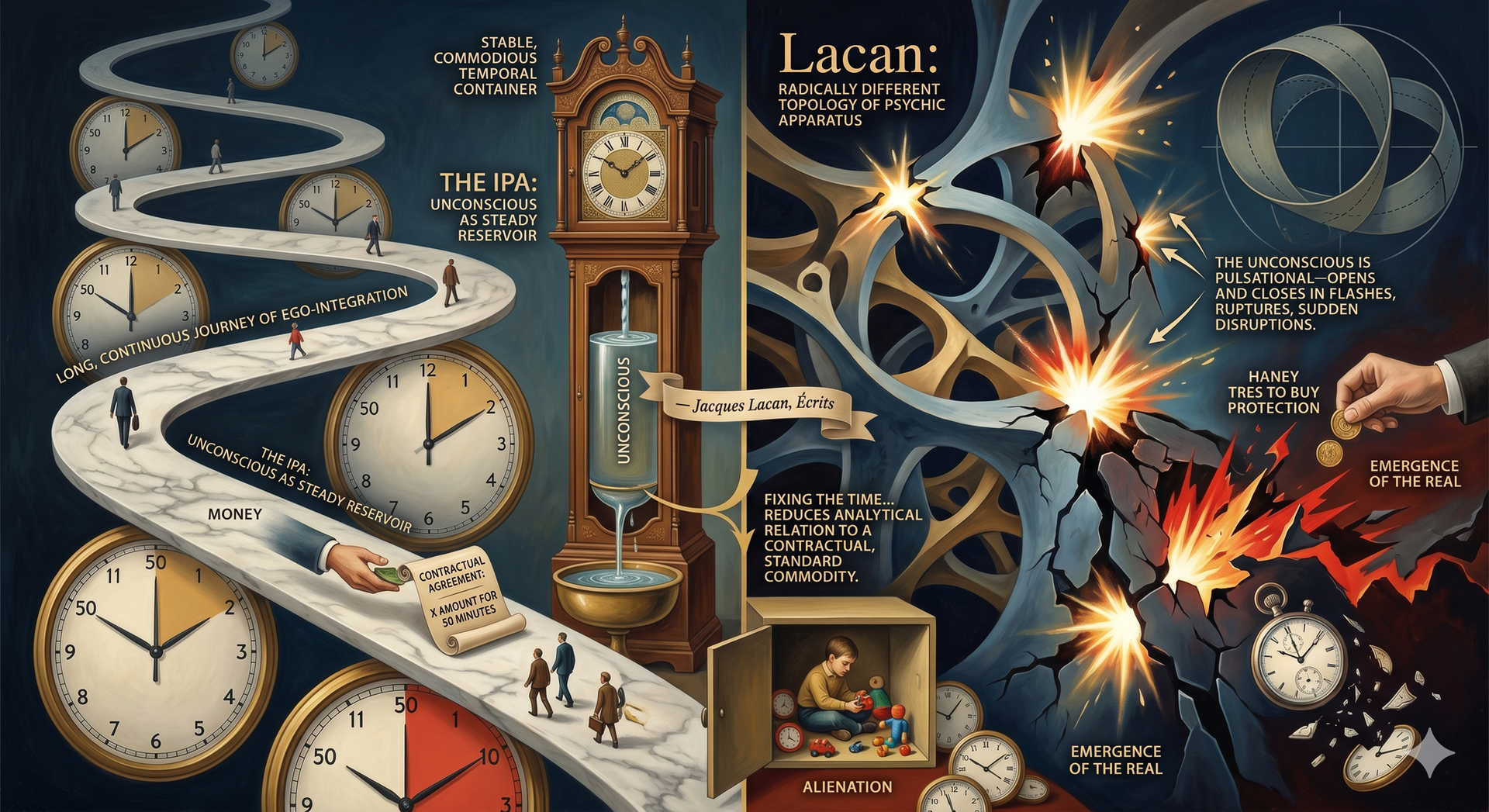
Aby obronić sesję o zmiennym czasie trwania przed zarzutami IPA dotyczącymi szarlataństwa i błędu w sztuce, Lacan nie odwoływał się do wygody klinicznej czy osobistego kaprysu. Zamiast tego sformułował rygorystyczną obronę osadzoną w topologii, lingwistyce oraz etyce pragnienia.
Jego argumenty – najsłynniej wyartykułowane w manifeście z 1953 roku „Funkcja i pole mowy i języka w psychoanalizie” (tzw. Wykład Rzymski) – można podzielić na cztery główne filary teoretyczne.
1. Dekonstrukcja „czasu standardowego” jako obrony ego
Lacan argumentował, że święta dla IPA 50-minutowa godzina nie była neutralną ramą, lecz sztucznym tworem wyrosłym z przemysłowego kapitalizmu, a nie z nieświadomości. Poprzez zafiksowanie końca sesji na przewidywalnej współrzędnej czasoprzestrzennej, standardowa rama aktywnie współdziała z oporem pacjenta.
Rama standardowa: Stałe 50 minut ──> Pacjent sam narzuca sobie tempo ──> Ego kontroluje narrację
Rama lakanowska: Zmienny czas trwania ──> Radykalna nieprzewidywalność ──> Załamanie obron ego / Dopuszczenie nieświadomości do głosu
Jeśli pacjent wie dokładnie, kiedy sesja się skończy, jego ego może bezpiecznie zaplanować budżet swoich mechanizmów obronnych:
- Może spędzić 40 minut na uprzejmej, intelektualnej gadaninie (tzw. mowa pusta / fr. parole vide).
- W 48. minucie zrzuca potężną, traumatyczną bombę prawdy, wiedząc, że zegarek zmusi analityka do powiedzenia: „Na tym musimy dzisiaj skończyć”.
Lacan nazwał to neutralizacją nieświadomości. Uczynienie końca sesji całkowicie nieprzewidywalnym sprawia, że pacjent nie może narzucić sobie tempa ani przygotować linii obrony. Zostaje zmuszony do mówienia bez ochronnego horyzontu czasowego, jakim dysponuje ego.
2. Logika retroaktywności (Nachträglichkeit)
Obrona Lacana opierała się w dużej mierze na freudowskiej koncepcji odroczonego działania lub retroaktywności (Nachträglichkeit), którą sformalizował lingwistycznie za pomocą point de capiton (punktu pikowania / przeszycia).
W języku znaczenie zdania pozostaje zawieszone aż do momentu dotarcia do ostatniego znaku interpunkcyjnego; ostatnie słowo retroaktywnie ustala sens wszystkich słów, które je poprzedzały.
[ Słowo 1 ] ──> [ Słowo 2 ] ──> [ Słowo 3 ] ──> [ CIĘCIE / INTERPUNKCJA ] │ (Znaczenie zostaje ustalone retroaktywnie)
Lacan przekonywał, że głównym narzędziem analityka jest interpunkcja. Jeśli analityk pozwala sesji ślepo biec, aż arbitralny zegar wybije pięćdziesiątą minutę, znak interpunkcyjny pada na losową, przypadkową frazę – często o charakterze obronnym.
Poprzez wykonanie precyzyjnego, taktycznego cięcia (skandowania), analityk wybiera dokładnie to znaczące, które retroaktywnie naświetli i zdestabilizuje cały dyskurs pacjenta. Pozwolenie pacjentowi na dalsze mówienie po kluczowym przejęzyczeniu z poziomu nieświadomości było dla Lacana prawdziwym błędem w sztuce klinicznej.
3. Sprzeciw wobec obsesyjnego urzeczowienia czasu
W swoich seminariach klinicznych Lacan wprost powiązał żądanie stałej, niezmiennej długości sesji z psychopatologią neurozy obsesyjnej.
Neurotyk obsesyjny panicznie boi się pragnienia Innego i próbuje je opanować poprzez zamknięcie go w przewidywalnej, mierzalnej strukturze. Pragnie umowy kontraktowej: „Płacę kwotę X za dokładnie Y minut”. Pozwala mu to traktować analizę jak transakcję rynkową, skutecznie kupując sobie ochronę przed wyłonieniem się Realnego.
„Ustalenie czasu sesji sprowadza relację analityczną do kontraktowego, standardowego towaru... daje podmiotowi schronienie, w którym może bezpiecznie odgrywać swoją alienację”. — Jacques Lacan, Écrits
Poprzez subwersję (podważenie) kontraktu za pomocą czasu zmiennego, analityk odmawia odgrywania roli pana wobec obsesjonika. Podmiot zostaje pozbawiony bezpieczeństwa, jakie daje forma towaru, i wrzucony z powrotem w lęk przed własnym strukturalnym brakiem.
4. Błąd teleologiczny: Psychoanaliza to nie podróż
IPA postrzegało analizę jako długą, ciągłą podróż ku integracji ego, wymagającą stabilnego, pojemnego naczynia czasowego. Lacan skontrował to radykalnie odmienną topologią aparatu psychicznego.
Nieświadomość nie jest głębokim, podziemnym rezerwuarem, który sączy się miarowo przez pięćdziesiąt minut. Nieświadomość ma charakter pulsacyjny – otwiera się i zamyka w błyskach, pęknięciach i nagłych zakłóceniach.
Dlatego sesja musi odpowiadać morfologii samej nieświadomości. Musi być błyskiem, nakłuciem lub nagłym uświadomieniem sobie czegoś, a nie wygodną, przedłużającą się rozmową. Lacan bronił krótkiej sesji, ponieważ traktował godzinę analityczną nie jako lekcję pedagogiczną, lecz jako wydarzenie.
Etyka cięcia
Ostateczna obrona Lacana miała charakter etyczny. Argumentował, że IPA zastąpiło etykę biurokracji (przestrzeganie reguł zegarka) etyką pragnienia (przestrzeganie reguł nieświadomości).
Dla Lacana standaryzacja czasu była aktem tchórzostwa – sposobem na to, by analityk schował się za stoperem, zamiast podjąć przerażające, subiektywne ryzyko decydowania o tym, kiedy dokładnie przemówiła nieświadomość i kiedy należy dokonać cięcia.
Bibliografia i lektury uzupełniające
Lacan, Jacques. „Funkcja i pole mowy i języka w psychoanalizie” [Wykład Rzymski, 1953] [w:] Écrits, tłum. Bruce Fink (New York: W.W. Norton & Company, 2006).
- Gdzie szukać: Zob. w szczególności rozdział „III. Echo mowy i zachodni mit Edypa”.
- Kontekst: Tekst, w którym Lacan opisuje, jak 45- lub 50-minutowa godzina standaryzuje analizę w produkt przemysłowy. Wprost wprowadza tu skandowanie jako narzędzie interpunkcji, argumentując, że zakończenie sesji na znaczącym z poziomu nieświadomości retroaktywnie określa jej znaczenie (Nachträglichkeit) poprzez punkt przeszycia (point de capiton).
Lacan, Jacques. „Warianty leczenia standardowego” [1953] [w:] Écrits, tłum. Bruce Fink (New York: W.W. Norton & Company, 2006).
- Gdzie szukać: Strony 269–302.
- Kontekst: Bezpośrednia polemika Lacana z przedstawicielami psychologii ego z kręgu IPA (Hartmannem, Krisem, Löwensteinem). Argumentuje, że sztywne ustalanie czasu sesji redukuje relację analityczną do „kontraktowego, standardowego towaru” i działa jako obrona ego, aktywnie chroniąc neurotyka obsesyjnego przed konfrontacją z pragnieniem Innego.
Lacan, Jacques. Seminarium, Księga XI: Cztery zasadnicze pojęcia psychoanalizy [1964], pod red. Jacques’a-Alaina Millera, tłum. Alan Sheridan (New York: W.W. Norton & Company, 1998).
- Gdzie szukać: Rozdział 1 („Ekskomunika”) oraz Rozdział 2 („Nieświadomość freudowska i nasza”).
- Kontekst: Lacan definiuje tutaj nieświadomość jako pulsacyjną – coś, co otwiera się i zamyka w błyskach, szczelinach i nagłych zakłóceniach (limen). Jest to jego główne metapsychologiczne uzasadnienie tego, dlaczego sesja musi odpowiadać morfologii wydarzenia, a nie pedagogicznej, linearnej podróży.
Dodatkowe materiały kliniczne i krytyczne:
Fink, Bruce. A Clinical Introduction to Lacanian Psychoanalysis: Theory and Technique (Cambridge: Harvard University Press, 1997).
- Gdzie szukać: Rozdział 1 („The Therapeutic Frame: Punctuation and Scansion”).
- Kontekst: Fink przedstawia najbardziej klarowny w języku angielskim przewodnik techniczny po tym, jak sesja o zmiennym czasie trwania rozbija budżet obronny neurotyka obsesyjnego (gadanina pustej mowy przez pierwsze 40 minut, po której następuje bomba prawdy w 48. minucie).
Hook, Derek. Six Lacanian Orientation Interviews on the Psychoanalytic Frame (London: Routledge, 2022).
- Gdzie szukać: Rozdział 2 („Time, Scansion and the Short Session”).
- Kontekst: Podręcznikowe ujęcie etyki cięcia, wyjaśniające, w jaki sposób śledzenie kairos (czasu logicznego) zamiast chronos (czasu zegarowego) chroni analizę przed przekształceniem się w zwykłą transakcję rynkową.
To defend the variable-length session against the IPA’s charges of charlatanism and malpractice, Lacan did not appeal to clinical convenience or personal whim. Instead, he mounted a rigorous defense grounded in topology, linguistics, and the ethics of desire.
His arguments—most famously articulated in his 1953 manifesto, "The Function and Field of Speech and Language in Psychoanalysis" (The Rome Discourse)—can be broken down into four core theoretical pillars.
The Deconstruction of "Standard Time" as an Ego Defense
Lacan argued that the IPA's sacred 50-minute hour was not a neutral frame, but an artificial construct derived from industrial capitalism, not the unconscious. By fixing the session's end at a predictable spatial-temporal coordinate, the standard frame actively colludes with the patient’s resistance.
Standard Frame: Fixed 50 Mins ──> Patient paces themselves ──> Ego controls the narrative
Lacanian Frame: Variable Time ──> Radical Unpredictability ──> Unconscious breakdown
If a patient knows exactly when a session will end, their ego can safely budget its defenses:
- They can spend 40 minutes on polite, intellectualized chatter (parole vide or "empty speech").
- They drop a massive, traumatic truth-bomb in the 48th minute, knowing the analyst will be forced by the clock to say, "We have to stop there for today."
Lacan called this a neutralization of the unconscious. By making the end of the session completely unpredictable, the patient cannot pace themselves or prepare their defenses. They are forced to speak without the ego's protective temporal horizon.
The Logic of Retroactivity (Nachträglichkeit)
Lacan's defense relied heavily on the Freudian concept of deferred action or retroactivity (Nachträglichkeit), which he formalized linguistically using the point de capiton (the anchoring button tie).
In language, a sentence’s meaning is suspended until the final punctuation mark is reached; the last word retroactively fixes the meaning of all the words that preceded it.
[ Word 1 ] ──> [ Word 2 ] ──> [ Word 3 ] ──> [ THE CUT / PUNCTUATION ]
                                                       │
                                        (Meaning is fixed retroactively)
Lacan argued that the analyst's primary tool is punctuation. If the analyst allows a session to blindly run until an arbitrary clock strikes fifty, the punctuation mark falls on a random, contingent phrase—often a defensive one.
By executing a precise, tactical cut (scansion), the analyst chooses the exact signifier that will retroactively illuminate and destabilize the patient’s entire discourse. To let the patient keep talking after a crucial unconscious slip is, for Lacan, the real clinical malpractice.
Opposing the Obsessional Objectification of Time
In his clinical seminars, Lacan explicitly linked the demand for a fixed, invariant session length to the psychopathology of the obsessional neurotic.
The obsessional neurotic is terrified of the Other’s desire and seeks to master it by locking it into a predictable, measurable structure. They want a contractual agreement: "I pay X amount for exactly Y minutes." This allows them to treat the analysis as a market transaction, effectively buying protection against the emergence of the Real.
"Fixing the time of the session reduces the analytical relation to a contractual, standard commodity... it gives the subject a shelter where he can safely play out his alienation."
— Jacques Lacan, Écrits
By subverting the contract through variable time, the analyst refuses to act as the obsessional's master. The subject is denied the safety of the commodity form and is thrown back into the anxiety of their own structural lack.
The Teleological Fallacy: Psychoanalysis is Not a Journey
The IPA viewed an analysis as a long, continuous journey of ego-integration requiring a stable, commodious temporal container. Lacan countered with a radically different topology of the psychic apparatus.
The unconscious is not a deep, subterranean reservoir that leaks out steadily over fifty minutes. The unconscious is pulsational—it opens and closes in flashes, ruptures, and sudden disruptions.
Therefore, the session must match the morphology of the unconscious itself. It must be a flash, a puncture, or a sudden realization rather than a comfortable, prolonged conversation. Lacan defended the short session because it treated the analytical hour not as a period of pedagogical instruction, but as an event.
The Ethics of the Cut
Lacan’s ultimate defense was ethical. He argued that the IPA had substituted an ethics of bureaucracy (following the rules of the clock) for an ethics of the desire (following the rules of the unconscious).
For Lacan, standardizing time was an act of cowardice—a way for the analyst to hide behind a stopwatch rather than taking the terrifying, subjective risk of deciding exactly when the unconscious had spoken and when the cut must be made.
To back up these precise theoretical claims and historical details, you need texts that explicitly deal with the mechanics of the séance à durée variable (variable-length session) and the administrative tracking of the 1953–1963 institutional split.
Bibliography & Further Reading
- Lacan, Jacques. "The Function and Field of Speech and Language in Psychoanalysis" [The Rome Discourse, 1953] in Écrits, trans. Bruce Fink (New York: W.W. Norton & Company, 2006).
- Where to look: See specifically the section "III. The Echo of Speech and the Western Myth of the Oedipus."
- Direct relevance: This is the text where Lacan outlines how the 45-to-50 minute hour standardizes analysis into an industrial product. He explicitly introduces scansion here as a punctuation tool, arguing that terminating the session on an unconscious signifier retroactively determines its meaning ($Nachträglichkeit$) via the point de capiton (anchoring button tie).
- Lacan, Jacques. "Variations on the Standard Treatment" [1953] in Écrits, trans. Bruce Fink (New York: W.W. Norton & Company, 2006).
- Where to look: Pages 269–302.
- Direct relevance: This text is Lacan’s direct polemic against the IPA's ego psychologists (Hartmann, Kris, Löwenstein). He argues that fixing the time of the session reduces the analytical relation to a "contractual, standard commodity" and functions as an ego defense, actively sheltering the obsessional neurotic from encountering the desire of the Other.
- Lacan, Jacques. The Seminar of Jacques Lacan, Book XI: The Four Fundamental Concepts of Psychoanalysis [1964], ed. Jacques-Alain Miller, trans. Alan Sheridan (New York: W.W. Norton & Company, 1998).
- Where to look: Chapter 1, "Excommunication," and Chapter 2, "The Freudian Unconscious and Ours."
- Direct relevance: Here, Lacan defines the unconscious as pulsational—something that opens and closes in flashes, punctures, and sudden disruptions (limen). This is his primary metapsychological justification for why a session must match the morphology of an event rather than a pedagogical, linear journey.
Secondary Clinical & Critical Material
- Fink, Bruce. A Clinical Introduction to Lacanian Psychoanalysis: Theory and Technique (Cambridge: Harvard University Press, 1997).
- Where to look: Chapter 1, "The Therapeutic Frame: Punctuation and Scansion."
- Direct relevance: Fink provides the clearest technical guide in English on how the variable-length session disrupts the obsessional neurotic's defense budget (the "empty speech" chatter of the first 40 minutes followed by the 48th-minute truth bomb).
- Hook, Derek. Six Lacanian Orientation Interviews on the Psychoanalytic Frame (London: Routledge, 2022).
- Where to look: Chapter 2, "Time, Scansion and the Short Session."
- Direct relevance: A contemporary textbook look at the ethics of the cut, explaining how tracking kairos (logical time) rather than chronos (clock time) protects the analysis from becoming an ordinary market transaction.
Written by
Subscribe for FREE to our Audience
Enter your email to access commenting, receive memos, logs, dispatches, and unfiltered fragments directly from the Theater.











Member discussion