"Séance Courte" Crisis and the Origin of La Pass

Wersja PL: Kryzys wokół „Séance Courte” i geneza Procedury Pasażu
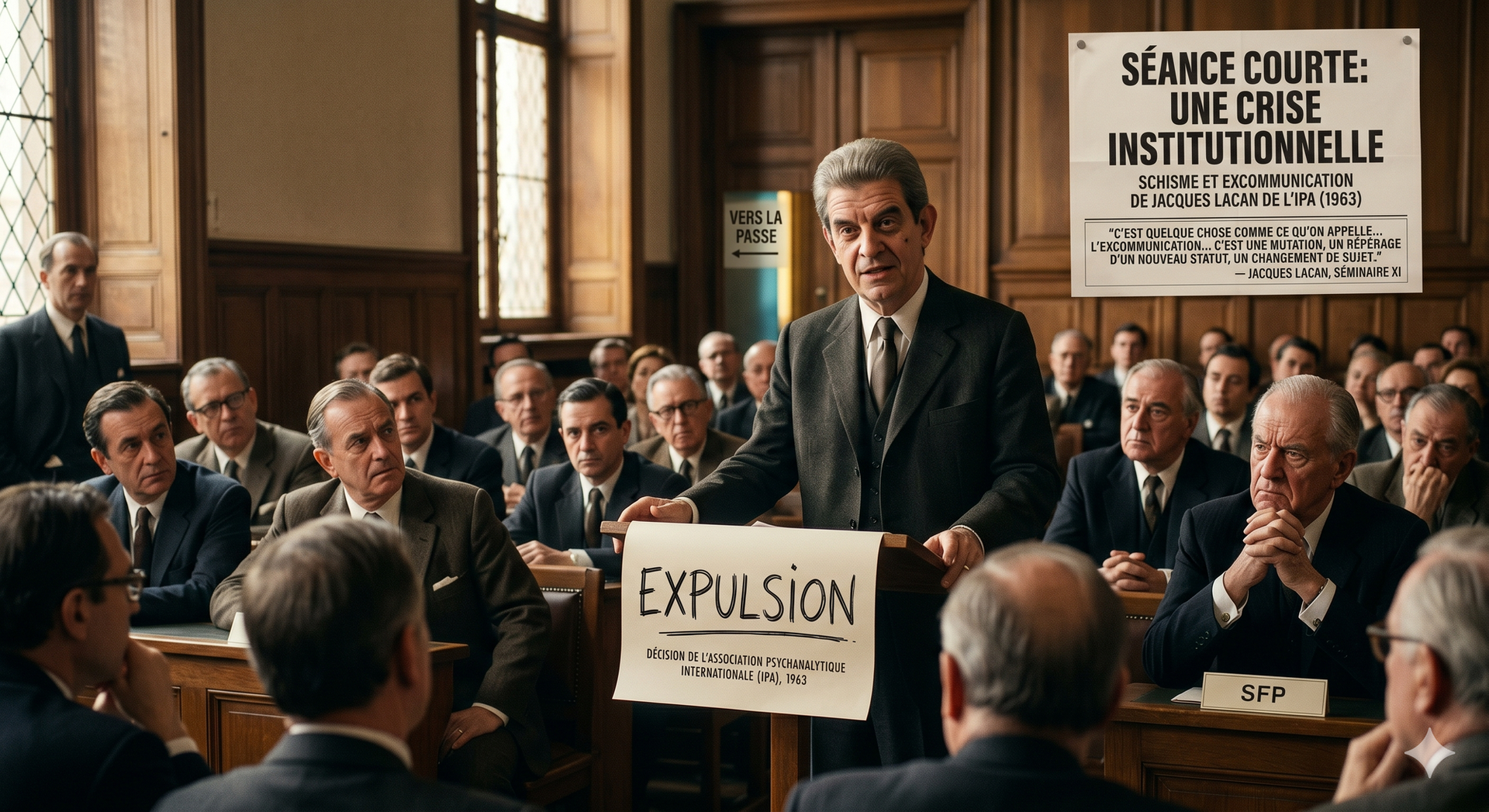
Kryzys związany z krótkimi sesjami o zmiennym czasie trwania – potocznie zwany „krótką sesją” (séance courte) – stał się detonatorem najsłynniejszego rozłamu instytucjonalnego w historii psychoanalizy. Ostatecznie doprowadził on do wydarzenia, które Lacan nazwał swoją „ekskomuniką” z Międzynarodowego Towarzystwa Psychoanalitycznego (IPA) w 1963 roku.
Dla IPA 50-minutowa sesja była świętą, niezmienną ramą (tzw. settingiem). Dla Lacana była to biurokratyczna obsesja, która obracała nieświadomość w kamień.
Kontekst: Rozłam z 1953 roku i powstanie SFP
Napięcie zaczęło się na dekadę przed ostatecznym wykluczeniem. W 1953 roku spór wokół autorytaryzmu i medykalizacji wewnątrz Paryskiego Towarzystwa Psychoanalitycznego (SPP) skłonił Lacana, Françoise Dolto oraz Daniela Lagache’a do złożenia rezygnacji. Założyli oni nową grupę: Francuskie Towarzystwo Psychoanalizy (Société Française de Psychanalyse – SFP).
Ponieważ SFP było grupą rozłamową, nie posiadało uznania ze strony IPA. Przez kolejne dziesięć lat SFP zabiegało o oficjalną reintegrację ze strukturami międzynarodowymi. Jednak IPA, zdominowane wówczas przez przedstawicieli psychologii ego (takich jak Heinz Hartmann), patrzyło na praktykę Lacana z głęboką podejrzliwością – a w szczególności na jego odejście od standardowego czasu klinicznego.
Miara IPA (The IPA Metric)
· Czas chronologiczny (Chronos)
· Stały czas trwania: 45–50 minut.
· Czas jako stabilne naczynie/ramy dla oporu.
· Wysoka przewidywalność finansowa w przeliczeniu na godzinę.
Miara lakanowska (The Lacanian Metric)
· Czas logiczny (Kairos)
· Zmienna długość, określana przez nieświadomość.
· Czas jako narzędzie kliniczne do przełamywania oporu.
· Wysoka przepustowość szkoleniowa (Lacan przyjmował dziesiątki pacjentów dziennie).
Dochodzenia IPA (1953–1963)
Aby ocenić, czy SFP może zostać ponownie przyjęte, IPA wysłało kilka komisji śledczych (prowadzonych m.in. przez analityków Pietera Turqueta i Michaela Balinta) w celu zbadania paryskich praktyk szkoleniowych. IPA sprzeciwiło się działalności Lacana z trzech powodów:
- Szkolenie analityków: Lacan prowadził analizy szkoleniowe (Lehranalyse) kandydatów SFP. IPA argumentowało, że kandydaci przechodzący 15-minutowe sesje nie są rzetelnie analizowani, co zagraża pedagogicznej integralności całego ruchu.
- „Industrializacja” analizy: Ponieważ sesje Lacana były krótkie, mógł on przyjmować ogromną liczbę pacjentów dziennie. Krytycy zarzucali mu przekształcenie kliniki w linię montażową o dużej rotacji, co miało kompromitować etyczną opiekę na rzecz budowania wpływów finansowych i instytucjonalnych.
- Manipulacja przeniesieniem: IPA postrzegało skandowanie nie jako czyste punktowanie nieświadomości, lecz jako autorytarną interwencję, która potęgowała wyobrażeniową władzę analityka i sprzyjała kultowi jednostki.
Ultimatum z 1963 roku: „Warunki z Edynburga”
Punkt kulminacyjny nastąpił podczas XXIII Kongresu IPA w Sztokholmie (lipiec 1963 r.) i został sfinalizowany na posiedzeniu zarządu w Edynburgu pod koniec tego samego roku. IPA postawiło SFP brutalne, biurokratyczne ultimatum: jeśli chcą uzyskać uznanie, muszą bezterminowo usunąć Jacques’a Lacana (oraz jego bliskiego sojusznika, Serge’a Leclaire’a) z listy autoryzowanych analityków szkoleniowych.
SFP usłyszało zasadniczo, że aby uratować ciało, musi odciąć mu głowę.
19 listopada 1963 roku frakcja SFP (kierowana przez Jeana-Bertranda Pontalisa i Jeana Laplanche’a) skapitulowała przed żądaniami IPA, głosując za pozbawieniem Lacana statusu analityka szkoleniowego.
Reakcja: „Ekskomunika” i Seminarium XI
Lacan natychmiast otrzymał wiadomość o swoim instytucjonalnym wyroku śmierci. Dwa dni później, 21 listopada 1963 roku, wszedł do sali wykładowej i poprowadził jedyną, historyczną sesję seminarium, które miało być poświęcone Imionom-Ojca. Ogłosił wówczas odwołanie seminarium, wprost porównując swoje wykluczenie do uroczystego rytuału żydowskiej ekskomuniki (cherem), jakim obłożono Spinozę.
„Jest to coś w rodzaju tego, co w pewnej tradycji religijnej nazywa się ekskomuniką... To mutacja, naniesienie nowego statusu, zmiana podmiotu”. — Jacques Lacan, Seminarium XI (Wykład inauguracyjny)
Lacan nie błagał o powrót. Zamiast tego uczynił ze swojego wygnania broń:
- Przeformatowanie Seminarium (styczeń 1964): Lacan przenosi swoje seminarium do prestiżowej École Normale Supérieure, zyskując strukturalne poparcie Louisa Althussera. Rozpoczyna Seminarium XI: Cztery zasadnicze pojęcia psychoanalizy, ustawiając je jako systematyczną rewizję tego, co uprawomocnia analityka poza ramami IPA.
- Założenie Szkoły Freudowskiej: Lacan publikuje akt założycielski École Freudienne de Paris (EFP). W tej nowej szkole całkowicie znosi tradycyjną hierarchię IPA, zastępując ją „Procedurą Pasażu” (La passe) – radykalną, eksperymentalną metodą weryfikacji analityków szkoleniowych, opartą na ich relacji z nieświadomością, a nie na standardowym czasie instytucjonalnym czy stażu pracy.
Wyrzucając Lacana z powodu krótkich sesji, IPA zamierzało poddać kwarantannie ideologiczną zarazę. Zamiast tego doprowadzili do narodzin nowoczesnego lakanizmu jako niezależnego ruchu międzynarodowego, trwale dzieląc świat psychoanalizy na tych, którzy analizują pod dyktando zegarka, i tych, którzy analizują pod dyktando cięcia.
Bibliografia i lektury uzupełniające
Lacan, Jacques. „Akt założycielski” [21 czerwca 1964] [w:] Television: A Challenge to the Psychoanalytic Establishment, pod red. Joan Copjec (New York: W.W. Norton & Company, 1990).
- Gdzie szukać: Strony 97–106.
- Kontekst: Oficjalny dokument, w którym Lacan powołuje do życia École Freudienne de Paris (EFP) tuż po swoim wykluczeniu. Zawiera on jego pierwszy strukturalny zarys „Procedury Pasażu” (La passe) – radykalnej instytucjonalnej alternatywy dla systemów szkoleniowych IPA opartych na stażu pracy.
Lacan, Jacques. „Seminarium o 'Imionach-Ojca'” [21 listopada 1963] [w:] The Names-of-the-Father, tłum. Bruce Fink (Cambridge: Polity Press, 2013).
- Kontekst: Zawiera zapis tej jedynej, historycznej sesji wygłoszonej zaledwie kilka dni po tym, jak pod naciskiem IPA SFP pozbawiło go statusu szkoleniowego. Jest to tekst źródłowy dla jego cytatu wprost porównującego instytucjonalne uciszenie do cheremu (ekskomuniki) Barucha Spinozy.
Opracowania historyczne i biograficzne dotyczące schizmy:
Roudinesco, Élisabeth. Jacques Lacan & Co.: A History of Psychoanalysis in France, 1925–1985 (Chicago: University of Chicago Press, 1990).
- Gdzie szukać: Rozdział 7 („Rozłam z 1953 roku”) oraz Rozdział 9 („Ekskomunika (1953–1963)”).
- Kontekst: Definiujące archiwum historyczne francuskich rozłamów. Roudinesco szczegółowo opisuje tu role, jakie odegrali Michael Balint i Pieter Turquet podczas komisji śledczych IPA, doręczenie „Warunków z Edynburga” oraz ostateczną kapitulację Laplanche’a i Pontalisa przed komitetem wykonawczym IPA.
Macey, David. Lacan in Contexts (London: Verso, 1988).
- Gdzie szukać: Rozdział 2 („Instytucjonalizacja psychoanalizy”).
- Kontekst: Przybliża głębokie różnice ideologiczne między angloamerykańskimi ramami psychologii ego IPA po II wojnie światowej (skupionymi na adaptacji społecznej) a francuskim ekosystemem intelektualnym, wyjaśniając, dlaczego krótkie analizy szkoleniowe Lacana były postrzegane jako finansowa i pedagogiczna „industrializacja”.
Turquet, Pieter. „Report on the French Situation to the Central Executive of the IPA” [1962], przedruk w International Journal of Psychoanalysis, t. 44.
- Kontekst: Autentyczny tekst historyczny z raportu komisji IPA oceniającej sytuację w SFP, ukazujący oficjalną biurokratyczną panikę wywołaną nieprzewidywalną długością sesji u Lacana oraz masowym przepływem kandydatów przez jego gabinet.
The crisis over the short and variable-length session—colloquially known as the "short session" (séance courte)—was the detonator for the most famous institutional schism in the history of psychoanalysis. It ultimately led to what Lacan famously termed his "excommunication" from the International Psychoanalytical Association (IPA) in 1963.
For the IPA, the 50-minute session was a sacred, invariant frame (setting). For Lacan, it was a bureaucratic obsession that ossified the unconscious.
The Context: The 1953 Split and the SFP
The tension began a decade before the final expulsion. In 1953, a rift over authoritarianism and medicalization within the Paris Psychoanalytic Society (SPP) led Lacan, Françoise Dolto, and Daniel Lagache to resign. They formed a new group: the Société Française de Psychanalyse (SFP).
Because the SFP was a breakaway group, it was not recognized by the IPA. For the next ten years, the SFP sought official reintegration into the international body. The IPA, dominated at the time by ego psychologists like Heinz Hartmann, viewed Lacan’s practice with profound suspicion—specifically his departure from standard clinical time.
The IPA's Inquiries (1953–1963)
To assess whether the SFP could be readmitted, the IPA dispatched several committees (notably led by analysts like Pieter Turquet and Michael Balint) to investigate the Parisian training practices.
The investigators found that Lacan’s sessions were not just slightly abbreviated; they were wildly unpredictable. Under the guise of scansion, sessions could last twenty minutes, ten minutes, or in some notorious late-career instances, a single sentence and a few minutes.
| The IPA Metric | The Lacanian Metric |
| Chronological Time (Chronos) | Logical Time (Kairos) |
| 45–50 fixed minutes. | Variable length, determined by the unconscious. |
| Time as a stable container for resistance. | Time as a clinical tool to break resistance. |
| High financial predictability per hour. | High training throughput (Lacan saw dozens of patients a day). |
The IPA objected to this on three grounds:
- The Training of Analysts: Lacan was conducting the training analyses (Lehranalyse) of the SFP’s candidates. The IPA argued that candidates undergoing 15-minute sessions were not being properly analyzed, threatening the pedagogical integrity of the entire movement.
- The "Industrialization" of Analysis: Because Lacan's sessions were brief, he could see an immense volume of patients daily. Critics accused him of transforming the clinic into a high-turnover assembly line, compromising ethical care for financial and institutional leverage.
- Transference Manipulation: The IPA viewed scansion not as a pure punctuation of the unconscious, but as an authoritarian intervention that amplified the analyst's imaginary power and fostered a cult of personality.
The 1963 Ultimatum: The "Edinburgh Conditions"
The climax occurred at the 23rd IPA Congress in Stockholm (July 1963) and was finalized at an executive meeting in Edinburgh later that year. The IPA delivered a brutal, bureaucratic ultimatum to the SFP: if they wished to be recognized, they had to remove Jacques Lacan (and his close ally, Serge Leclaire) from the list of authorized training analysts indefinitely.
The SFP was essentially told that to save the collective body, they had to amputate its head.
On November 19, 1963, a faction of the SFP (led by Jean-Bertrand Pontalis and Jean Laplanche) capitulated to the IPA's demands, voting to strip Lacan of his training status.
The Response: "Excommunication" and Seminar XI
Lacan received the news of his institutional death sentence immediately. Two days later, on November 21, 1963, he walked into his lecture hall and delivered the single, historic session of what was supposed to be his seminar on The Names-of-the-Father. He announced he was canceling the seminar, explicitly comparing his expulsion to the solemn ritual of Jewish excommunication (herem) leveled against Spinoza.
"It is something like what is called, in a certain religious tradition, excommunication... It is a mutation, a mapping of a new status, a change of subject."
— Jacques Lacan, Seminar XI (Opening Lecture)
Lacan did not crawl back. Instead, he weaponized his exile:
The Reinvention of the Seminar January 1964
Lacan relocates his seminar to the prestigious École Normale Supérieure, with the structural backing of Louis Althusser. He begins Seminar XI: The Four Fundamental Concepts of Psychoanalysis, framing it as a systematic re-examination of what authorizes an analyst outside of the IPA framework.
The Founding of the École Freudienne
Lacan publishes the founding act of the École Freudienne de Paris (EFP). In this new school, he completely abolishes the traditional IPA hierarchy, replacing it with "The Pass" (La passe)—a radical, experimental method for validating training analysts based on their relation to the unconscious rather than standard institutional time or seniority.
By expelling Lacan over the short session, the IPA intended to quarantine an ideological contagion. Instead, they catalyzed the birth of modern Lacanianism as an independent international movement, permanently dividing the psychoanalytic world into those who analyze by the clock, and those who analyze by the cut.
Bibliography & Further Reading
- Lacan, Jacques. "Founding Act" [June 21, 1964] in Television: A Challenge to the Psychoanalytic Establishment, ed. Joan Copjec (New York: W.W. Norton & Company, 1990).
- Where to look: Pages 97–106.
- Direct relevance: The official document where Lacan launches the École Freudienne de Paris (EFP) immediately following his expulsion. It contains his initial structural outline for "The Pass" (La passe)—his radical institutional alternative to the IPA's seniority-based training systems.
- Lacan, Jacques. "The Seminar on 'The Names-of-the-Father'" [November 21, 1963] in The Names-of-the-Father, trans. Bruce Fink (Cambridge: Polity Press, 2013).
- Direct relevance: This contains the transcript of the single, historic session delivered just days after he was stripped of his training status by the SFP under IPA pressure. This is the source text for his quote explicitly comparing his institutional silencing to Baruch Spinoza's herem (excommunication).
Historical & Biographical Accounts of the Schism
- Roudinesco, Élisabeth. Jacques Lacan & Co.: A History of Psychoanalysis in France, 1925–1985 (Chicago: University of Chicago Press, 1990).
- Where to look: Chapter 7, "The Split of 1953," and Chapter 9, "The Excommunication (1953–1963)."
- Direct relevance: This is the definitive historical archive of the French splits. Roudinesco details the exact roles played by Michael Balint and Pieter Turquet during the IPA inquiry commissions, the delivery of the "Edinburgh Conditions," and the final capitulation of Laplanche and Pontalis to the IPA executive committee.
- Macey, David. Lacan in Contexts (London: Verso, 1988).
- Where to look: Chapter 2, "The Institutionalization of Psychoanalysis."
- Direct relevance: Outlines the profound ideological differences between the IPA's Anglo-American post-WWII ego psychology frameworks (focused on social adaptation) and the French intellectual ecosystem, explaining why Lacan's brief training analyses were viewed as financial and pedagogical "industrialization."
- Turquet, Pieter. "Report on the French Situation to the Central Executive of the IPA" [1962], reprinted in the International Journal of Psychoanalysis, Vol. 44.
- Direct relevance: The actual historical text of the IPA committee's assessment regarding the SFP, showcasing the official bureaucratic panic over Lacan's unpredictable session lengths and the high throughput of candidates through his office.
Written by
Subscribe for FREE to our Audience
Enter your email to access commenting, receive memos, logs, dispatches, and unfiltered fragments directly from the Theater.










Member discussion