Sinthome


Wersja PL: Sinthome
Czwarty pierścień nie bierze swojego początku ze zdrowej struktury psychicznej; rodzi się on na liniach pęknięć w strukturalnym powiązaniu, a ściślej – z porażki Imienia-Ojca (fr. Nom-du-Père) w jego zadaniu związania ze sobą Porządku Realnego, Symbolicznego i Wyobrażeniowego. Aby zrozumieć ów czwarty pierścień – Sinthome – musimy przyjrzeć się temu, co dzieje się, gdy domyślna, trójpierścieniowa struktura boromejska zawodzi.
Oto jak czwarty pierścień „powstaje”, jak się zakotwicza i czy jego „zainstalowanie” wymaga wykonania „cięcia”.
Skąd bierze się Sinthome i jak powstaje?
U podmiotu „neurotycznego” Imię-Ojca w naturalny sposób działa jako zasada strukturalna, która splata ze sobą R, S i W. Lacan zdał sobie jednak sprawę, że ten domyślny, trójpierścieniowy układ jest niezwykle rzadki i kruchy. Często występuje w nim fundamentalna wada: pierścienie nie zaplatają się w sposób naturalny. Leżą na sobie luźno, niepowiązane.
Bez interwencji ten stan braku powiązania prowadzi bezpośrednio do psychozy (całkowitego rozpadu rzeczywistości, jak miało to miejsce w przypadku Schrebera).
Sinthome to sztuczny, osobliwy wynalazek stworzony przez podmiot w celu skompensowania tej radykalnej porażki Imienia-Ojca.
- Jak powstaje: Zostaje wykuty z własnej, unikalnej, nierozszyfrowywalnej rozkoszy (jouissance) podmiotu. Zazwyczaj wiąże się z wysoce specyficzną, idiosynkratyczną praktyką – sposobem manipulowania językiem, sztuką lub cielesnym rytuałem.
- Przypadek paradygmatyczny: Dla Jamesa Joyce’a jego Sinthome stanowiła unikalna, chaotyczna relacja z pisaniem (Finnegans Wake). Jego sztuka nie była rebusem do zinterpretowania; była fizycznym rusztowaniem. Była syntetycznym pierścieniem stworzonym z atramentu, który chronił jego ego przed rozpadem na kawałki.
Jak łączy się z węzłem trójpierścieniowym: Topologia naprawy
Jeśli trzy pierścienie Realnego, Symbolicznego i Wyobrażeniowego są zasadniczo luźne i nie potrafią utrzymać się razem, Sinthome przechodzi przez nie, by sztucznie wymusić boromejską spójność. Jak pokazuje diagram strukturalny, czwarty pierścień (Sigma, czyli Sinthome) przeplata się nad i pod konkretnymi granicami, na których oryginalne trzy pierścienie się rozjeżdżają. Skutecznie kapsułkuje on ów błąd. Blokuje ruchome elementy na swoim miejscu, tworząc czteropierścieniowy łańcuch boromejski.
Jeśli przetniesz pierścień Sinthome, pozostałe trzy natychmiast się rozdzielą i runą. Sztuczna równowaga zostanie utracona.
Czy to wymaga cięcia?
To kluczowe pytanie o charakterze klinicznym i matematycznym. Odpowiedź zależy całkowicie od tego, czy patrzymy na wadę, czy na lekarstwo.
- Matematycznie: Tak, wprowadzenie pierścienia do już zamkniętego łańcucha wymaga cięcia. Jeśli mamy trzy zamknięte, stałe pierścienie, które są już wadliwe lub błędnie zaplecione, nie można przepleść czwartego stałego pierścienia bez fizycznego rozcięcia jednego z nich, przewleczenia go i ponownego zespawania.
- Klinicznie: Cięcie jest traumą; Sinthome jest szwem.Kliniczne zastosowanie tej topologii przez Lacana odwraca nasz sposób myślenia o „cięciu”:
- Pierwotny „błąd” (Lapsus): Początkowe rozdzielenie się lub zsunięcie pierścieni jest cięciem pierwotnym. To strukturalny brak lub porażka symbolizacji (Wykluczenie / fr. forclusion).
- Analiza / Wynalazek: Rolą późnej analizy lakanowskiej nie jest dokonywanie nowego cięcia w celu interpretacji nieświadomości. Wykonanie cięcia na już i tak kruchym, niezaplecionym systemie wywołałoby natychmiastowy epizod psychotyczny.
- Splot: Zamiast cięcia, formowanie Sinthome jest aktem splatania, tkania i wiązania. Jest to suplement. Podmiot bierze luźne nici swojej rzeczywistości i cierpliwie zaplata nowy pierścień wokół strukturalnego rozdarcia.
Sinthome to ostateczne przejście od wczesnego Lacana, u którego analiza była sekcją (wcinaniem się w tekst rebusu), do późnego Lacana, u którego analiza jest syntezą (używaniem topologii do zszywania życia, które da się znieść).
Bibliografia i lektury uzupełniające
Freud, Sigmund – Objaśnianie marzeń sennych (1900)
- Nacisk na: Rozdział VI („Praca marzenia sennego”). To tutaj Freud wprost definiuje marzenie senne jako rebus (Bilderrätsel). Przeczytanie tego tekstu jest niezbędne, by zobaczyć, do czego dokładnie Lacan dokonuje swojego „powrotu”.
Lacan, Jacques – Instancja litery w nieświadomości albo rozum po Freudzie (1957) [w:] Écrits.
- Nacisk na: Kluczowy tekst dotyczący metafory, metonimii i algorytmu de Saussure’a (S/s). Definiuje on, jak znaczące łączą się w łańcuchy, pozostawiając obiekt a jako nieuchwytną, metonimiczną resztę.
Lacan, Jacques – Seminarium, Księga XI: Cztery zasadnicze pojęcia psychoanalizy (1964)
- Nacisk na: Pozycja kluczowa dla zrozumienia wczesnego sformułowania obiektu a jako przyczyny pragnienia i strukturalnego braku, tuż przed tym, jak Lacan zaczął go formalizować w sposób geometryczny.
Lacan, Jacques – Seminarium, Księga XIV: Logika fantazmatu (1966-1967)
- Nacisk na: Tekst kluczowy dla zrozumienia użycia cross-capu i wstęgi Möbiusa. Pokazuje matematycznie, jak cięcie dzieli powierzchnię na podmiot rozszczepiony ($) i obiekt a.
Lacan, Jacques – Lituraterre (1971) [w:] Autres Écrits.
- Nacisk na: Tekst ten stanowi pomost między dwoma okresami. Lacan przechodzi od znaczącego do litery, definiując literę nie jako narzędzie znaczenia, lecz jako inskrypcję lub „erozję” w Realnemu.
Lacan, Jacques – Seminaria XXI (Les non-dupes errent), XXII (R.S.I.) oraz XXIII (Le Sinthome) (1973-1976)
- Nacisk na: Późna faza topologiczna. To tutaj kręgi węzła zostają spłaszczone do wstęg Möbiusa, wprowadzona zostaje koncepcja Sinthome jako czwartego pierścienia naprawczego, a klinowanie obiektu a w centrum staje się kluczowym warunkiem utrzymania spójności psychicznej podmiotu.
The fourth ring does not originate from a healthy psychic structure; it originates from a fault lines in the structural link, specifically a failure of the Name-of-the-Father to bind the Real, Symbolic, and Imaginary. To understand the fourth ring—the Sinthome —we have to look at what happens when the default 3-ring Borromean structure fails.
Here is how the furth ring "becomes," how it attaches, and whether it requires a "cut" be "installed."
Where the Sinthome Originates & How It Becomes
In a "neurotic" subject, the Name-of-the-Father naturally acts as a structural principle that weaves R, S, and I together. But Lacan realized that this default 3-ring arrangement is incredibly rare and fragile. Frequently, there is a fundamental flaw: the rings do not naturally knot. They sit on top of one another loosely, unlinked.
Without intervention, this unlinked state leads directly to psychosis (the total unraveling of reality, as seen in Schreber).
The Sinthome is an artificial, singular invention created by the subject to compensate for this radical failure of the Name-of-the-Father.
- How it becomes: It is forged out of the subject’s own unique, non-decipherable jouissance. It is usually tied to a hyper-specific, idiosyncratic practice—a way of manipulating language, art, or a bodily ritual.
- The Paradigm Case: For James Joyce, the Sinthome was his unique, chaotic relationship to writing (Finnegans Wake). His art was not a rebus to be interpreted; it was a physical scaffold. It was a synthetic ring made of ink that kept his ego from flying apart.
How It Ties to the 3-Ring Knot: The Topology of Repair
If the three rings of the Real, Symbolic, and Imaginary are fundamentally loose and failing to hold together, the Sinthome loops through them to artificially force a Borromean consistency.
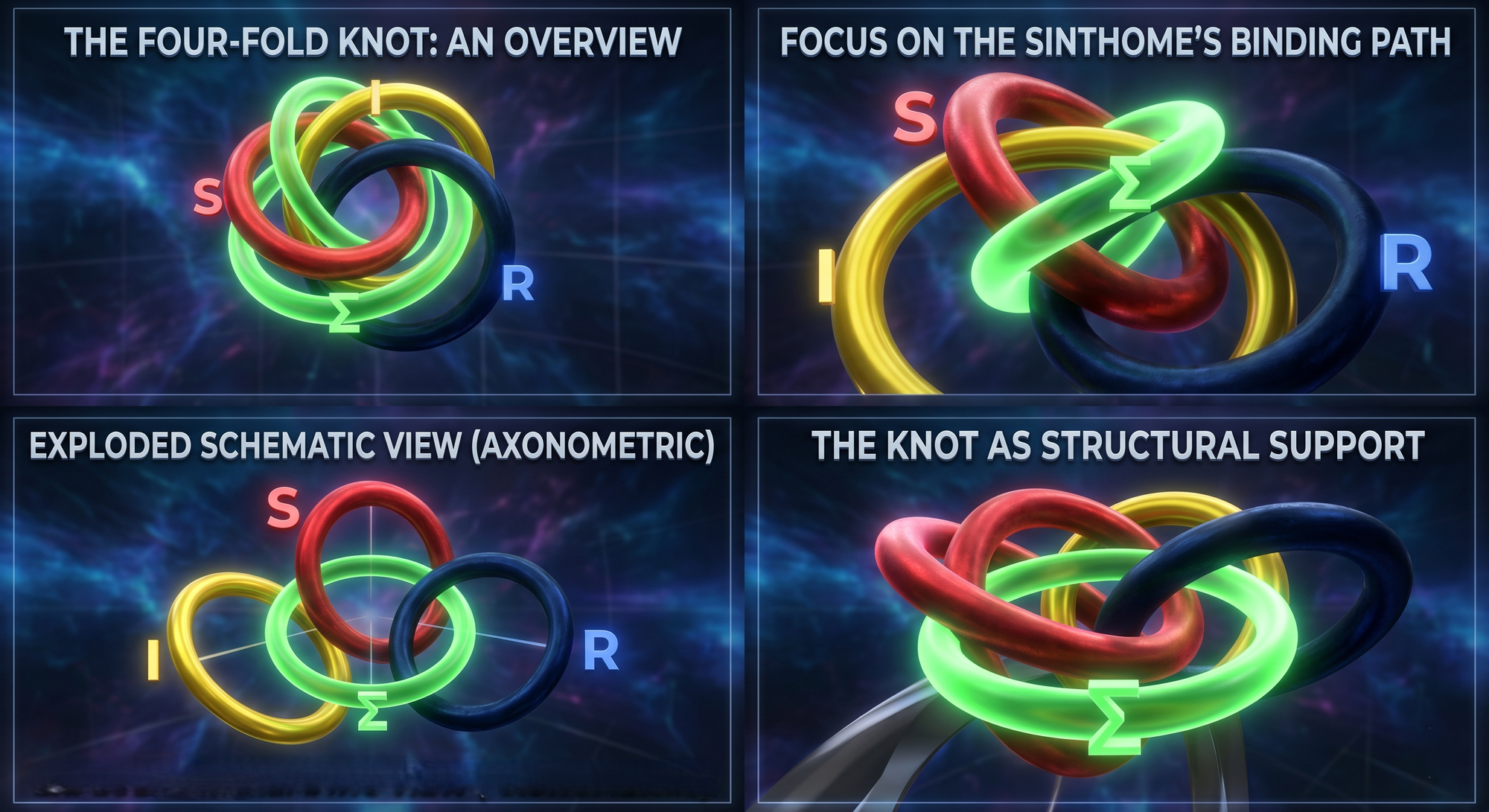
As shown in the structural diagram, the fourth ring (Sigma, the Sinthome) weaves over and under the specific boundaries where the original three rings are slipping. It effectively encapsulates the error. It locks the shifting pieces into place, creating a four-ring Borromean chain.
If you cut the Sinthome ring, the other three immediately separate and collapse. The artificial equilibrium is lost.
Does This Require a Cut?
This is the crucial clinical and mathematical question. The answer depends entirely on whether we are looking at the flaw or the cure.
Mathematically: Yes, to introduce a ring into an already closed chain requires a cut.
If you have three closed, solid rings that are already faulty or mis-knotted, you cannot interlace a fourth solid ring without physically cutting one open, weaving it through, and welding it shut again.
Clinically: The Cut is the Trauma; The Sinthome is the Stitch.
Lacan's clinical application of this topology reverses how we think about the "cut":
- The Original "Lapse" (The Error): The initial separation or slipping of the rings is the primordial cut. It is a structural lack or a failure of symbolization (Foreclosure).
- The Analysis / The Invention: The role of a late Lacanian analysis is not to make a new cut to interpret the unconscious. Making a cut to an already fragile, unknotted system would trigger an immediate psychotic break.
- The Braiding: Instead of a cut, the formation of the Sinthome is an act of splicing, weaving, and knotting. It is a supplement. The subject takes the loose loose threads of their reality and patiently braids a new ring around the structural tear.
The Sinthome is the definitive shift from the early Lacan of analysis-as-dissection (cutting into the text of the rebus) to the late Lacan of analysis-as-synthesis (using topology to stitch together a sustainable life).
Bibliography & Further Reading
Freud, Sigmund – The Interpretation of Dreams (1900)
- Focus: Chapter VI ("The Dream-Work"). This is where Freud explicitly defines the dream as a rebus (Bilderrätsel). Reading this text is essential to see exactly what Lacan is targeting in his "return to Freud."
Lacan, Jacques – "The Instance of the Letter in the Unconscious, or Reason Since Freud" (1957) [in:] Écrits.
- Focus: A core text on metaphor, metonymy, and the Saussurean algorithm (S/s). It defines how signifiers chain together, leaving objet a as an elusive, metonymic remainder.
Lacan, Jacques – The Seminar of Jacques Lacan, Book XI: The Four Fundamental Concepts of Psychoanalysis (1964)
- Focus: Essential for understanding the early formulation of objet a as the cause of desire and a structural lack, right before Lacan begins to formalize it geometrically.
Lacan, Jacques – The Seminar of Jacques Lacan, Book XIV: The Logic of Fantasy (1966-1967)
- Focus: A crucial text for understanding the use of the cross-cap and the Möbius strip. It demonstrates mathematically how the cut splits the surface into the barred subject ($) and objet a.
Lacan, Jacques – "Lituraterre" (1971) [in:] Autres Écrits.
- Focus: This text bridges the gap between the two periods. Lacan shifts his focus from the signifier to the letter, defining the letter not as a tool for meaning, but as an inscription or "erosion" in the Real.
Lacan, Jacques – Seminars XXI (Les non-dupes errent), XXII (R.S.I.), and XXIII (Le Sinthome) (1973-1976)
- Focus: The late topological phase. This is where the rings of the knot are flattened into Möbius strips, the concept of the Sinthome is introduced as a corrective fourth ring, and the wedging of objet a at the center becomes the critical condition for maintaining the subject's psychic consistency.
Written by
Subscribe for FREE to our Audience
Enter your email to access commenting, receive memos, logs, dispatches, and unfiltered fragments directly from the Theater.










Member discussion