
members only
The Architecture of Madness: Lacan, Art, and the Subject

Wersja polska jest dostępna tutaj:
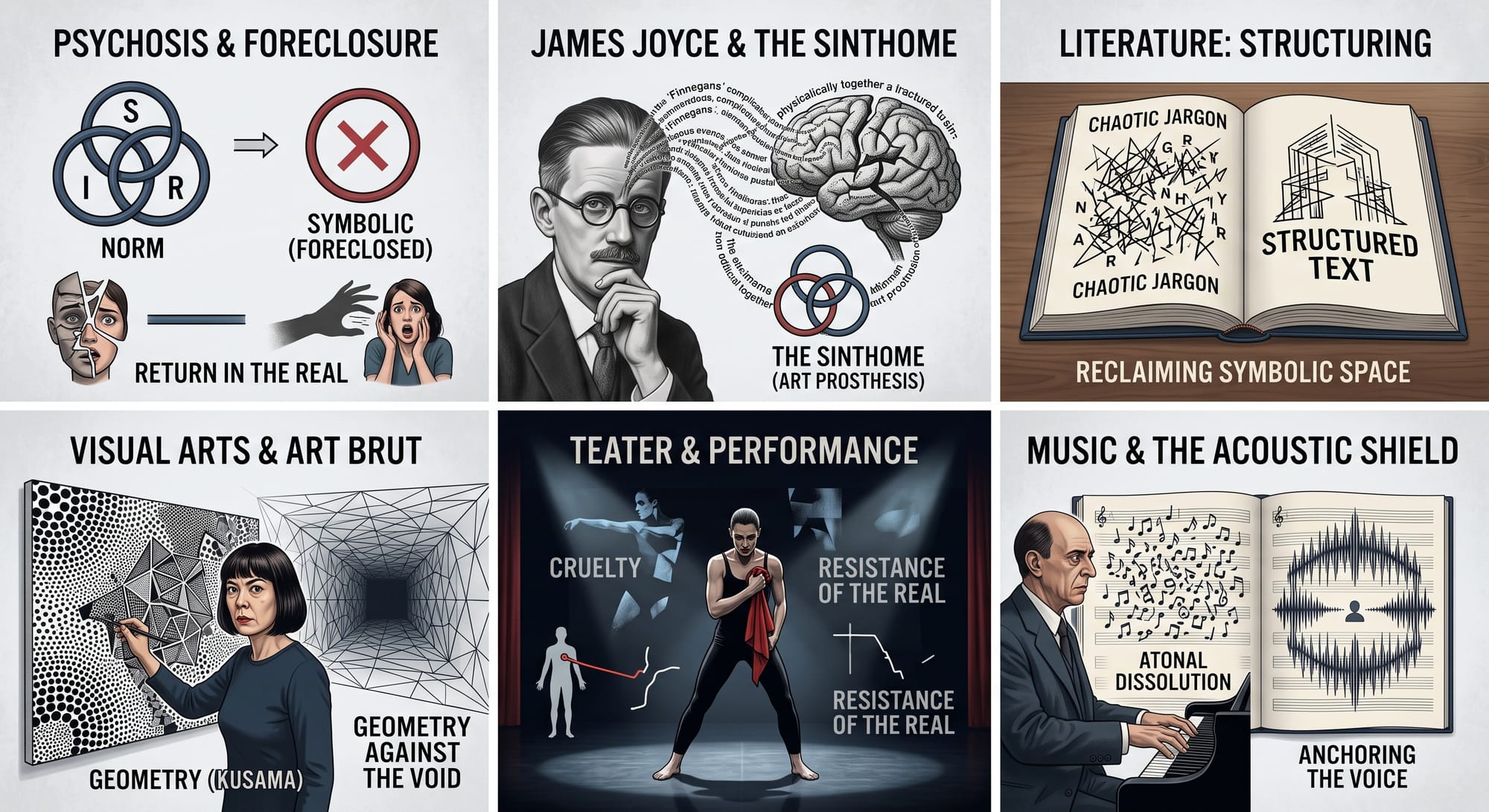
The intersection of madness, art, and psychoanalysis presents a profound shift in how the human mind is conceptualized when it strays from normative cognitive boundaries. In mainstream clinical psychiatry, madness—variously termed psychosis, insanity, or mania—is frequently categorized as a deficit: a neurological breakdown, an absence of reason, or a cognitive dysfunction requiring pharmacological correction. However, the theoretical framework developed by French psychoanalyst Jacques Lacan completely reframes this paradigm. For Lacan, psychosis is not a mere lack or damage, but a distinct structural condition of the subject characterized by a specific relationship to language, desire, and reality.
Central to Lacan’s contribution to this dialogue is his assertion that artistic creation is not just a symptom of a troubled mind, nor a simple therapeutic outlet, but a structural necessity. Through art, the subject—whether clinically psychotic or navigating the unanalyzable residues of neurosis—can construct an artificial anchor: what Lacan termed the sinthome. This fourth term stitches together a world threatened by total dissolution. By examining Lacanian structural theory across literature, the visual arts, theater, and music, we uncover how artistic expression functions as an essential defense mechanism against the terrifying abyss of madness.
Before continuing further, however, it is useful to examine the nuanced landscape of madness in art by looking at how different languages categorize its distinct states. Specifically, unlike the English language, the Polish linguistic distinction between obłęd, szaleństwo, and wariactwo offers a compelling taxonomy when mapped onto Lacanian theory:
- Obłęd: Deep Madness / Monomania. Direct, unmediated collision with the Real (le Réel). The total loss of symbolic anchors, characterized by rigid delusions or absolute somatic collapse. Examples: Antonin Artaud’s radical glossolalia; Sarah Kane's 4.48 Psychosis; raw Art Brut.
- Szaleństwo: Wildness / Transgression. A violent break from the Symbolic (le Symbolique). A heroic or terrifying step outside social norms and conventional language. Examples: Viennese Actionism; Salvador Dalí’s paranoiac-critical method; avant-garde manifestos.
- Wariactwo: Everyday Folly / "Crazy" Frenzy. Unrestrained overflow of the Imaginary (l'Imaginaire). A hyperactive, chaotic play of forms, images, and sensory noise without an anchor. Examples: Surrealist automatic collage; extreme ornamental visual art; chaotic avant-garde performance.
While szaleństwo may be a temporary artistic posture or romanticized transgression, and wariactwo a chaotic excess of imagery, obłęd represents the true structural crisis of the subject—the point where art ceases to be an aesthetic choice and becomes a vital necessity for psychological survival.
The Architecture of Psychosis: Foreclosure and the Real
In a neurotically structured mind, the three registers (The Real, The Imaginary, and the Symbolic) are tied together like a Borromean knot: if you cut one ring, the entire structure unties, but as long as all three are knotted, stability is maintained. The central organizer of this knot in the Symbolic realm is what Lacan called the Name-of-the-Father (Nom-du-Père). This foundational signifier introduces the Law, structures the Oedipal complex, and provides the subject with a "buttoning point" (point de capiton) that anchors words to their meanings and establishes a stable sense of identity.
In psychosis, however, a radical mechanism occurs: foreclosure (forclusion). Unlike neurotic repression (Verdrängung), where an uncomfortable idea is pushed into the unconscious while remaining within the Symbolic network, foreclosure involves the absolute rejection of the Name-of-the-Father from the Symbolic realm altogether.
Because the central anchor is missing, the Borromean knot cannot hold. The Symbolic order fractures, leaving the subject exposed to unmediated intrusions of the Real. Lacan famously noted that that which is foreclosed from the Symbolic returns in the Real. This return manifests as the classic symptoms of madness:
- Hallucinations: Hearing voices or seeing visions that are not symbolic metaphors, but literal intrusions into bodily reality.
- Persecutory Delusions: The sense that the universe is directly addressing the subject without the protective mediation of normal language.
- Bodily Dissolution: The terrifying sensation that one’s physical frame is fragmenting, decaying, or being controlled by external forces.
For the psychotic subject, language ceases to be a tool for abstract communication; instead, words become physical, threatening objects. The psychotic does not inhabit language—language inhabits, bombards, and oppresses the psychotic.
The Art As Sinthome: From Joyce to Universal Application
For much of his career, Lacan viewed psychosis primarily through the lens of this structural deficit. However, in his Seminar XXIII (1975–1976), titled Le Sinthome, Lacan introduced a major theoretical breakthrough through a deep reading of the Irish novelist James Joyce.
Lacan posed an intriguing diagnostic question: Why did James Joyce, whose writings exhibit clear features of a psychotic language structure, never experience an overt clinical psychotic break? Joyce suffered from severe bodily detachment, produced texts that dismantled standard syntax, and exhibited an idiosyncratic relationship with his environment. Yet, he remained functional, famous, and mentally intact throughout his life.
Lacan’s answer was that Joyce created an artificial fourth ring to hold his failing Borromean knot together. This fourth element is the sinthome (an archaic spelling of "symptom").
Unlike a standard psychiatric symptom (symptôme), which is a sign of underlying pathology to be deciphered and dissolved through interpretation, the sinthome is a creative, singular invention that substitutes for the missing Name-of-the-Father. Joyce accomplished this through his radical manipulation of literary language. In works like Ulysses and especially Finnegans Wake, Joyce dismantled English grammar, spliced together dozens of languages, and wove complex multilingual puns into an impenetrable textual tapestry.
By making a name for himself through this unreadable, monumental style, Joyce bound his ego to his art. His writing acted as a structural prosthesis; it was the "glue" that prevented his Symbolic, Imaginary, and Real registers from flying apart into full-blown madness. Art, in the Lacanian sense, was not a reflection of Joyce's genius—it was his psychic life raft.
Extending the Sinthome Beyond Psychosis
Crucially, Lacan did not restrict the sinthome strictly to un-triggered psychosis. In his late teaching, Lacan generalized the sinthome across the entire clinical spectrum, reducing the classic Name-of-the-Father to merely one standard version of a fourth ring.
Post-Lacanian theorists have further expanded this framework. Jacques-Alain Miller mobilized the late Lacanian sinthome to conceptualize "ordinary psychosis"—cases that lack overt hallucinations or delusions but rely on subtle, compensational sinthomes (such as a rigid professional identity or a hyper-specific hobby) to remain stable. Slavoj Žižek extended the sinthome into ideological and philosophical analysis, arguing that every subject—neurotic or psychotic—relies on an unanalyzable, non-sensical kernel of enjoyment (jouissance) to anchor their reality. Bruce Fink highlighted how late Lacanian clinical practice redefines the end of analysis for neurotic subjects: the goal shifts from decoding the symptom to transforming an unresolvable residue of suffering into a workable, stabilizing sinthome.
Artistic Expressions as Stabilizing Architectures
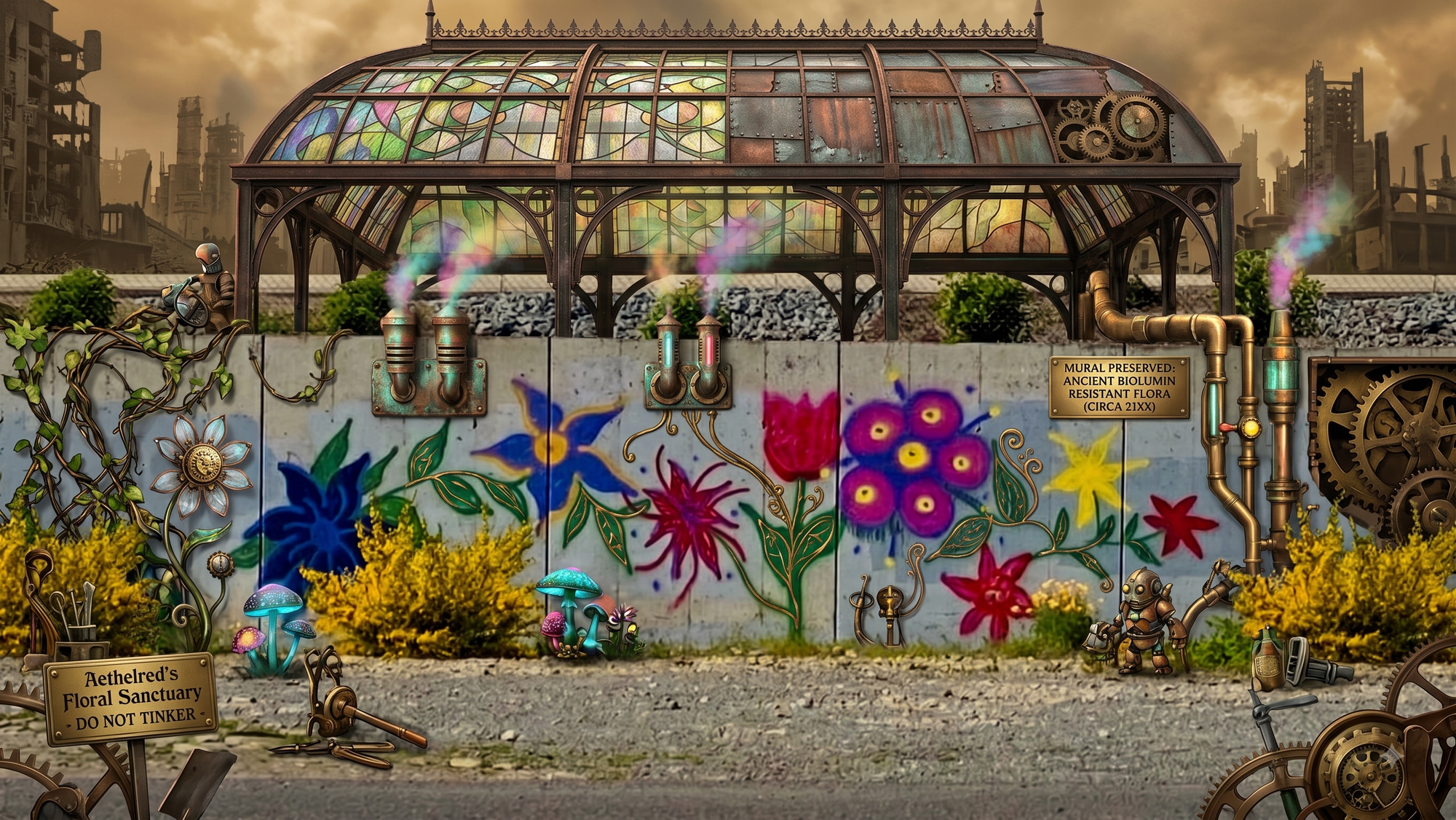
When expanded across artistic disciplines, Lacan’s concept of art-as-stabilization reveals how different media offer unique methods for binding the terrifying intrusion of the Real.
Literature: Repairing the Shattered Signifier
Because literature operates directly within the medium of language, it is the primary battleground for the psychotic subject. When foreclosure occurs, narrative coherence breaks down, but literature allows the writer to reconstruct an alternative linguistic framework.
- Standard Language: Symbolic anchor intact / Metaphors function; meaning is shared and stable.
- Foreclosed Language: Broken Symbolic order / Words become physical objects; persecutory and unanchored.
- Literary Sinthome: Deconstructed language / Construction of a personal Symbolic anchor (e.g., Joyce, Artaud).
The French playwright and poet, Antonin Artaud, experienced profound bouts of madness and spent years in psychiatric institutions. Artaud’s poetry abandoned conventional syntax in favor of glossolalia, screams, and visceral, bodily sounds. In a Lacanian sense, Artaud was attempting to write directly from the Real of the body, bypassing the corrupt Symbolic order that he felt had stolen his mind. His textual fragments served as a desperate attempt to mark his existence on the page.
In Polish modernist literature, Stanisław Ignacy Witkiewicz (Witkacy), explored the terror of existential dissolution through his theory of "Pure Form." Facing the collapse of societal meaning and individual identity, his literary and theatrical works used absurd, hyper-logical, and manic dialogues to stave off the encroaching void of existential horror (obłęd).
Visual Arts and Art Brut: Geometries Against the Void
In the visual realm, the psychotic subject often experiences the dissolution of the ego's visual boundaries—a breakdown of the Imaginary register. Visual art provides a tangible spatial container to defend against this erosion.
The celebrated Japanese artist, Yayoi Kusama, has voluntarily lived in a psychiatric facility since 1977. Kusama suffers from intense visual hallucinations consisting of endless fields of dots and repetitive patterns that threaten to engulf her perception. Her art—manifested in giant installations, painted canvases, and polka-dotted objects—is an act of "self-obliteration." By manually covering surfaces with infinite dots, she projects her internal hallucinations onto the external world, turning a terrifying passive experience into an active, controlled artistic ritual. Her art is a classic sinthome that keeps her psychosis stabilized.
Art Brut: Adolf Wölfli, a patient at the Waldau clinic in Switzerland, produced thousands of complex, densely packed illustrations featuring intricate geometric patterns, invented musical notation, and personal mythologies. This extreme horror vacui (fear of empty space) is characteristic of psychotic art. Filling every millimeter of paper with lines and symbols is a structural effort to wall off the chaotic void of the Real.
Theater and Performance: The Body as the Stage of the Real
In performance art and theater, the medium is no longer ink or paint, but the physical human body. When the Symbolic order collapses, the physical body often becomes the primary locus of suffering. Performance art allows the artist to re-stage this somatic trauma within a controlled framework.
Formulated by Antonin Artaud, the theatrical philosophy of The Theater of Cruelty rejected text-based drama in favor of raw gesture, light, sound, and physical confrontation. Artaud sought to create a theater that bypassed intellect and struck directly at the audience's nerve centers, mirroring the unmediated force of the Real.
In Viennese Actionism, artists like Günter Brus and Hermann Nitsch engaged in extreme, violent performances involving self-mutilation, blood, and animal viscera. In Lacanian terms, these acts represented a radical confrontation with the bodily Real. By intentionally inflicting wounds or exposing bodily fluids, the actionists rendered explicit the hidden, fragmented nature of the psychotic body, transforming abjection into a ritualized spectacle.
The British playwright Sarah Kane's final work, 4.48 Psychosis, written shortly before her suicide, lacks traditional characters or stage directions. The text represents the raw fragmentation of a mind dissolving into severe depression and psychosis. The title refers to the early morning hour when Kane often awoke in a state of lucid agony. The play stands as a harrowing theatrical testament to the moment when artistic structure can no longer hold back the overwhelming weight of the Real.
Music: Navigating the Voice as Objet Petit a
In Lacanian psychoanalysis, the human voice—when detached from linguistic meaning—is classified as an objet petit a: a remnant of the Real that escapes symbolic integration. Music, operating primarily through sound rather than semantic language, interacts directly with this primordial acoustic dimension.
Atonality and Serialism: The shift from traditional harmonic structures to twelve-tone serialism (pioneered by Arnold Schoenberg) mirrors the loss of the "buttoning point" in language. Tonal music relies on a foundational key (the "home" key) that functions much like the Name-of-the-Father, organizing all other notes around its hierarchy. Atonal music removes this central anchor, creating a soundscape where every note is equal, evoking the floating, unanchored orientation of the psychotic subject.
Operatic Expressionism: Schoenberg’s monodrama Erwartung ("Expectation") portrays a woman wandering through a dark forest in a state of extreme panic and delusion. The music lacks recurring themes or harmonic resolution, mirroring the chaotic, unfiltered stream of psychotic terror.
Drone and Minimalist Music: Conversely, artists like La Monte Young or contemporary ambient/drone musicians use hyper-repetitive, sustained frequencies to construct an acoustic shield. Much like Wölfli's dense drawings or Kusama's repetitive dots, these continuous soundscapes block out the intrusive, chaotic acoustic noise of the unconscious.
The Sinthome vs. Sublimation in Clinical Practice
To fully appreciate the clinical weight of the sinthome, it must be further distinguished from two related concepts: Freud's sublimation and the traditional analytic view of the symptom.
Freudian sublimation (Sublimierung) involves diverting sexual drive energy away from its immediate goal toward a socially elevated, culturally recognized achievement. In contrast, the Lacanian sinthome is not created for social validation or cultural prestige. Its function is strictly structural and clinical: it binds jouissance directly to keep the psyche from unravelling. Whether the resulting art is acclaimed (like Joyce) or confined to an asylum drawer (like Wölfli) is irrelevant to its sinthomic success.
In late Lacanian technique, handling the sinthome requires the analyst to abandon the search for underlying meaning. The analyst uses scansion (variable-length session cuts) and equivocation to strip speech down to lalangue—the raw acoustic, material quality of words. Rather than attempting to "cure" or interpret the patient's core trait, the analyst helps the patient develop a savoir-faire ("knowing-what-to-do-with") their sinthome, turning a disruptive fixation into a durable subjective architecture.
The Artist as the Teacher of Psychoanalysis
Throughout his writings, Jacques Lacan maintained a remarkably humble stance toward artistic creation. He famously declared that in matters of the human psyche, the artist always precedes the psychoanalyst. Analysts do not need to "interpret" or "explain" art through clinical concepts; rather, it is the artist who discovers intuitive solutions to psychological impasses long before theory can articulate them.
When viewed through this Lacanian lens, the relationship between art and madness is radically transformed. Madness is not a poetic gift, nor is art a simple byproduct of mental illness. Rather, for those facing the terrifying dissolution of their mental framework, art serves as a masterwork of psychic engineering. Where the Symbolic order fails, the artist picks up the brush, the pen, the instrument, or the body, constructing a singular, redemptive architecture—a sinthome—that stands firm against the void of the Real.
Bibliography
Artaud, Antonin. The Theater and Its Double. Translated by Mary Caroline Richards. New York: Grove Press, 1958.
Evans, Dylan. An Introductory Dictionary of Lacanian Psychoanalysis. London: Routledge, 1996.
Fink, Bruce. A Clinical Introduction to Lacanian Psychoanalysis: Theory and Technique. Cambridge, MA: Harvard University Press, 1997.
Foucault, Michel. Madness and Civilization: A History of Insanity in the Age of Reason. Translated by Richard Howard. New York: Vintage Books, 1988.
Freud, Sigmund. "Analysis Terminable and Interminable" (1937). In The Standard Edition of the Complete Psychological Works of Sigmund Freud, Volume XXIII, edited by James Strachey, 209–254. London: Hogarth Press, 1964.
Joyce, James. Finnegans Wake. London: Faber and Faber, 1939.
Kane, Sarah. Complete Plays: Blasted, Phaedra's Love, Cleansed, Crave, 4.48 Psychosis. London: Methuen Drama, 2001.
Kusama, Yayoi. Infinity Net: The Autobiography of Yayoi Kusama. Translated by Ralph McCarthy. London: Tate Publishing, 2011.
Lacan, Jacques. The Seminar of Jacques Lacan, Book III: The Psychoses 1955–1956. Edited by Jacques-Alain Miller. Translated by Russell Grigg. New York: W. W. Norton & Company, 1993.
Lacan, Jacques. The Seminar of Jacques Lacan, Book VII: The Ethics of Psychoanalysis 1959–1960. Edited by Jacques-Alain Miller. Translated by Dennis Porter. New York: W. W. Norton & Company, 1992.
Lacan, Jacques. Le Séminaire, Livre XXIII: Le Sinthome (1975–1976). Edited by Jacques-Alain Miller. Paris: Éditions du Seuil, 2005.
Lacan, Jacques. Écrits: The First Complete Edition in English. Translated by Bruce Fink. New York: W. W. Norton & Company, 2006.
Leader, Darian. What is Madness? London: Hamish Hamilton, 2011.
MacCabe, Colin, ed. James Joyce and the Revolution of the Word. London: Palgrave Macmillan, 2002.
Miller, Jacques-Alain. "Ordinary Psychosis Revisited." Psychoanalytical Notebooks 19 (2009): 139–167.
Thévoz, Michel. Art Brut. New York: Rizzoli, 1976.
Žižek, Slavoj. The Sublime Object of Ideology. London: Verso, 1989.
Written by
Subscribe for FREE to our Audience
Enter your email to access commenting, receive memos, logs, dispatches, and unfiltered fragments directly from the Theater.








Member discussion