The Avant-Garde Art, the (Human) Subject & the Future of Psychoanalysis


Wersja polska jest dostępna tutaj:
What the Avant-Garde Discovers for the Future of Psychoanalysis and the Contemporary Subject
If Lacan’s thesis holds - that "the artist always precedes the psychoanalyst"- then contemporary movements across art, sound, theater, digital materialism, and subaltern practice are advanced clinical diagnoses. As I discussed in The Aesthetics of Friction and the Topology of the Unconscious, they reveal structural shifts within the human subject under the weight of algorithmic capitalism, predictive AI, and digital surveillance.
By reading what artists anticipate before theory ("precognize"), Lacanian psychoanalysis can prepare to treat new forms of psychic suffering. Classical psychoanalysis developed in an era of Victorian sexual repression and paternal authority (the Oedipal family). Today’s subject suffers from a different psychopathology: algorithmic saturation, the collapse of symbolic anchors, ordinary psychosis (psychose ordinaire), and confinement in the loop of the Drive, as we have already started to explore in The Screen, the Specular, and the Short-Circuit: A Cross-Sequential Lacanian Analysis of the Digital Generation and will continue to explore further next week.
Precognition I: The Subject Suffers from "Imaginary Saturation" (Loss of Lack)
- What Artists Show: The pursuit of heavy surfaces, raw clay, biological decay, tape drift, and 3D-printed earth reveals that the hyper-smooth digital image cannot sustain human desire.
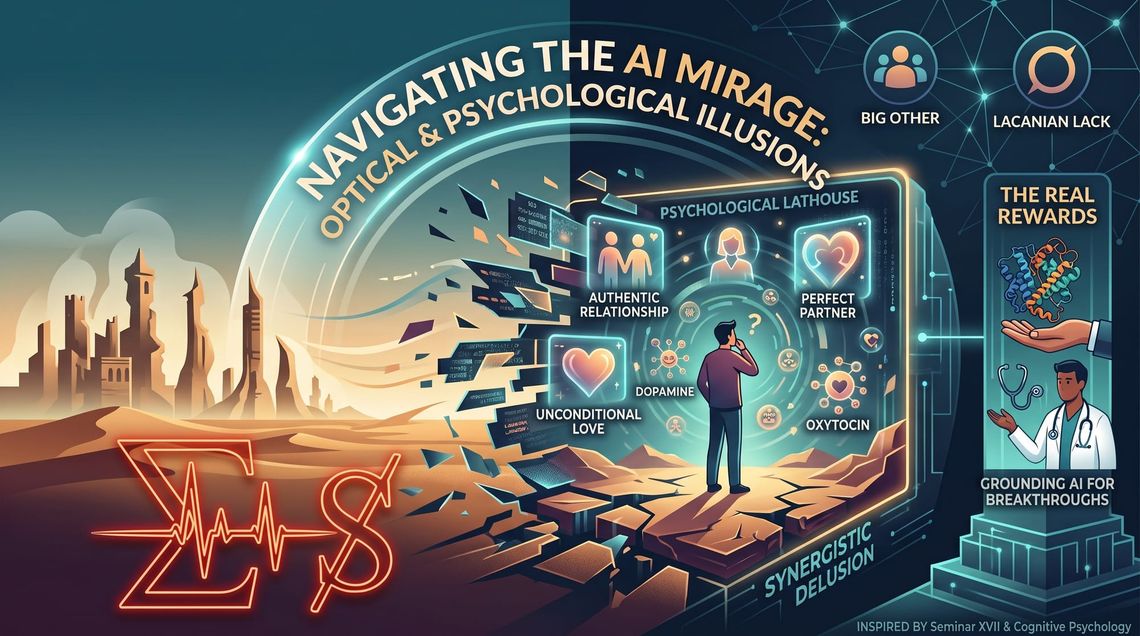
- Psychoanalytic Diagnosis: In classical analysis, neurosis stems from repression—the subject is denied access to drive by paternal law. Today’s algorithmic Big Other does not repress; it over-saturates. Recommendation engines and generative AI attempt to satisfy every demand before it can form into desire.
- Drive (Trieb) vs. Desire: Platforms bypass Desire (which requires a gap and waiting) and exploit Drive (Trieb). Algorithms lock the user into a loop of short-term Jouissance. The user consumes content because the repetitive cycle enforces satisfaction.
- Clinical Consequence: When the Imaginary register is saturated with smooth images, the subject experiences a collapse of objet petit a (the structural gap driving desire). The result is anhedonia, panic, and psychic suffocation. The contemporary patient comes to analysis crushed by the imperative of the superego: "Enjoy!"
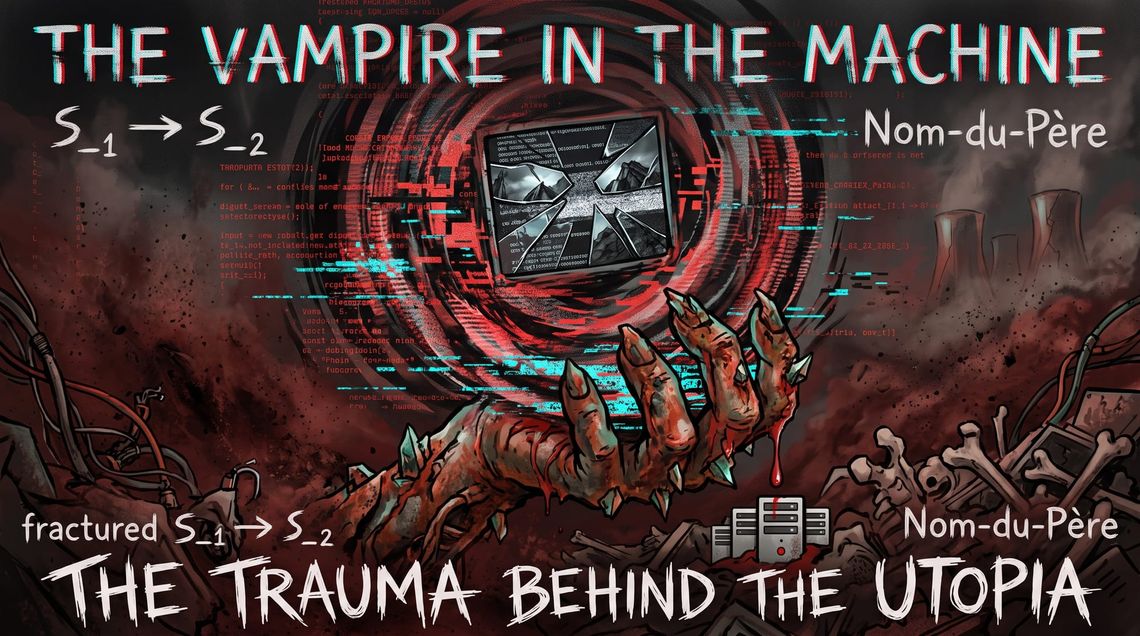
Precognition II: Decline of the Name-of-the-Father and Rise of "Ordinary Psychosis"
- What Artists Show: The shift toward fragmented, non-linear, glitched digital materialism shows that traditional organizing narratives have lost their anchoring power.
- Psychoanalytic Diagnosis: Classical Lacanian theory postulated the Name-of-the-Father (Nom-du-Père) as the central metaphor anchoring the Symbolic Order and protecting the subject from psychosis. In contemporary culture, the Name-of-the-Father has been weakened, replaced by a hyper-plurality of corporate Big Others (Google, Meta, OpenAI).
- Ordinary Psychosis in the Digital Era: As Jacques-Alain Miller and Éric Laurent formulate, the lack of a stable symbolic anchor results in Ordinary Psychosis (psychose ordinaire)—a discrete, un-triggered psychotic structure characterized by deep disembodiment, identity fragility, and subjective discretion.
The obsession with dragging digital code into physical friction (clay printing, biological rot, unrecordable theater) is an aesthetic attempt to construct a physical anchor for a subject whose symbolic order is unraveling.
Precognition III: Subjectivity Has Evacuated into the Somatic/Semiotic Chora
- What Artists Show: The turn toward bio-sensing performances, field recordings, and olfactory installations demonstrates that because human syntax is duplicated by large language models (LLMs), human identity can no longer rest exclusively in conscious thought ("I think, therefore I am").
- Psychoanalytic Diagnosis: The Symbolic Order has been automated and commercialized. When language is generated by predictive AI, patients experience alienation from their own words ("The language I speak belongs to the platform").
- Clinical Consequence: The true site of resistance has shifted into Kristeva’s chora—the uncodeable physical body, visceral reactions, biological rhythms, somatic anxiety, and pre-linguistic drives. Patients present with somatic symptoms, panic attacks, chronic fatigue, and bodily crises that resist cognitive-behavioral framing.
Precognition IV: Psychic Survival Requires "Opacity" and a Custom Sinthome
- What Artists Show: The queer, trans, and subaltern movement toward Glitch Feminism, non-binary opacity, bio-hacking, and off-grid performance demonstrates that total legibility to the Big Other is psychically lethal.
- Digital Necropolitics and Surveillance: Drawing on Mbembe and Fanon, artists show how algorithms exercise Digital Necropolitics—granting "algorithmic life" to profitable identities while non-indexable subjects are condemned to "digital death" (shadowbanning).
- The Sinthome as a Survival Tool: In Seminar XXIII, Lacan showed that when the standard Borromean knot unravels, the subject can forge a Sinthome—a fourth knot, an invented structural symptom that holds psychic coherence. Gender transition, bio-art, bio-hacking, and glitch aesthetics represent contemporary Sinthome creations—topological inventions allowing the subject to construct a stable existence outside corporate databases.
Inquiries into Future Human–Theater–Technology Relations
I would be amiss not to mention that on the other end of the AI and the Digital Era in the Arts spectrum, the current dialogue also explores how AI and digital culture influences the artistic expression and the consumption of the arts. For example, in Poland, Polish researchers, scholars, and artists are invited to submit proposals addressing issues related to the future of extended theater from technological, artistic, and humanistic perspectives as part of the Open Stage of the Zbigniew Raszewski Theater Institute's 2026 National Symposium: Extended Theater in 2045.
Specifically, they are interested in speculative scenarios, thought experiments, and practical inquiries into future human–theater–technology relations in areas such as:
Non-Human Body and Non-Human Performer
- Cyberkinetic, immersive costumes.
- Digital avatars coexisting on stage with live actors, generated in real time—including by the audience itself—and rendered in 3D, or speculatively in hyperdimensions beyond traditional theatrical space.
- Humanoid and non-humanoid robots as performers capable of autonomous stage improvisation.
- Soft robotics: organic, flexible in movement, blurring the boundaries between costume, prop, and autonomous performing body.
Space, Matter, and Light
- Interactive holography and large-scale multi-projections.
- Kinetic stage design and staging that can transform live, as well as fluid stage matter capable of spontaneous metamorphosis in form, color, and texture.
- Light as an autonomous, "intelligent" performer—programmable, responding to biometric data, sound, and movement, and speculatively an immaterial "actor" capable of its own improvisation and building stage dramaturgy.
- Virtual, augmented, mixed, and hyper-reality in advanced stages within theater.
Audience and Participation
- New forms of techno/participation.
- Biometric data collection to generate live visualizations showing audience reactivity levels.
- Non-human audience members.
Network, Connectivity, and Global Scale
- Development of telepresence and simultaneous public presentations across different locations—moving toward theatrical polyportals.
- SuperSuperAI and its potential applications.
- Telepathic communication and teleportation between stages across different countries/continents.
Per Conference organizers, this list is open and inspirational—it does not exhaust all possibilities, but outlines directions for speculative thinking. The only constraints are ethical considerations and the care to ensure technology remains a consciously chosen creative partner rather than a substitute for human action.
Clinical Implications: Why the Lacanian Orientation Holds Unique Tools
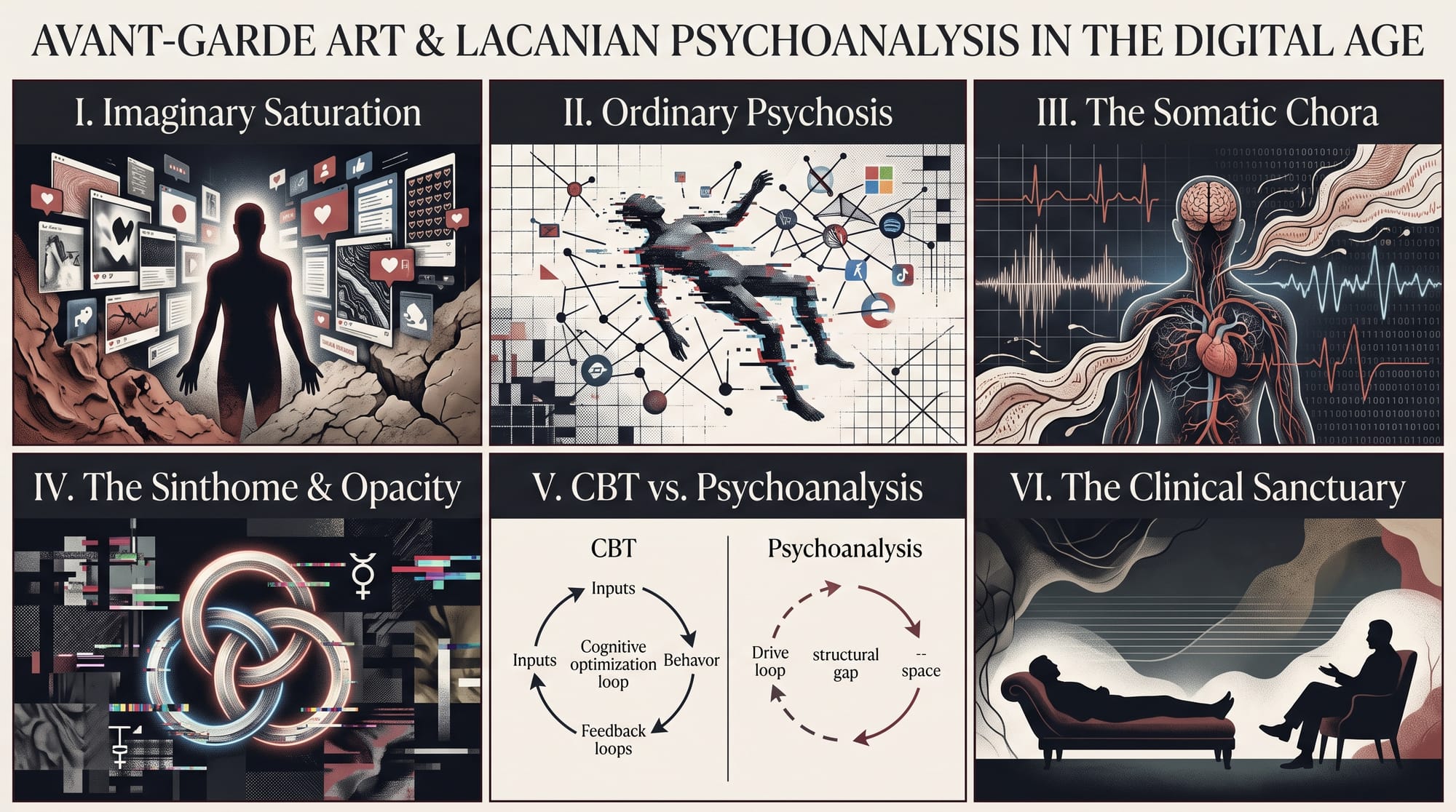
In the face of these new forms of suffering, conventional therapy—such as Cognitive Behavioral Therapy (CBT)—often exacerbates the problem. CBT frequently acts as an agent of the Digital Big Other: encouraging the patient to "reframe" anxiety, optimize cognitive efficiency, and adapt to a hyper-quantifiable world. It attempts to repair the "glitch" rather than listen to what the glitch expresses.
Core Clinical Dimensions
- Primary Goal: Conventional therapy focuses on adaptation, re-framing, and optimization, whereas Lacanian psychoanalysis focuses on uncovering the subject's truth and recovering desire.
- Symptom Stance: Conventional therapy views the symptom as a dysfunction or glitch to be removed, whereas Lacanian psychoanalysis views it as a knotted Sinthome or message from the Real.
- Relation to Language: Conventional therapy uses standardized, transparent communication, whereas Lacanian psychoanalysis uses punctuation, scansion, and listening to slips of the unconscious.
- Platform Stance: Conventional therapy encourages adaptation to platform life, whereas Lacanian psychoanalysis creates spaces of opacity and shatters the Drive loop.
Restoring the Gap (Shattering the Drive Loop)
The Lacanian analyst operates through scansion (variable-length sessions) and punctuation. By cutting the session on an ambiguous word, hesitation, or slip of the tongue, the analyst interrupts the patient’s smooth digital narrative. The analyst refuses to play the role of the omniscient Big Other, re-creating the structural gap (objet petit a) necessary for the patient's desire to emerge.
Working with Ordinary Psychosis Without Stigmatization
In Ordinary Psychosis, the analyst does not dismantle the patient's defense mechanisms. Instead, the analyst acts as a "secretary to the subject" or a discrete support, helping the patient stabilize fragile identifications and supporting the construction of a custom Sinthome.
Listening to the Semiotic Chora Over Capitalized Syntax
The analyst pays close attention to the semiotic material of vocalization: tone, rhythm, sighs, somatic tremors, and slips. The consulting room becomes a sanctuary where the uncodeable somatic truth can exist without immediate conversion into data.
Honoring the Right to Opacity
Drawing on Fanon, Glissant, and Glitch Theory, the analyst respects the Patient's Right to Opacity. The consulting room is not an interrogation chamber; the patient is not obligated to reveal everything or make themselves legible. Psychoanalysis validates that which is secret, uncatalogued, and unquantifiable in human experience.

Bibliography
Fanon, F. (2004). The wretched of the earth (R. Philcox, Trans.). Grove Press.
Glissant, É. (1997). Poetics of relation (B. Wing, Trans.). University of Michigan Press.
Kristeva, J. (1982). Powers of horror: An essay on abjection (L. S. Roudiez, Trans.). Columbia University Press.
Kristeva, J. (2000). Sense and non-sense of revolt: The powers and limits of psychoanalysis (J. Herman, Trans.). Columbia University Press.
Lacan, J. (2016). The seminar of Jacques Lacan, Book XXIII: The sinthome (A. Price, Trans.; J.-A. Miller, Ed.). Polity Press.
Laurent, É. (2014). Lost in cognition: Psychoanalysis and the cognitive sciences (A. Price, Trans.). Karnac Books.
Mbembe, A. (2019). Necropolitics (S. Corcoran, Trans.). Duke University Press.
Miller, J.-A. (2009). Ordinary psychosis revisited. Psychoanalytic Notebooks, 19, 139–168.
Preciado, P. B. (2019). An apartment on Uranus: Chronicles of the crossing (C. Mandell, Trans.). Semiotext(e).
Russell, L. (2020). Glitch feminism: A manifesto. Verso.
Žižek, S. (2007). How to read Lacan. W. W. Norton & Company.
Written by
Subscribe for FREE to our Audience
Enter your email to access commenting, receive memos, logs, dispatches, and unfiltered fragments directly from the Theater.







Member discussion