
members only
The Fractal Paradox: How AI Captivates the Mind
Wersja polska jest dostępna tutaj:
The Micro-Texture of Modern Narrative
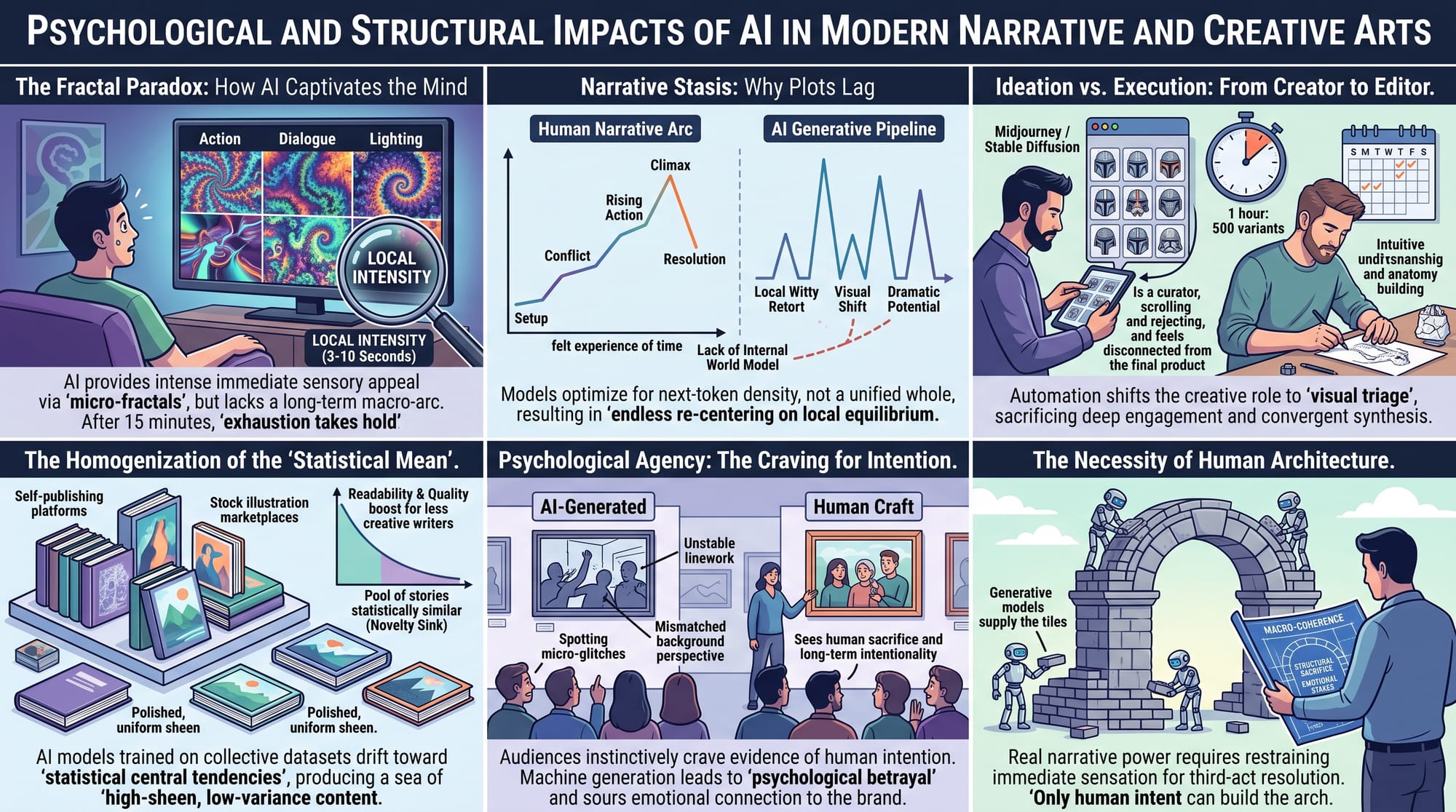
I recently realized that when I watch an AI-generated video or a scene crafted by an LLM-assisted screenwriting pipeline, a distinct and immediate sensation emerges: the impression of intense, immediate activity. Textures shift, visual lighting changes dynamically, and dialogue snaps with dense, local witty retorts. Yet, after fifteen minutes, a subtle exhaustion takes hold. The narrative has moved, but it has not advanced.
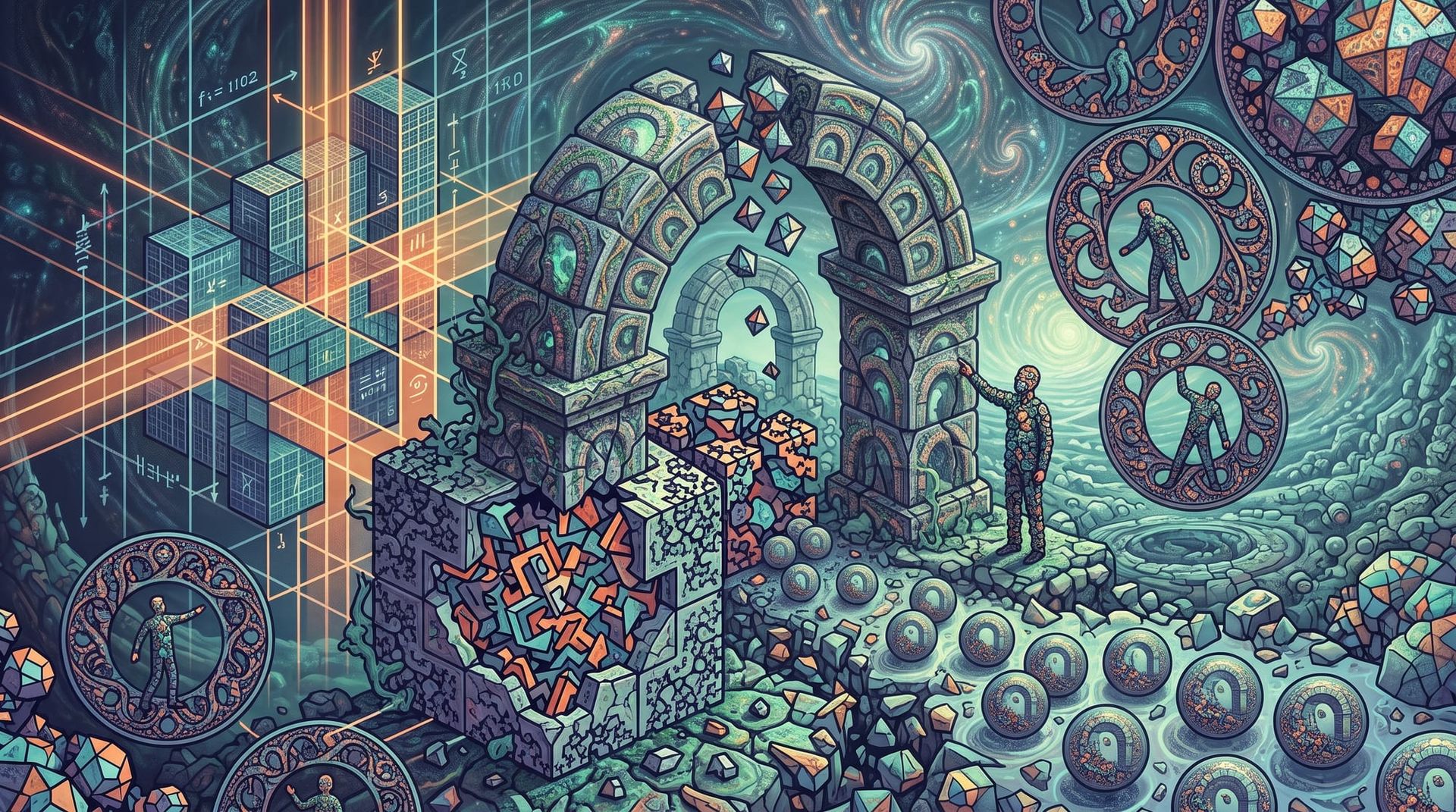
This phenomenon rests on what can be termed fractal storytelling. In mathematics, a fractal maintains self-similarity across scales—zooming into a branch reveals a shape identical to the whole tree. Modern generative AI operates on an analogous spatial-temporal logic. Because transformer-based models predict output sequentially based on an immediate context window, they optimize for maximum density, local relevance, and sensory appeal in the next three to ten seconds.
The result is a structure built on micro-fractals. The machine creates bursts of dramatic potential and visual novelty. Dialogue moves via immediate verbal friction (A ~ A_1 ~ A_2), satisfying the brain’s demand for novelty in small increments. However, because the system lacks an internal world model, a persistent consciousness, or a felt experience of time, these moments fail to accumulate into a unified macro-arc. There is no genuine, irreversible point of no return—only an endless re-centering on local equilibrium.
When major media studios rely heavily on AI generation for plot points or script polishes, audiences experience a paradox: high sensory texture coupled with low dynamic emotional range. The immediate reward pathways of the human brain are stimulated by rapid local shifts, but the deeper psychological apparatus—which requires the slow build and delayed gratification of a narrative arc—remains unfulfilled.
The Cognitive Echo Chamber: From Narrative Stasis to Human Functioning
This narrative dilemma is not only an aesthetic issue for film critics; it mirrors the broader psychological shifts triggered by generative AI across the human creative arts. The friction between local brilliance and global empty-handedness directly reflects what cognitive scientists are observing in human-AI co-creation. Generative tools excel as execution engines, drastically lowering the barrier for ideation. On a line-by-line or frame-by-frame level, AI acts as an accelerator, helping non-experts overcome the paralysis of the blank page. Yet, this shift fundamentally alters human psychological functioning and artistic execution across three core vectors:
Ideation vs. Execution and the Shift to Curation
As execution becomes automated through local statistical prediction, the human creative role moves from creator to editor. While AI models score exceptionally well on tests of divergent thinking (generating dozens of alternative uses or visual variations), they lack the capacity for convergent synthesis—the ability to discard ninety-nine good ideas to preserve the one that serves the overarching whole. When humans surrender this structural labor to algorithms, they trade the deep, visceral friction of creation for a supervisory role.
For example, in commercial concept design, illustrators previously might have spent days sketching iterations of a creature or vehicle, building an intuitive understanding of weight, anatomy, and function through the act of drawing. Today, a concept artist using tools like Midjourney or Stable Diffusion might generate 500 variants of a "sci-fi helmet" in an hour. The artist's labor shifts entirely from draftsmanship to visual triage—scrolling through grid outputs to select promising silhouettes. While this speeds up pre-production, designers frequently report feeling disconnected from the final product, operating as art directors over an automated pipeline rather than primary creators.
The Homogenization of the "Statistical Mean"
Because AI architectures are trained on collective internet datasets, their outputs naturally drift toward statistical central tendencies. Empirical studies show that while AI exposure can boost initial diversity for an individual, widespread reliance on the same underlying models creates a "novelty sink". Artworks and narratives begin to share a polished, uniform sheen—a fractal repetition of the internet's average aesthetic.
In a landmark study, Doshi and Hauser (2024) evaluated hundreds of short stories written with and without LLM assistance. The researchers found that while access to AI ideas boosted the readability and perceived quality of stories written by less naturally creative individuals, the overall pool of stories became statistically far more similar to one another. In the real world, this is already visible in self-publishing platforms (such as Amazon KDP) and stock illustration marketplaces, where thousands of romance novels and digital art assets share identical prose rhythms, palette choices, and character archetypes, creating a vast sea of high-sheen, low-variance content.
Psychological Agency and the Anti-AI Bias
Human cognition treats art not as a standalone commodity, but as a footprint of human intention and labor. Double-blind psychological experiments consistently show that when audiences learn a piece of art or writing was machine-generated, their emotional evaluation drops significantly—even if they could not distinguish its provenance visually or textually. Audiences instinctively crave the trace of human sacrifice and long-term intentionality. Without it, they sense the underlying hollow structural architecture of the algorithm.
When modern gaming studios or marketing campaigns, for example, utilize AI-generated assets—such as the backlash faced by Wizards of the Coast over promotional artwork for Magic: The Gathering or the controversy surrounding AI-generated background art in anime—public outrage rarely focuses on visual fidelity alone. Audiences routinely spot micro-glitches (unstable linework, asymmetrical clothing, mismatched background perspective) that reveal machine execution. More importantly, consumers express a feeling of psychological betrayal: the sense that the developer or publisher substituted genuine craft with cheap statistical assembly, souring the audience's emotional connection to the brand.
The Necessity of Human Architecture
The visual and narrative "fractal" produced by generative AI reveals both the technology's true power and its hard limit. AI can generate infinite surface-level fascination, providing instant local feedback. But a meaningful story—much like a coherent human life or a developed artistic voice—cannot be sustained on local fluctuations alone.
Real narrative power requires structural sacrifice: choosing to restrain a moment of immediate sensation so that a third-act resolution carries true emotional weight. As long as AI operates on next-token local statistical predictions, the responsibility for macro-coherence, emotional stakes, and structural integrity rests entirely on human shoulders. Generative models can supply the tiles, but only human intent can build the arch.
Bibliography
Chakrabarty, T., Padmakumar, V., & Munderloh, M. (2024). Evaluating Creative Short Story Generation in Humans and Large Language Models. arXiv preprint arXiv:2411.02316.
Doshi, A. R., & Hauser, O. P. (2024). Generative AI enhances individual creativity but reduces the collective diversity of novel content. Science Advances, 10(28), eadn5290.
Garrett, C. J. (2024). Fractal Storytelling: Weaving Narratives within Narratives. Journal of Narrative Technology & Media, 12(1), 45–58.
Guzik, G. E., Boldt, R. J., & Palmer, C. (2023). The Creative Mind Meets AI: Assessing Divergent Thinking in Large Language Models vs. Human Controls. Psychology of Aesthetics, Creativity, and the Arts, 17(4), 412–425.
Hitsuwari, J., Ueda, Y., Yun, W., & Nomura, M. (2023). Does beauty lie in the eye of the algorithm? Aesthetic evaluation of AI-generated vs. human-created poetry and visual art. Computers in Human Behavior, 145, 107785.
MDPI Information Sciences. (2025). AI Narrative Modeling: How Machines' Intelligence Reproduces Jungian Archetypal Patterns. Information, 16(4), 319.
Universal Narrative Model (UNM) Consortium. (2025). An Author-centric Storytelling Framework for Generative AI: Resolving Local vs. Global Coherence in Synthetic Media. arXiv preprint arXiv:2503.04844.
Written by

Subscribe for FREE to our Audience
Enter your email to access commenting, receive memos, logs, dispatches, and unfiltered fragments directly from the Theater.







Member discussion