The Void & the Topologically Informed Clinic

Intro Overview / Wprowadzenie
"Prelude": Click here for the Intro level Overview
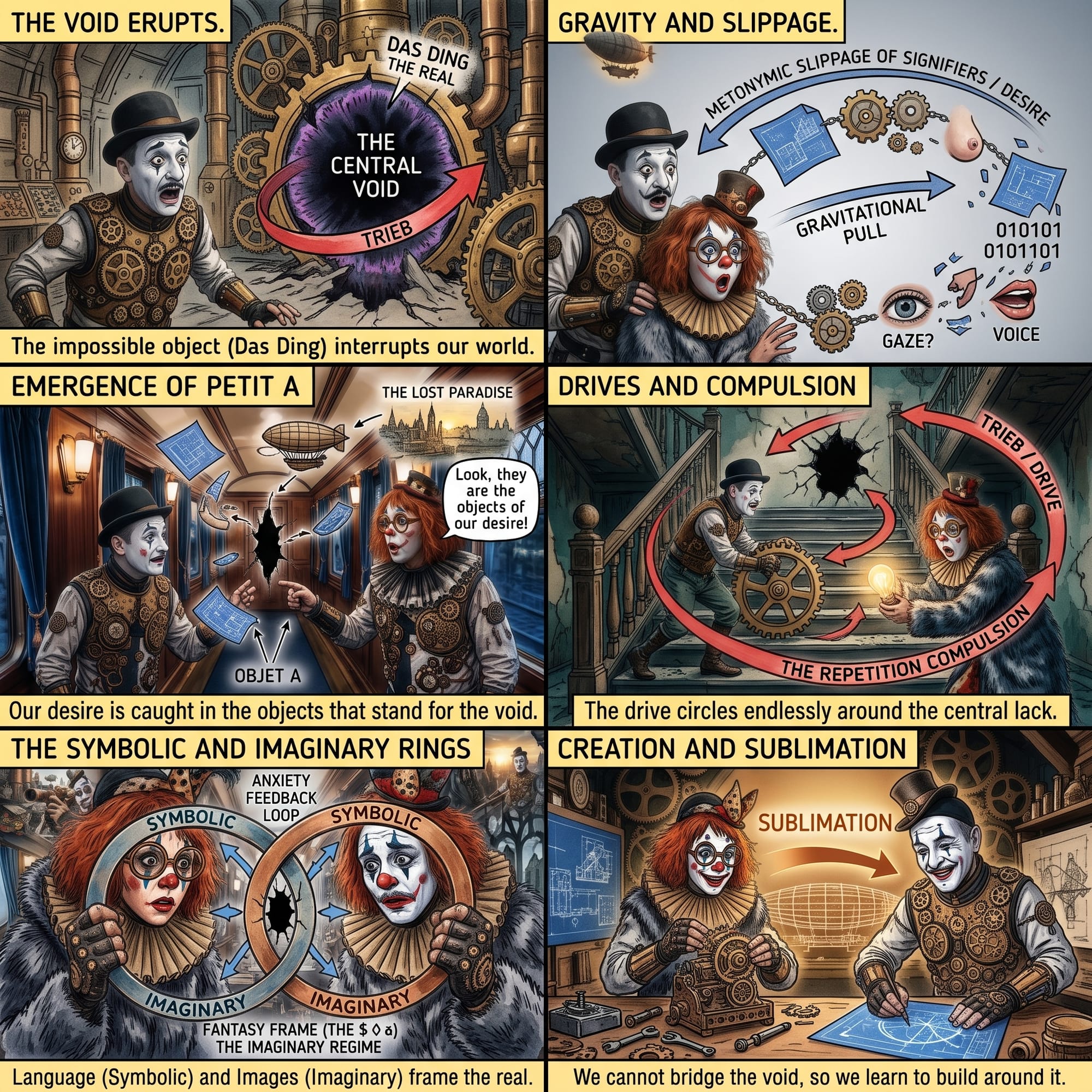
Welcome to the clinic. Let’s drop the dense, impenetrable jargon for a moment and look at what Jacques Lacan actually meant by "the Void."
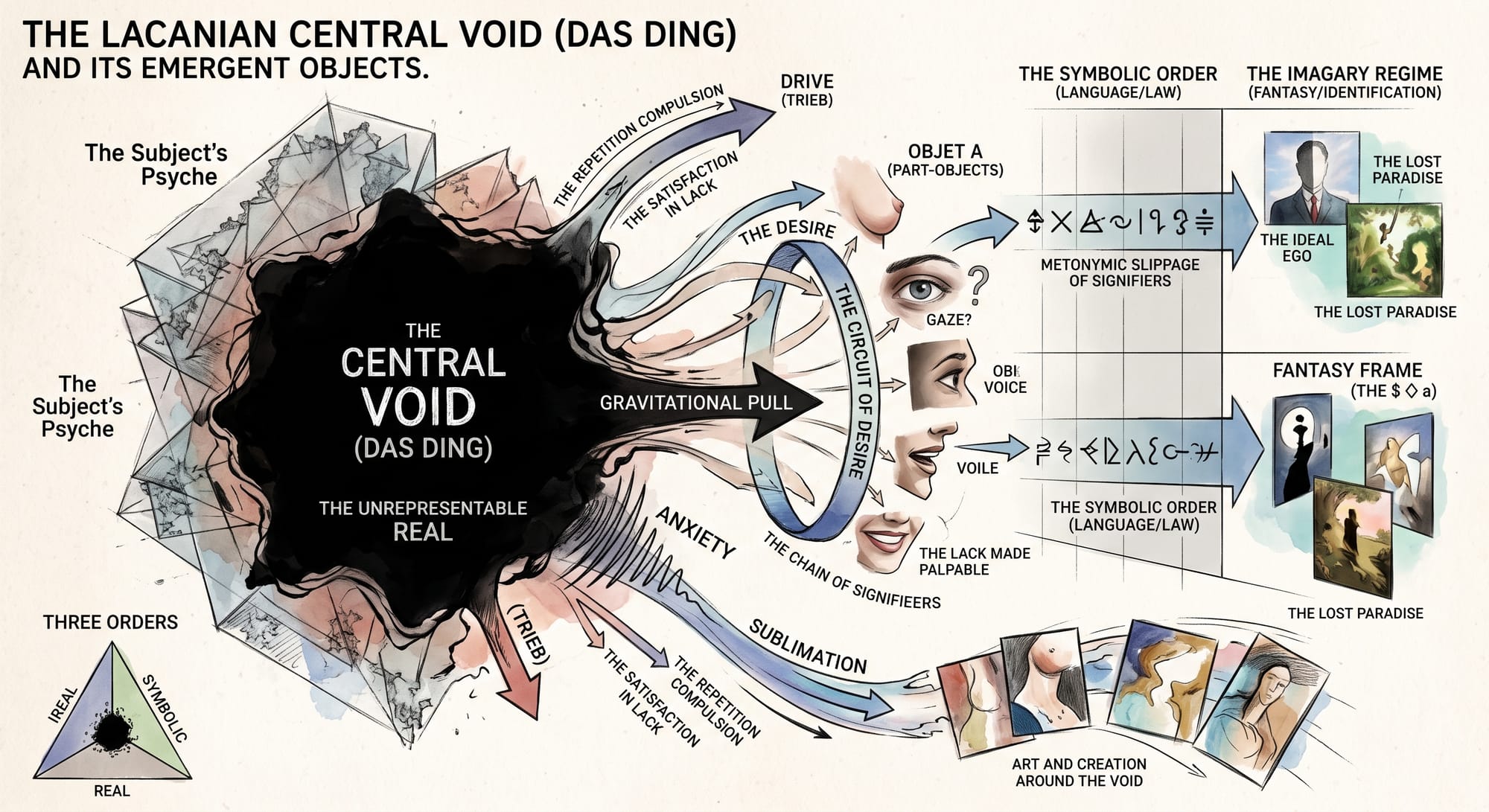
In Lacanian psychoanalysis, the Void is not a dark, terrifying cosmic emptiness, nor is it a sign of depression. It is the fundamental structural gap at the very center of human psychology. It is the engine that makes you you. To understand it, we have to look at how a human being is constructed through three distinct phases or registers:
- The Real: The unmediated, chaotic state of infancy where there is no separation between you, your mother, or the world. Everything is fully present.
- The Symbolic: Language, society, and the rules of the world.
- The Imaginary: The ego, your self-image, and the illusions you construct to feel whole.
The Void is created the exact moment you enter the Symbolic register—the moment you learn to speak.
How Language Creates the Hole. Think of language as a cookie cutter. The moment you press it into the "Real" world to name something, a shape is cut out, but a piece is always left behind. When an infant wants something, it experiences a raw, unnameable biological urgency. But to get it, the infant must translate that urgency into words: "I want milk," or "I want Mom."
The tragedy of human psychology is that words can never fully capture the raw reality of what we feel. Language is a system of differences; it points to things but isn't the thing itself. By accepting language, you enter society, but you pay a massive toll: a piece of your unmediated, authentic self is permanently lost.
That lost, unnameable piece leaves behind a structural vacuum. That vacuum is the Void.
The Borromean Knot & Object a. In his later years, Lacan illustrated the psyche using the Borromean Knot—three overlapping rings representing the Real, the Imaginary, and the Symbolic. If you cut one, the whole structure falls apart. He placed he letter a right in the dead center where all three rings intersect. That is what Lacan called the objet petit a (the object-cause of desire).
The objet a isn't an actual object you can buy or possess. It is the imaginary plug we invent to cover up the Void at the center of the knot. Because the Void feels uncomfortable, our minds constantly try to fill it with things we think will finally make us whole:
- The perfect career
- The ideal romantic partner
- The next tech gadget
- The ultimate vacation
But have you ever noticed that when you finally get the thing you desperately wanted, there is a momentary flash of joy, followed almost immediately by a lingering sense of disappointment? A feeling of, "Is this it?"
That is the Void asserting itself. You cannot plug a structural hole with a material object. The job of the object wasn't actually to satisfy you; its job was to keep you desiring.
The Clinical Takeaway: Why the Void is Good News? In analysis, people often arrive trying to "fix" this feeling of emptiness. They think they are broken because they feel a deep, recurring lack. The Lacanian position is entirely different: The Void is not a pathology; it is the condition for freedom.
If you were completely full, completely satisfied, you would be a rock. You would have no reason to get out of bed, no reason to create art, no reason to talk to another human being, and no reason to love. Desire requires a gap. You cannot move forward unless there is an empty space ahead of you to move into.
The goal of Lacanian analysis isn't to fill the Void. It is to help you stop running from it, to strip away the exhausting, illusory objects you've been trying to stuff into it, and to help you achieve what Lacan called sublimation—learning to circle gracefully around that emptiness, using it as the creative fuel for your life.
Wersja PL: „Preludium” - kliknij tutaj po wprowadzenie na poziomie podstawowym
Witamy w klinice. Porzućmy na chwilę gęsty, nieprzenikniony żargon i przyjrzyjmy się temu, co Jacques Lacan naprawdę miał na myśli, mówiąc o „Pustce” (fr. le vide).
W psychoanalizie lakanowskiej Pustka nie jest mroczną, przerażającą kosmiczną pustką ani objawem depresji. To fundamentalna strukturalna szczelina w samym centrum ludzkiej psychiki. To silnik, dzięki któremu jesteś sobą. Aby ją zrozumieć, musimy przyjrzeć się temu, jak istota ludzka jest konstruowana poprzez trzy odrębne fazy lub porządki:
- Realne (Porządek Realny): Bezpośredni, chaotyczny stan niemowlęctwa, w którym nie ma separacji między tobą, twoją matką a światem. Wszystko jest w pełni obecne.
- Symboliczne (Porządek Symboliczny): Język, społeczeństwo i reguły rządzące światem.
- Wyobrażeniowe (Porządek Wyobrażeniowy): Ego, twój obraz samego siebie oraz iluzje, które tworzysz, aby poczuć się całością.
Pustka powstaje w dokładnie tym samym momencie, w którym wkraczasz w Porządek Symboliczny – w momencie, gdy uczysz się mówić.
Jak język tworzy dziurę
Pomyśl o języku jak o foremce do ciastek. W momencie, gdy odciskasz ją w świecie „Realnego”, aby coś nazwać, wycinasz określony kształt, ale jakiś kawałek zawsze zostaje pominięty. Kiedy niemowlę czegoś chce, doświadcza czystego, nienazywalnego biologicznego, naglącego napięcia. Jednak aby to otrzymać, musi przełożyć to napięcie na słowa: „Chcę mleka” lub „Chcę mamę”.
Tragedia ludzkiej psychiki polega na tym, że słowa nigdy nie potrafią w pełni uchwycić surowej rzeczywistości tego, co czujemy. Język to system różnic; wskazuje na rzeczy, ale sam w sobie nie jest rzeczą. Akceptując język, wchodzisz do społeczeństwa, ale płacisz za to ogromną cenę: kawałek twojego bezpośredniego, autentycznego „ja” zostaje bezpowrotnie utracony.
Ten utracony, nienazywalny fragment pozostawia po sobie strukturalną próżnię. Ta próżnia to właśnie Pustka.
Węzeł boromejski i obiekt a
W późniejszych latach życia Lacan ilustrował psychikę za pomocą węzła boromejskiego – trzech nakładających się na siebie pierścieni reprezentujących Realne, Wyobrażeniowe i Symboliczne. Jeśli przetniesz jeden, cała struktura się rozpadnie.
Literę a umieścił w samym środku, tam gdzie przecinają się wszystkie trzy pierścienie. To jest to, co Lacan nazwał objet petit a (obiektem-przyczyną pragnienia).
Obiekt a nie jest rzeczywistym przedmiotem, który można kupić lub posiadać. To wyobrażeniowa zatyczka, którą wymyślamy, aby zakryć Próżnię w centrum węzła. Ponieważ z pustką czujemy się niekomfortowo, nasz umysł nieustannie próbuje wypełnić ją rzeczami, które – jak nam się wydaje – w końcu uczynią nas całością:
- Idealna kariera
- Wymarzony partner życiowy
- Kolejny technologiczny gadżet
- Wyprawa życia
Ale czy zauważyłeś kiedyś, że kiedy w końcu zdobywasz rzecz, której tak rozpaczliwie pragnąłeś, następuje chwilowy błysk radości, po którym niemal natychmiast pojawia się nieustępliwe poczucie rozczarowania? Myśl typu: „I to wszystko?”
To właśnie daje o sobie znać Pustka. Nie da się załatać strukturalnej dziury materialnym obiektem. Zadaniem tego obiektu wcale nie było cię zadowolić; jego zadaniem było podtrzymanie twojego pragnienia.
Wniosek kliniczny: Dlaczego Pustka to dobra wiadomość?
Ludzie często trafiają na analizę, próbując „naprawić” to poczucie pustki. Myślą, że są zepsuci, ponieważ odczuwają głęboki, powracający brak. Stanowisko lakanowskie jest całkowicie odmienne: Pustka nie jest patologią; jest warunkiem wolności.
Gdybyś był całkowicie pełny, całkowicie zaspokojony, byłbyś jak kamień. Nie miałbyś powodu, by wstać z łóżka, tworzyć sztukę, rozmawiać z drugim człowiekiem ani kochać. Pragnienie wymaga szczeliny. Nie możesz ruszyć naprzód, dopóki przed tobą nie ma pustej przestrzeni, w którą możesz wejść.
Celem analizy lakanowskiej nie jest wypełnienie Pustki. Chodzi o to, aby pomóc ci przestać przed nią uciekać, odrzeć cię z wycieńczających, iluzorycznych obiektów, którymi próbowałeś ją zapchać, i pomóc ci osiągnąć to, co Lacan nazywał sublimacją – naukę pełnego wdzięku krążenia wokół tej pustki i używania jej jako twórczego paliwa dla swojego życia.
The Void & the Topologically Informed Clinic
Wersja PL: Próżnia i klinika uwzględniająca perspektywę topologiczną
Kiedy dyskutujemy o „Pustce” (le vide) na zaawansowanym seminarium, musimy ją jednoznacznie zdefiniować poprzez jej nieeuklidesowe, architektoniczne funkcje w klinice: jako strukturalną konieczność powierzchni nieorientowalnych, dosłowną geometrię podmiotu ($) oraz fundamentalną operację kastracji.
Torus i cięcie strukturalne
Aby zrozumieć Pustkę w lakanowskiej teorii pragnienia, musimy wyjść poza dwuwymiarowe diagramy Eulera i przyjrzeć się geometrii torusa. Standardowy torus posiada dwa odrębne typy zamkniętych ścieżek wektorowych – czyli pętli nierozkładalnych – które definiują jego grupę fundamentalną:
- Pętle żądania (oś x / południk), które owijają się wokół mniejszego obwodu rury.
- Pętla pragnienia (oś y / równoleżnik), która rotuje wokół centralnego otworu.
W Seminarium VIII (Przeniesienie) oraz Seminarium IX (Identyfikacja) Lacan wykazuje, że podmiot może nieskończenie powtarzać pętle żądania. Ponieważ jednak pętle te są związane z powierzchnią rury, nigdy nie penetrują ani nie wyczerpują centralnego otworu.
Pustka to właśnie ta centralna przestrzeń podłużna. Jest to strukturalny brak, wokół którego krążą żądania podmiotu. Kluczowy ruch topologiczny następuje wtedy, gdy spiralna pętla żądania czysto przecina torus, powodując inwersję. Poprzez rozcięcie torusa wzdłuż określonej ścieżki, rozróżnienie między „wewnętrzną” próżnią rury a „zewnętrzną” próżnią centralną zapada się, odsłaniając objet petit a jako krawędź, na której przestrzenie te wzajemnie dokonują swojej subwersji.
Nieorientowalność: Cross-Cap i butelka Kleina
Podmiot lakanowski jest radykalnie nieorientowalny. Lacan polega na cross-capie (topologicznym modelu rzeczywistej płaszczyzny rzutowej), aby zmapować dokładną relację między podmiotem podzielonym ($) a obiektem a.
Cross-cap powstaje poprzez wzięcie sfery, wycięcie w niej otworu (co tworzy granicę) i wszycie wstęgi Möbiusa w tę krawędź graniczną. Wymaga to, aby powierzchnia przecinała samą siebie wzdłuż linii przenikania.
- Pustka to początkowy dysk wycięty ze sfery – fundamentalna strata wyprodukowana przez znaczące (kastracja).
- Wszyta w niego wstęga Möbiusa reprezentuje strukturę podmiotową, w której prawda i iluzja, wnętrze i zewnętrze, istnieją na jednej ciągłej ścieżce.
Kiedy analityk wykonuje cięcie na tym cross-capie, oddzielając wstęgę Möbiusa od sferycznej reszty, ze struktury odpada mały fragment. Ten odpadnięty element – ta pozostałość po operacji topologicznej – to objet petit a. Pustka nie jest nicością; jest strukturalną granicą, która pozwala powierzchni nieorientowalnej utrzymać swoją formę bez eksplodowania w absolutną psychozę.
Pustka boromejska i Sinthome
W końcowej fazie swojego nauczania (od Seminarium XXI do Seminarium XXIII) Lacan przechodzi całkowicie na pozycje teorii węzłów. Pustka staje się dosłownym centrum węzła boromejskiego, w którym trzy pierścienie Realnego, Symbolicznego i Wyobrażeniowego są połączone w taki sposób, że przecięcie jednego uwalnia pozostałe dwa.
Jak widać w matrycy boromejskiej, centralne, puste przecięcie, w którym zbiegają się wszystkie trzy pierścienie, jest miejscem lokacji obiektu a.
Psychological mapping of topological feature
- Centralne nałożenie: objet petit a (wydobycie rozkoszy / jouissance)
- Wewnętrzne granice pierścieni: strukturalne granice rejestrów (J_A, J_phi, znaczenie)
- Globalna dziura: Pustka Realnego, wokół której inscenizowana jest rzeczywistość
Jeśli w zapętlaniu dochodzi do awarii – jeśli pierścienie nie nakładają się prawidłowo, by ograniczyć tę centralną Pustkę – rezultatem jest psychoza kliniczna. Realne wybuch bezpośrednio w pole podmiotu, ponieważ brakuje mu topologicznego domknięcia. Rozwiązaniem analitycznym w takich przypadkach jest stworzenie Sinthome (czwartego pierścienia). Sinthome działa jako lokalna łata topologiczna lub syntetyczny mechanizm węzłowy. Sztucznie ogranicza ono Pustkę, zapewniając, że wyobrażeniowe ego i symboliczne systemy językowe pozostaną powiązane pomimo strukturalnej wady węzła pierwotnego.
Teza Seminarium: Celem kliniki zorientowanej topologicznie jest uświadomienie sobie, że podmiot nie posiada braku; podmiot jest brakiem. Cięcie analityka nie leczy rany; ono matematycznie reorganizuje granice Próżni, tak aby podmiot mógł poruszać się w swojej własnej strukturalnej nieorientowalności bez całkowitej destabilizacji podmiotowej.
Bibliografia i lektury uzupełniające
Źródła pierwotne: Topologiczne seminaria Lacana
Lacan, Jacques. The Seminar of Jacques Lacan, Book IX: Identification (1961–1962). (Niepublikowane tłumaczenie na j. angielski autorstwa Cormaca Gallaghera).
- Znaczenie: Kluczowy punkt wejścia, w którym Lacan wprowadza torus i cross-cap, przenosząc klinikę z paradygmatów czysto lingwistycznych w stronę geometrii strukturalnej.
Lacan, Jacques. Seminarium, Księga X: Lęk (1962–1963). Pod red. Jacques’a-Alaina Millera.
- Znaczenie: Wprost definiuje ekstrakcję objet petit a jako topologiczną resztę wynikającą z cięcia na powierzchni nieorientowalnej.
Lacan, Jacques. Seminarium, Księga XXIII: Sinthome (1975–1976). Pod red. Jacques’a-Alaina Millera.
- Znaczenie: Definitywne źródło wiedzy o węźle boromejskim i wprowadzeniu Sinthome jako lokalnej łaty topologicznej na awarie strukturalne (psychozę).
Literatura wtórna: Egzegeza topologii lakanowskiej
Burgoyne, Bernard. „The Topology of Joyce” [w:] The Cambridge Companion to Lacan, pod red. Jean-Michela Rabaté, 201–216. Cambridge: Cambridge University Press, 2003.
- Nacisk na: Przystępna, a zarazem matematycznie rzetelna analiza późnej teorii węzłów Lacana i jej zastosowania w klinice psychoz.
Granon-Lafont, Jeanne. La Topologie de Jacques Lacan. Paris: Point Hors Ligne, 1990.
- Nacisk na: Niezbędny klasyk (dla czytających po francusku), który precyzyjnie rozrysowuje geometryczną mechanikę cross-capu, wstęgi Möbiusa i butelki Kleina w zastosowaniu seminaryjnym.
Nasio, Juan-David. Pięć lekcji o teorii psychoanalitycznej Jacques'a Lacana. * Nacisk na: Zawiera doskonałe, bogate wizualnie rozdziały poświęcone koncepcji obiektu a oraz topologicznemu statusowi cięcia.
Zaawansowane intersekcje strukturalne i matematyczne
Chiesa, Lorenzo. Subjectivity and Otherness: A Philosophical Reading of Lacan. Cambridge, MA: MIT Press, 2007.
- Nacisk na: Rozdział 5 oferuje mistrzowskie, rygorystyczne prześledzenie formalizacji podmiotu ($) poprzez cross-cap i matrycę boromejską.
Svolos, Thomas. Twenty-First Century Psychoanalysis: Turning Lacanianism Upside Down. London: Routledge, 2020.
- Nacisk na: Bada, jak późny, topologiczny Lacan zmienia współczesną klinikę – w szczególności analizuje, jak „zwyczajna psychoza” współczesnej kultury odnosi się do niezaplecionych próżni.
Žižek, Slavoj. The Parallax View. Cambridge, MA: MIT Press, 2006.
- Nacisk na: Wykorzystuje nieorientowalną geometrię wstęgi Möbiusa i butelki Kleina do wyjaśnienia ontologicznego statusu Próżni w ekonomii politycznej i filozofii.
When we discuss "the Void" (le vide) in an advanced seminar, we must explicitly define it through its non-Euclidean, architectural functions in the clinic: as a structural necessity of non-orientable surfaces, the literal geometry of the subject ($), and the foundational operation of castration.
The Torus and the Structural Cut
To understand the Void in Lacanian desire, we have to move past 2D Euler diagrams and look at the geometry of the torus. A standard torus possesses two distinct types of closed vector paths, or irreducible loops, which define its fundamental group:
- The demand loops (x-axis / meridian), which wrap around the minor tube circumference.
- The desire loop (y-axis / longitude), which rotates around the central hole.
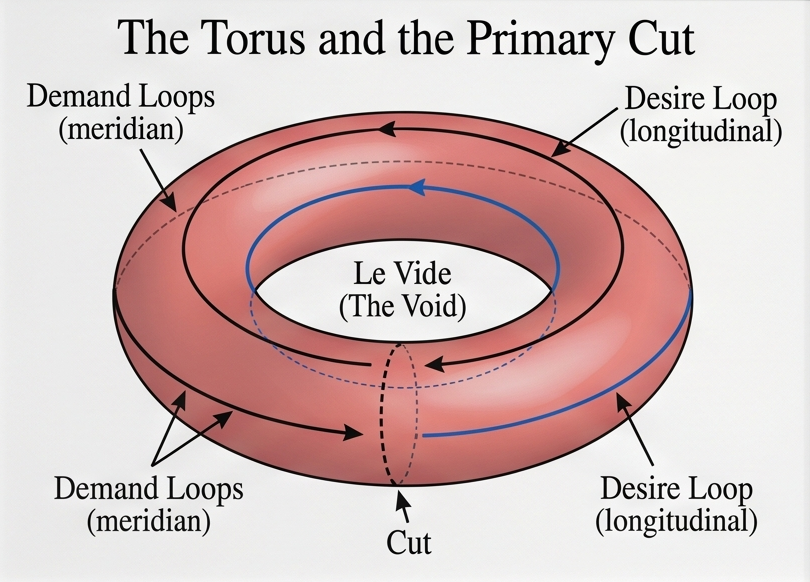
In Seminar VIII (Transference) and Seminar IX (Identification), Lacan demonstrates that a subject can repeat demand loops infinitely. However, because these loops are bound to the surface of the tube, they never penetrate or exhaust the central hole.
The Void is this central longitudinal space. It is a structural lack around which the subject's demands circulate. The crucial topological move occurs when a spiraling demand loop cuts the torus cleanly, causing an inversion. By slicing the torus along a specific path, the distinction between the "interior" void of the tube and the "exterior" central void collapses, exposing the objet petit a as the edge where these spaces subvert one another.
Non-Orientability: The Cross-Cap and Klein Bottle
The Lacanian subject is radically non-orientable. Lacan relies on the cross-cap (a topological model of the real projective plane) to map the exact relationship between the divided subject ($) and the objet petit a.
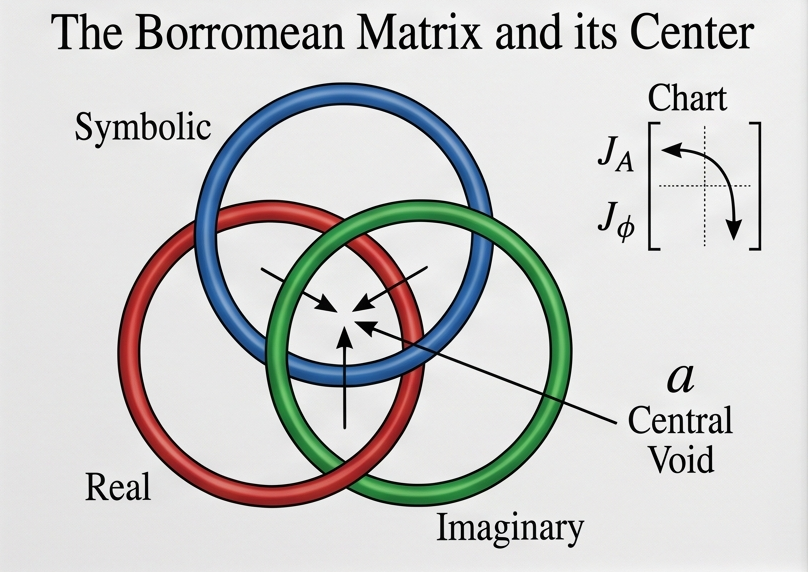
A cross-cap is created by taking a sphere, cutting a hole in it (creating a boundary), and sewing a Möbius strip to that boundary edge. This requires the surface to intersect itself along a line of penetration.
- The Void is the initial disk cut out of the sphere—the fundamental loss produced by the signifier (castration).
- The Möbius strip sewn onto it represents the subjective structure where truth and illusion, interior and exterior, exist on a single continuous path.
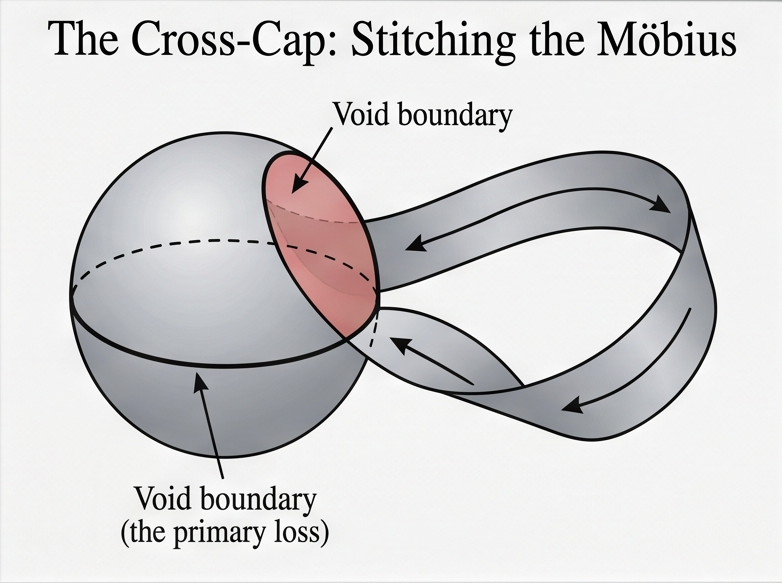
When the analyst performs a cut on this cross-cap, separating the Möbius strip from the spherical remainder, the structure drops a small piece. This fallen piece—this leftover remnants of the topological operation—is the objet petit a. The Void is not nothingness; it is the structural limit that allows a non-orientable surface to hold its form without exploding into absolute psychosis.
The Borromean Void and the Sinthome
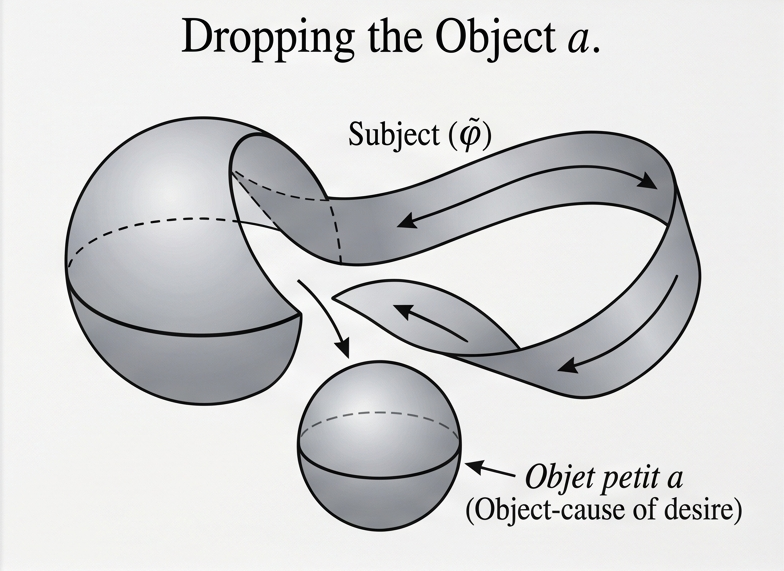
In the final phase of his teaching (Seminar XXI through Seminar XXIII), Lacan shifts completely to knot theory. The Void becomes the literal center of the Borromean Knot, where the three rings of the Real, Symbolic, and Imaginary are linked in such a way that the severing of one releases all three.
As seen in the Borromean matrix, the central empty intersection where all three rings converge is the locus of the objet petit a.
| Topological Feature | Psychoanalytic Mapping |
| Central Overlap | The objet petit a (the extraction of enjoyment / jouissance) |
| Internal Ring Borders | The structural limits of the registers (J_A, J_phi, Meaning) |
| The Global Hole | The Void of the Real, around which reality is staged |
If there is a failure in the knotting—if the rings do not overlap correctly to bound this central Void—the result is clinical psychosis, where the Real erupts directly into the subject's field because it lacks topological containment.
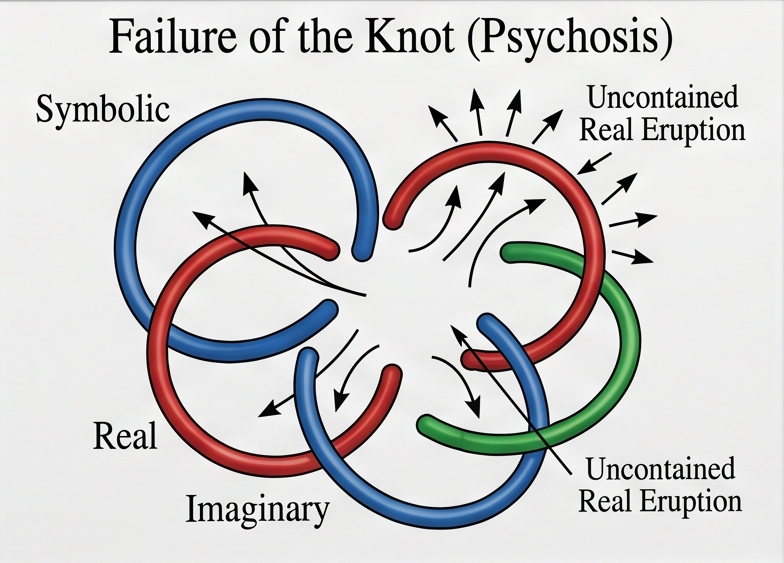
The analytical solution in such cases is the creation of a Sinthome (a fourth ring). The Sinthome acts as a local topological patch or a synthetic knotting mechanism. It artificially bounds the Void, ensuring that the Imaginary ego and the Symbolic language systems remain tied together despite a structural flaw in the primary knot.
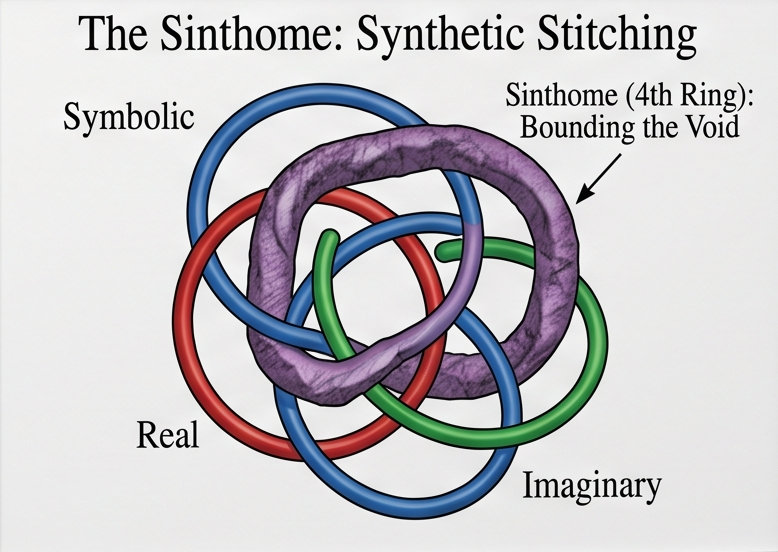
Seminar Thesis: The goal of a topologically informed clinic is the realization that the subject does not have a lack; the subject is a lack. The analyst's cut does not heal a wound; it mathematically reorganizes the boundaries of the Void so the subject can navigate its own structural non-orientability without total subjective destabilization.
References and Further Reading
Primary Sources: Lacan’s Topological Seminars
- Lacan, Jacques. The Seminar of Jacques Lacan, Book IX: Identification (1961–1962). (Unpublished Translation by Cormac Gallagher).
- Significance: This is the critical entry point where Lacan introduces the torus and the cross-cap, moving the clinic away from purely linguistic paradigms to structural geometry.
- Lacan, Jacques. The Seminar of Jacques Lacan, Book X: Anxiety (1962–1963). Edited by Jacques-Alain Miller, translated by A. R. Price. Cambridge: Polity Press, 2014.
- Significance: Explicitly defines the extraction of objet petit a as a topological remainder resulting from a cut on a non-orientable surface.
- Lacan, Jacques. The Seminar of Jacques Lacan, Book XXIII: The Sinthome (1975–1976). Edited by Jacques-Alain Miller, translated by A. R. Price. Cambridge: Polity Press, 2016.
- Significance: The definitive source on the Borromean knot and the introduction of the Sinthome as a localized topological patch for structural failures (psychosis).
Secondary Literature: Exegesis of Lacanian Topology
- Burgoyne, Bernard. "The Topology of Joyce." In The Cambridge Companion to Lacan, edited by Jean-Michel Rabaté, 201–216. Cambridge: Cambridge University Press, 2003.
- Focus: An accessible yet mathematically sound analysis of Lacan’s late knot theory and its application to clinical psychosis.
- Granon-Lafont, Jeanne. La Topologie de Jacques Lacan. Paris: Point Hors Ligne, 1990.
- Focus: An essential classic (if you read French) that maps out the precise geometric mechanics of the cross-cap, Möbius strip, and Klein bottle as used in the seminar rooms.
- Nasio, Juan-David. Five Lessons on the Psychoanalytic Theory of Jacques Lacan. Translated by David Pettigrew and François Raffoul. Albany: State University of New York Press, 1998.
- Focus: Contains excellent, highly visual chapters on the concept of the objet a and the topological status of the cut.
Advanced Structural & Mathematical Intersections
- Chiesa, Lorenzo. Subjectivity and Otherness: A Philosophical Reading of Lacan. Cambridge, MA: MIT Press, 2007.
- Focus: Chapter 5 offers a masterful, rigorous tracing of the formalization of the subject ($) through the cross-cap and the Borromean matrix.
- Svolos, Thomas. Twenty-First Century Psychoanalysis: Turning Lacanianism Upside Down. London: Routledge, 2020.
- Focus: Explores how the late topological Lacan alters the modern clinic, specifically looking at how the "ordinary psychosis" of contemporary culture relates to unknotted voids.
- Žižek, Slavoj. The Parallax View. Cambridge, MA: MIT Press, 2006.
- Focus: Specifically utilizes the non-orientable geometry of the Möbius strip and Klein bottle to explain the ontological status of the Void in political economy and philosophy.
Written by
Subscribe for FREE to our Audience
Enter your email to access commenting, receive memos, logs, dispatches, and unfiltered fragments directly from the Theater.











Member discussion