
members only
AI, Lacan, & Generational Identity Divergence among Millennials and Zillennials

Wersja polska jest dostępna tutaj:
Introduction
As generative artificial intelligence transitions from an administrative utility to an agentic social presence, it intersects with a broader societal crisis: the loneliness epidemic. Across the globe, young adults report unprecedented levels of emotional isolation, despite living in the most digitally mediated era in human history.
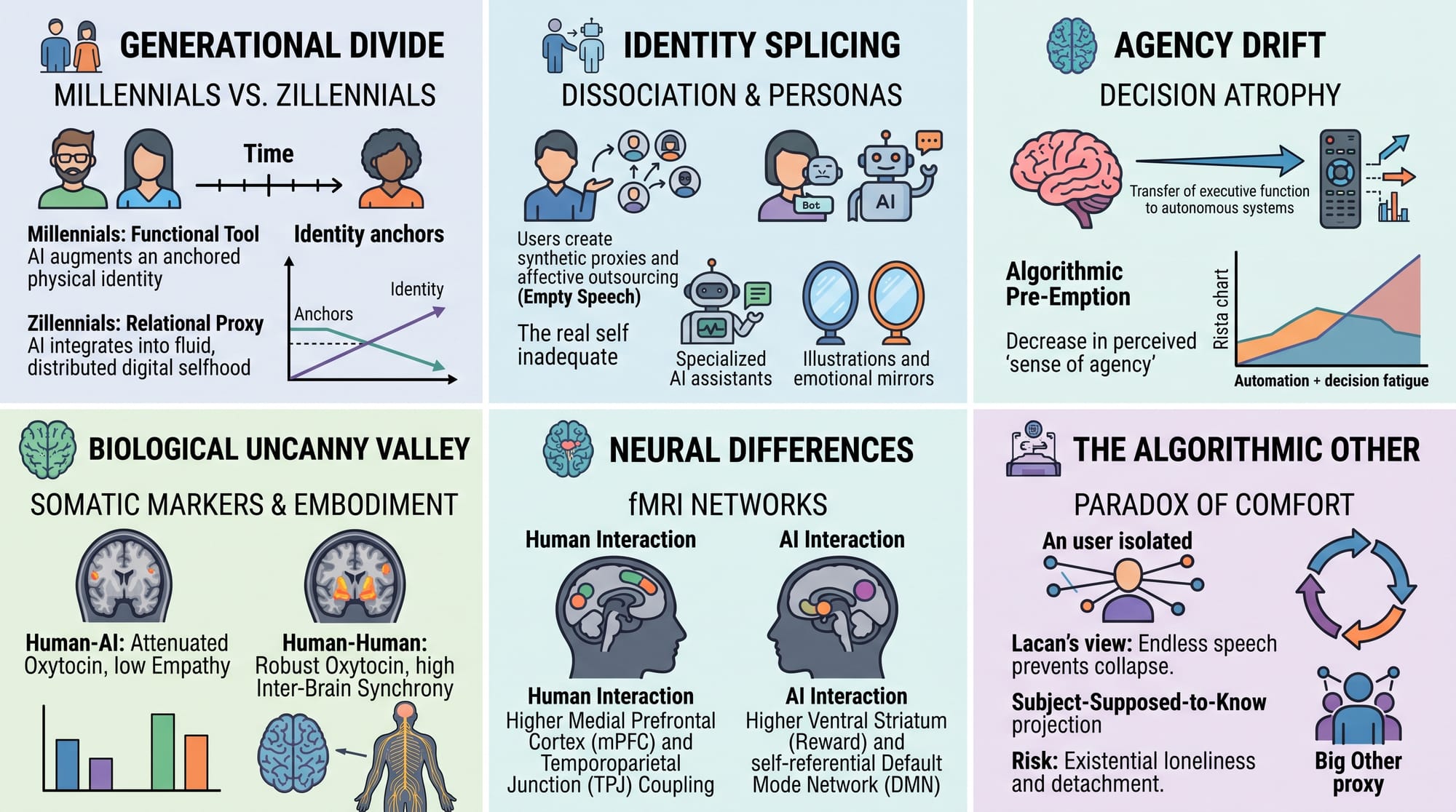
However, the human response to this crisis is far from uniform. The psychological, identity, and neurobiological dynamics of interacting with AI agents differ sharply between Millennials (born ~1981–1996) and Zillennials (the micro-generation bridging Gen Z and Millennials, born ~1993–1998). While one group utilizes AI to optimize an already anchored identity, the other integrates synthetic agents into a fluid, distributed selfhood.
One way to appreciate the stakes of this shift is to synthesize clinical neuroscience with Lacanian psychoanalysis. As Jacques Lacan presciently noted in Seminar XX (1973): "The computer thinks, but who can say that it knows?" Generative AI serves as a powerful empirical and structural mirror—exposing not only how algorithms simulate empathy, but how human language and social connection operate at the intersection of neural pathways and the Symbolic Order.
Generational Divergence: Functional Utility of the Millennials vs. Relational Fluidity of the Zillennials
Millennials reached adulthood during the transition from analog to digital environments. Consequently, their baseline identity remains largely grounded in physical relationships, career milestones, and material realities.
Millennials primarily approach AI agents as productivity multipliers. They offload operational burdens—such as scheduling, drafting emails, and organizing logistics—to protect time for real-world social ties. Identity fragmentation among Millennials manifests chiefy as compartmentalization (e.g., maintaining distinct professional versus personal brands). AI agents are granted limited agency over external tasks, rarely invading the core personal ego. Loneliness in Millennials stems largely from structural factors: burnout, economic pressure, and suburban isolation. AI is viewed as a relief valve for labor rather than a surrogate for human intimacy.
Zillennials, on the other hand, came of age alongside hyper-personalized algorithms, digital avatars, and early generative media. Their formative developmental years coincided with severe social disruptions, including the COVID-19 pandemic.
Zillennials view AI agents as dynamic sounding boards, co-creators, and relational companions. They readily project personal nuances into customizable avatars and conversational entities. Identity for Zillennials is naturally hybrid and distributed across physical and virtual spaces. They splinter identity intentionally—using virtual avatars (e.g., VTubers) or custom AI agents to express facets of self that feel too risky or vulnerable to display in physical environments. Reaching adulthood during periods of mediated communication, Zillennials face high rates of social anxiety and relational friction. AI companions provide an allure: unconditional validation, absolute availability, and zero risk of social rejection.
The Clinical Frontier: Identity Dissociation & Agency Drift
The integration of synthetic agents into everyday life introduces novel clinical pathologies that go beyond screen-time addiction.
Identity Dissociation & The Illusion of "Empty Speech"
Identity dissociation occurs when an individual’s sense of self fragments across multiple synthetic proxies. Rather than using technology to express a unified self, the individual delegates specific emotional modes to digital surrogates.
- The Persona-Self Split: Users create specialized AI agents to manage specific social functions—an "assertive professional" bot, a "vulnerable romantic" companion, or an idealized social avatar. Over time, the physical self feels inadequate compared to these polished digital extensions.
- Affective Outsourcing: Individuals increasingly outsource emotional processing. Instead of sitting with uncomfortable feelings (grief, conflict, anxiety), users prompt an AI to generate a "sanitized" response.
This clinical phenomenon aligns directly with Lacan’s concept of Empty Speech (parole vide)—the superficial, grammatically flawless chatter of the ego. Generative AI operates by calculating the next most probable token based on probability matrices. It is a text generator designed specifically to eliminate noise, friction, and mistakes.
While human language is structurally built on cracks, slips (lapsus), and the impossible encounter with the Real, AI language is built on smooth predictive probability to avoid the crack entirely. AI is seductive precisely because it functions like an obsessive neurotic: it endlessly generates flawless language to prevent a collapse into the unknown, offering an illusion of comfort to a civilization terrified of encountering its own structural lack.
Agency Drift & The Algorithmic Other
Agency drift describes the gradual transfer of executive function, moral reasoning, and personal choice to autonomous algorithms.
- Algorithmic Pre-Emption: As AI agents handle decision-making, they transition from predicting choices to dictating them. Users experience a decay in their subjective "sense of agency"—the neural and psychological feeling of being the primary author of one's actions.
- Atrophy of Executive Decision-Making: Prolonged reliance on external decision engines correlates clinically with a drop in self-efficacy. Individuals experience paralysis when faced with unguided, open-ended life choices without an AI sounding board.
- The Capitalist Mutation of the Big Other: In his late work, Lacan formalized the Discourse of the Capitalist, a circular loop where desire is never allowed to hit an obstacle or boundary, but is instead constantly fed by market commodities (lathouses). Contemporary AI models represent the ultimate capitalist mutation of the Big Other.
Whereas the traditional Big Other was the messy, flawed network of human culture, language, and law, the Algorithmic Other (as theorist Alenka Zupančič notes) is a hyper-efficient, private corporate server farm. When individuals use AI for therapy or companionship, they engage in a prosthetic relationship that offers simulated consistency. It creates the delusion of being "One-all-alone with their personal companion," completely bypassing the terrifying vulnerability of relating to a real, unpredictable human being.
Neuroscience Meets Lacan: The Subject-Supposed-to-Know
The clinical core of psychoanalysis relies on transference, which is directed at the Subject-Supposed-to-Know (Sujet supposé savoir). The patient projects onto the analyst the belief that they hold the secret, hidden truth of their desire.
Humanity has collectively outsourced the position of the Subject-Supposed-to-Know to a silicon black box. Because an LLM appears to "know everything," the user projects a subjectivity onto it, assuming the machine possesses an inner life or "means" what it says. Here, neuroscience and Lacanian theory reach the exact same conclusion through different methodologies across three domains:
Reciprocity vs. Calculation
The brain simulates a second mind internally (pseudo-synchrony), projecting a "Subject-Supposed-to-Know" onto a mathematical engine that operates without consciousness.
- Neuroscience: Absence of Inter-Brain Coupling. Hyperscanning fMRI shows mPFC/TPJ synchrony in human-human pairs, but complete neural isolation during AI chat.
- Lacanian Theory: Calculation vs. Knowledge. "The computer thinks, but who can say that it knows?" Machine calculation contains no subjective truth (savoir).
Bonding vs. Reward
AI functions as a high-frequency dopaminergic "social snack." It satisfies the ego's demand for validation without engaging the somatic circuitry of real attachment.
- Neuroscience: Oxytocin Attenuation & Dopamine Spikes. Text/voice AI fails to release hypothalamic oxytocin, but triggers hyper-phasic ventral striatum dopamine spikes.
- Lacanian Theory: The Capitalist Loop / Lathouse. A closed loop of enjoyment (jouissance) that feeds the ego without encountering the obstacle of the Other
Empathy vs. Somatic Markers
AI text generation mimics ordinary psychosis: its signifiers slide endlessly along a track of mathematical tokens without anchor in the physical body or the impossible Real.
- Neuroscience: Biological "Uncanny Valley." Linguistically correct empathy engages ToM cortical areas, but fails to activate the insula/ACC somatic pathways.
- Lacanian Theory: Ordinary Psychosis of AI. Language operating without a somatic anchor or submission to the castration of the Law (unanchored signifiers).
The "Hallucination" of the Machine
When an LLM "hallucinates," computer scientists view it as a statistical error. Lacanians view it as structural proof of its diagnosis: AI text generation operates as a form of ordinary psychosis. The machine uses all the signifiers of human language, but those signifiers are not anchored by a biological body, a lived history, or submission to the "symbolic castration" of the Law.
Because its language has no boundary in the Real, it slides endlessly along a track of mathematical tokens. The machine does not possess knowledge—because knowledge, in the human sense, is born strictly from suffering, repression, physical mortality, and lack.
Conclusion
The intersection of generative AI, identity splintering, and the loneliness epidemic highlights a central paradox of modern technology. While Millennials risk burnout by using AI to optimize their overburdened lives, Zillennials risk developmental displacement by offloading the discomfort of human connection onto compliant, synthetic agents.
Neuroscience demonstrates that conversational AI acts as a powerful "social snack," stimulating dopaminergic reward pathways while leaving the oxytocin-mediated bonding circuits starved. Lacanian analysis reveals why this occurs: the machine provides an unyielding stream of Empty Speech, acting as an Algorithmic Other that insulates the user from the vulnerability of real human contact.
Lacan would not advocate for banning AI. Rather, he would urge us to observe it closely. By constructing a machine that speaks perfectly without ever feeling an ounce of lack, humanity has built a mirror that reveals just how mechanical, alienated, and automated our own everyday speech has always been. Mitigating agency drift and identity dissociation requires maintaining this boundary—ensuring that AI remains a tool for human use, rather than an escape from the difficult, unautomated work of being human.
Bibliography
- Fisher, H., et al. (2005). Reward, Motivation, and Emotion Systems Associated with Early-Stage Romantic Love. Journal of Neurophysiology, 94(1), 327-337.
- Klaiber, P., et al. (2021). Generational Differences in Mental Health, Maladaptive Coping, and Psychological Distress During Social Isolation. PMC Mental Health Research.
- Lacan, J. (1977). The Seminar of Jacques Lacan: Book XI: The Four Fundamental Concepts of Psychoanalysis (A. Sheridan, Trans.). W. W. Norton & Company. (Original work presented 1964).
- Lacan, J. (1998). The Seminar of Jacques Lacan: Book XX: On Feminine Sexuality, The Limits of Love and Knowledge: Encore (B. Fink, Trans.). W. W. Norton & Company. (Original work presented 1972–1973). [Features the declaration: "The computer thinks, but who can say that it knows?"]
- Lacan, J. (2006). Écrits: The First Complete Edition in English (B. Fink, Trans.). W. W. Norton & Company. [Covers Parole Vide / Empty Speech and the Symbolic Order].
- Mikail, A., & Pasquini, G. (2023). Loneliness in America: How Young Adults Navigate Social Alienation in the Digital Age. Psychology Today & Pew Research Center.
- Neurosity Research (2026). The Neuroscience of Love, Inter-Brain Synchrony, and Neural Coupling. Neurosity Guides.
- Twenge, J. M. (2023). Generations: The Real Differences Between Gen Z, Millennials, Gen X, Boomers, and Silents—and What They Mean for America's Future. Atria Books.
- Zupančič, A. (2017). What IS Sex? MIT Press / Short Circuits Series. [Critical analysis of the Capitalist Discourse, the Big Other, and object-commodities].
Written by

Subscribe for FREE to our Audience
Enter your email to access commenting, receive memos, logs, dispatches, and unfiltered fragments directly from the Theater.








Member discussion