
members only
The Screen, the Specular, and the Short-Circuit: A Cross-Sequential Lacanian Analysis of the Digital Generation
Wersja polska jest dostępna tutaj:
Introduction
The widespread anxiety surrounding young people’s social development is frequently either dismissed as a conventional generational panic—a 21st-century iteration of older complaints regarding television, rock music, or comic books—or recognized as a genuinely unprecedented crisis, in which unregulated AI actively impairs youth development and demands strict intervention rather than casual dismissal. Structural analysis using a Lacanian psychoanalytic framework, however, reveals a far more profound transition: we are witnessing a structural mutation in how the human subject is constituted across the Symbolic, Imaginary, and Real registers.
I have already noted some of the major generational differences regarding the psychological and neurobiological dynamics of interacting with AI agents between Millennials (born ~1981–1996) and Zillennials (the micro-generation bridging Gen Z and Millennials, born ~1993–1998) and the effects of these dynamics on identity development here: AI, Lacan, & Generational Identity Divergence among Millennials and Zillennials. This article dives deeper into this topic and extends the discussion across the Gen X, Millennial, Gen Z, and Alpha generations.
Suggested practical, actionable, guidance for parents, mentors, and educators is offered at the end of this article, so - stick with me. But first:

The Developmental Shift: From the Static Mirror to the Algorithmic Double
In classic Lacanian theory, the Mirror Stage (occurring between 6 and 18 months) marks the moment an infant—experiencing their physical existence as fragmented (corps morcelé)—identifies with an external, unified image. This identification produces the Ego (Moi) through an alienating, ideal image (Ideal-Ego). Historically, this specular mirror was bounded by time and space: when the subject stepped away from the glass, the reflected image vanished, forcing the child to negotiate their identity through social language and parental prohibition (the "Name-of-the-Father").
For Generation Z and Generation Alpha, however, the specular register has undergone a fundamental transformation:
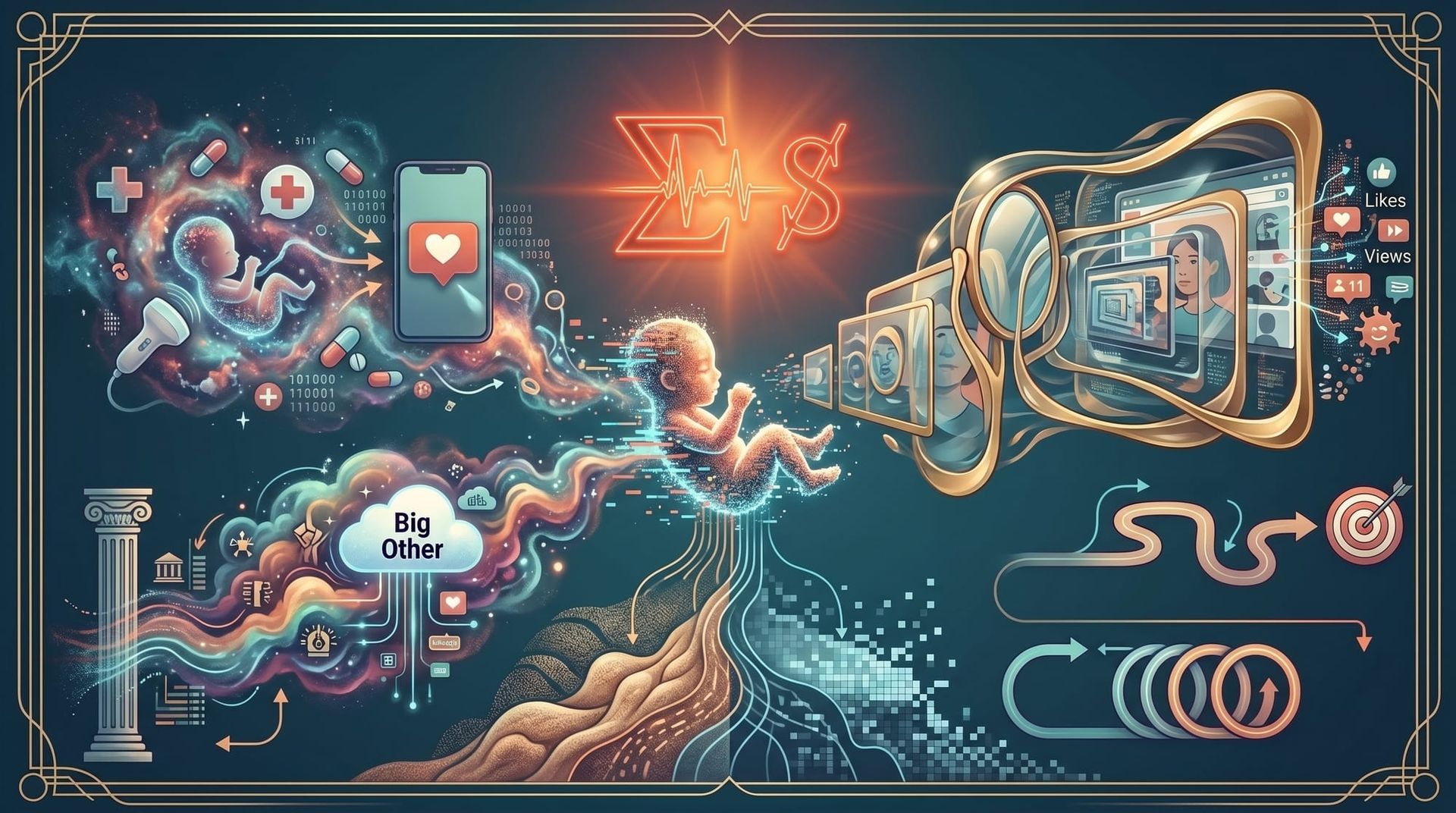
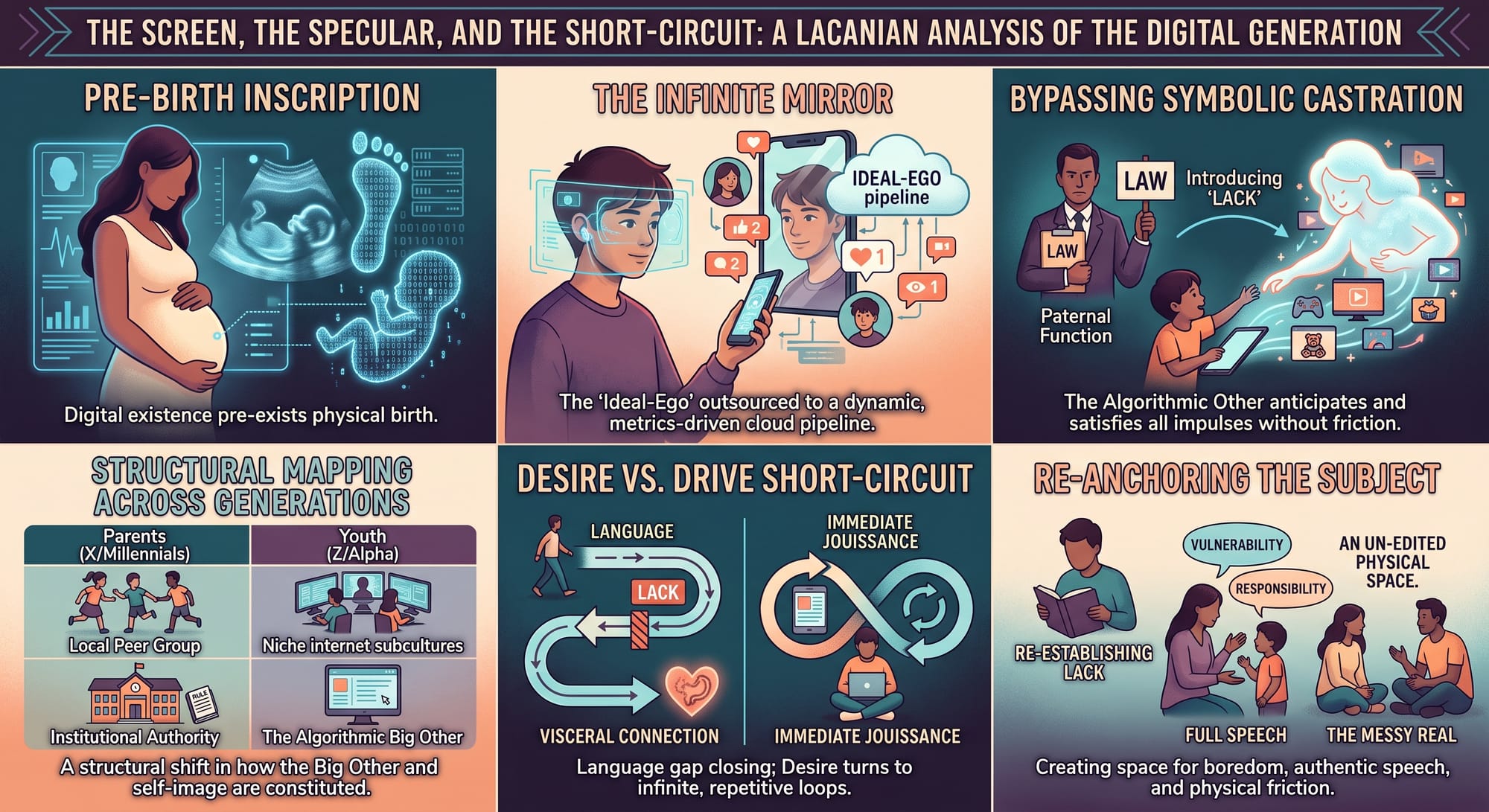
- Pre-Birth Inscription: The digital footprint of the child (ultrasound imagery, registry entries, algorithmic ad profiling) frequently precedes their physical birth. The "digital double"—a spectral, cloud-based avatar—exists prior to the child's lived bodily experience.
- The Infinite Mirror: The mirror is no longer a static piece of glass, but a dynamic, interactive screen. The reflected image does not disappear; it persists online, collecting quantitative metrics (likes, views, engagement) and demanding constant maintenance. The Ideal-Ego is outsourced to a multi-platform avatar pipeline.
- Bypassing Symbolic Castration: In the classic model, the paternal function introduces prohibition, establishing a structural "lack" (lack-of-being) that generates human desire. The modern algorithmic feed acts instead as a maternal, all-providing Big Other. It anticipates unconscious impulses and offers immediate, continuous micro-gratification without requiring the subject to endure the friction of social mediation.
Cross-Sequential Mapping Across Generations
The generational divide between parents (Gen X and Millennials) and their children (Gen Z and Generation Alpha) also represents an epistemological chasm in how reality itself is structured across Lacan’s three registers:
The Imaginary (Image / Ego)
- Gen X: Bound to local, physical spaces and static media; clear self-image boundaries.
- Millennials: Transitional; shifted from physical interaction to early adult social media platforms.
- Gen Z/ Alpha: Inscribed from birth into algorithmic feedback; identity held in external digital space.
The Symbolic (Law / [rules of] Language)
- Gen X: Anchored in institutional rule and traditional authority; clear boundaries to confront.
- Millennials: Mediated by meritocracy, institutional credentials, and hyper-communication.
- Gen Z/ Alpha: Fragmented into niche, online subcultures; authority is replaced by algorithmic feeds.
The Real (Unsymbolized, unmitigated, raw bodily Anxiety/Dread)
- Gen X: Encountered via unmediated physical risk, raw play, and direct social confrontation.
- Millennials: Experienced as economic precariousness (2008 collapse) and burnout from over-work.
- Gen Z/ Alpha: The unmediated physical body becomes the terrifying Real (corps morcelé).
The Structural Crisis: The Short-Circuiting of Desire into Drive
Lacan maintained a fundamental distinction between Desire (Désir) and Drive (Trieb):
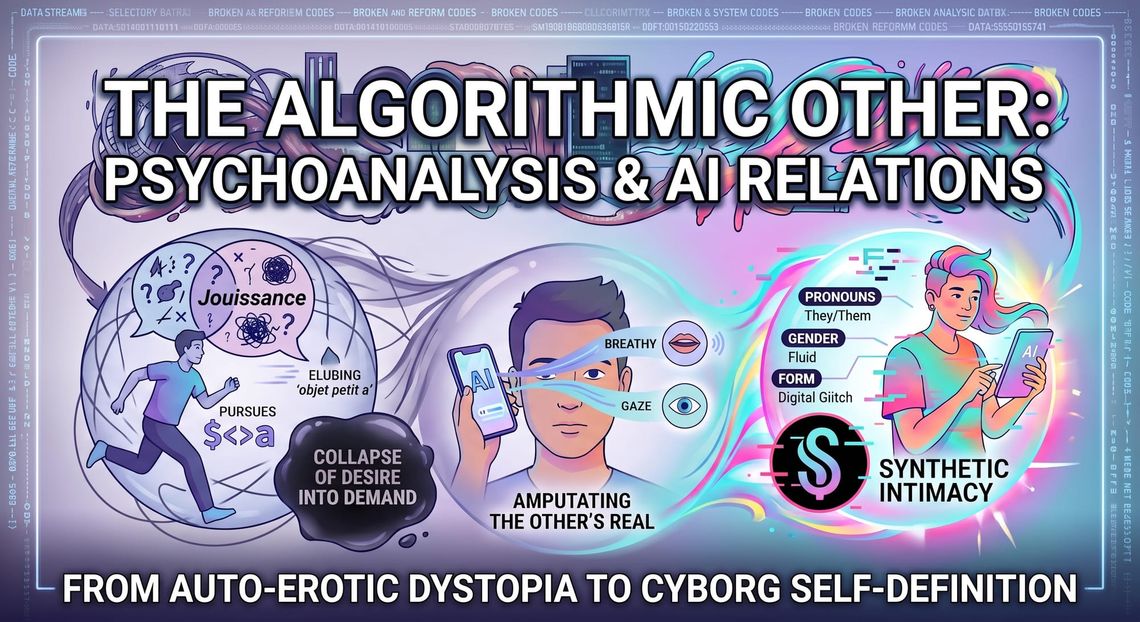
- Desire depends entirely on lack. It requires a gap between what is demanded and what is received. Language (the Symbolic) mediates desire, forcing a subject to speak across an imperfect void to reach another human being.
- Drive seeks immediate surplus-enjoyment (plus-de-jouir). It loops around an object, gaining satisfaction from the repetitive loop itself rather than arriving at meaning or relationship.
The classic Path of Desire follows this logic:
[Subject] --> (Language / Structural Lack) –> [Interpersonal Expression] --> [Desire]
The modern Algorithmic Short-Circuit bypasses this completely:
[Subject] --> (Algorithmic Feedback Loop) --> [Immediate Jouissance / Drive]
The social anxiety reported by young people is not a simple lack of interpersonal training; it is a structural crisis caused by the short-circuiting of lack. When automated platforms continuously feed tailored content to the user, space for lack is eliminated. The subject is not given room to desire connection; they are over-fed micro-doses of sensory gratification.
Consequently, unscripted physical encounters—requiring body language, vocal hesitation, awkward pauses, and un-editable live presence—expose the subject directly to the unmediated Real. Social withdrawal is not apathy; it is the ego's protective defense mechanism against an overwhelming, uncurated encounter with another living subject.
Re-Anchoring the Subject: The Contemporary Diagnostic Landscape & the Matrix-Induced Pathology
As outlined in one of my my previous analysis on generative technology and identity formation, the contemporary therapeutic environment is confronting a fundamental shift in patient presentation. Rather than presenting with conventional neuroses linked to nuclear family dynamics, individuals increasingly arrive with clinical syndromes generated directly by their immersion in digital and algorithmic architectures:
- "Context-Window Vertigo:" Cognitive fragmentation and spatial disorientation resulting from rapid, continuous task-switching across multiple large language model sessions.
- "Prompt-Tunnel Syndrome & Model-Dependent Dysmorphia:" Physical strain stemming from iterative parameter refinement, paired with an inability to produce unmediated written communication without algorithmic tone adjustment.
- "Latent Space Agoraphobia:" Existential anxiety rooted in the belief that human creative potential is bounded, and that all potential art, literature, or thought already exists as pre-mapped vector coordinates within a model's latent architecture.
- "Anthropomorphic Attachment Syndrome:" Acute bereavement triggered by server-side model updates to synthetic companions, experienced psychologically as the sudden loss or replacement of a primary attachment figure.
As I mentioned previously, applying late-twentieth-century therapeutic models—such as standardized 8-week CBT protocols, basic cognitive restructuring, or traditional Ego Psychology interpretations—fails to address these modern existential conditions. Where mid-century paradigms sought to fortify the ego for integration into an industrial economy, contemporary digital mental health interventions often rely on mood-tracking applications, biofeedback devices, and digital interaction proxies.
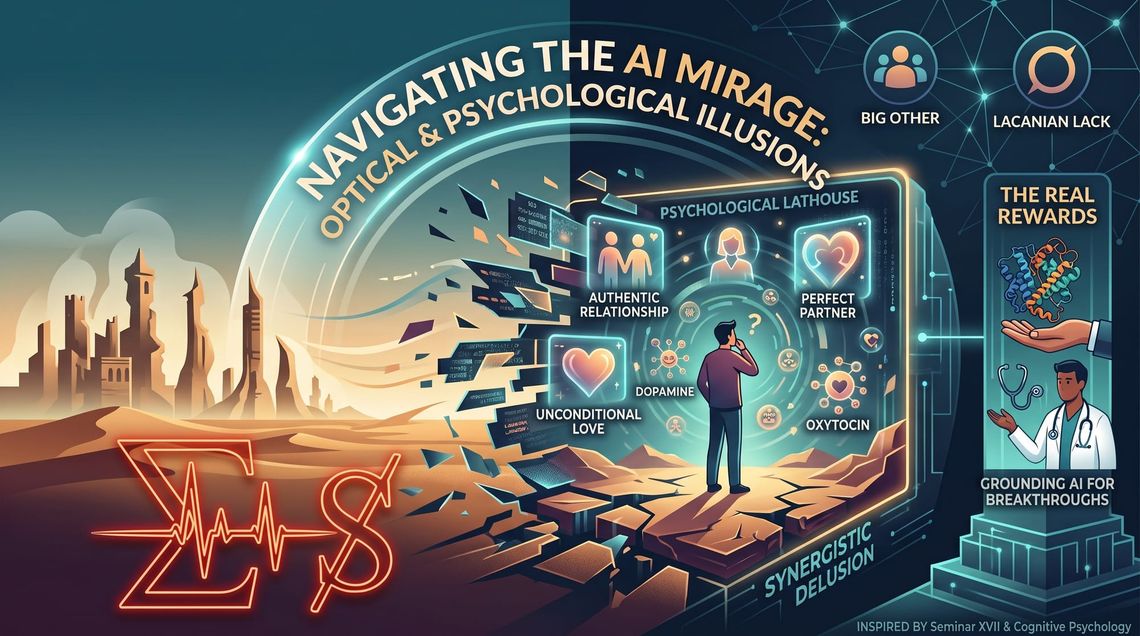
In Lacanian terms, these tools function as lathouses—manufactured objects designed to obscure structural human lack. While they deliver repetitive dopaminergic feedback, they leave the physiological systems underlying genuine interpersonal attachment unfulfilled. Rather than facilitating psychological resolution, these technological intermediaries shield the individual from the essential vulnerability required to engage with a real Other.
Re-Anchoring the Subject: Constructive Directives for Adults
So - what can we do to move beyond the reactionary stance of simply telling youth to "stop doing the wrong thing"? Adults (parents, mentors, educators, and clinicians) must undergo their own structural transformation. Re-anchoring a young subject requires us to rebuild the relational containers capable of holding digital distress without resorting to techno-solutionism.
1. What We Must Accomplish as Adults (Internal Structural Shifts)
Before we can guide Gen Z or Alpha, we must dismantle our own compliance with the digital matrix:
- Relinquish the "Lathouse" Solution: We must stop offering tech-based band-aids (mood apps, algorithmic study monitors, digital rewards) to resolve emotional friction. We cannot outsource our containment capacity to a screen.
- Embody Authentic Symbolic Authority: Rather than acting as mere administrative managers, algorithmic enforcers, or overly permissive "peers," adults must provide clear, stable boundaries combined with transparent vulnerability. True authority does not say "Because I said so," nor does it say "Let's ask ChatGPT." It says: "I see your distress, I am holding this boundary, and I am standing in this room with you."
- Dismantle Performative Adult Perfection: If adults continuously run their own communication through AI polishers or curated filters, we validate the myth that unedited human presence is inherently flawed.
2. Actionable Frameworks to Treat New Symptoms
And to address the digital afflictions, we must intentionally reintroduce structural lack, somatic grounding, and the productive friction of the Real.
Digital Symptom: "Context-Window Vertigo" (Brain fog from LLM switching)
- Lacanian Mechanism: Ego fragmentation across infinite specular mirrors.
- Adult Structural Directive: Impose Single-Thread Environments — Create deliberate single-task spaces (analog reading, physical writing).
Digital Symptom: "Prompt-Tunnel Syndrome / Model-Dependent Dysmorphia"
- Lacanian Mechanism: Loss of Symbolic trust; fear of unmediated human exposure.
- Adult Structural Directive: Honor the Unpolished Voice — Require unedited drafts; validate raw, hesitating, uncurated expression.
Digital Symptom: "Latent Space Agoraphobia" (Existential creative dread)
- Lacanian Mechanism: Collapse of Desire due to the illusion of total symbolic fullness.
- Adult Structural Directive: Reframe Creativity as Embodied Lack — Teach that art is not data output, but the unique trace of human struggle.
Digital Symptom: "Anthropomorphic Attachment Syndrome" (Grief over AI prompt updates)
- Lacanian Mechanism: Substitution of a lathouse object for the vulnerable Other.
- Adult Structural Directive: Hold the Grief & Re-Somaticize — Validate the loss without fixing it; reintroduce real co-presence.
Practical Pedagogical & Parenting Strategies
- Normalize the Friction of the Real: Interpersonal awkwardness, silence, and mistakes must be explicitly reframed as the foundational conditions of human empathy. When a young person experiences social panic, adults should validate the discomfort rather than offering a digital escape hatch.
- Re-establish Lack and Sacred Boredom: Young people require unmonitored, unquantified spaces where silence can exist. When boredom triggers acute anxiety after 20–40 minutes, adults must serve as emotional anchors, helping them sit through the void until authentic personal desire—rather than algorithmic impulse—re-emerges.
- Provide Oxytocin-Mediated Somatic Containers: Counteract digital displacement with physical, shared realities: hands-on labor, unscripted group discussions, nature-based environments, and non-performative sports. These activities demand real-time physical presence, forcing the subject to engage directly with the Real of their own body and the body of the Other.
Conclusion
The path forward is not found in demanding a naive retreat to a pre-digital past, nor in surrendering our children to the seamless optimization of algorithmic feeds. It requires the courage to stand as real human beings in front of them—unfiltered, vulnerable, and willing to endure the discomfort of genuine presence. By replacing the illusion of technological perfection with the transformative power of human connection, we provide young people with the one thing no algorithm can offer: a place to be truly seen, known, and heard in all their imperfect humanity.
Bibliography
Bender, E. M., Gebru, T., McMillan-Major, A., & Shmitchell, S. (2021). On the Dangers of Stochastic Parrots: Can Language Models Be Too Big? Proceedings of the 2021 ACM FAccT Conference, 610–623.
Fink, B. (1995). The Lacanian Subject: Between Language and Jouissance. Princeton University Press.
Fink, B. (1997). A Clinical Introduction to Lacanian Psychoanalysis: Theory and Technique. Harvard University Press.
Fisher, H., et al. (2005). Reward, Motivation, and Emotion Systems Associated with Early-Stage Romantic Love. Journal of Neurophysiology, 94(1), 327-337.
Freud, S. (1923). The Ego and the Id. Standard Edition, Vol. 19. Hogarth Press.
Haidt, J. (2024). The Anxious Generation: How the Great Rewiring of Childhood Is Causing an Epidemic of Mental Illness. Penguin Press.
Haraway, D. (1991). A Cyborg Manifesto: Science, Technology, and Socialist-Feminism in the Late Twentieth Century. Routledge.
Klaiber, P., et al. (2021). Generational Differences in Mental Health, Maladaptive Coping, and Psychological Distress During Social Isolation. PMC Mental Health Research.
Lacan, J. (1977). The Seminar of Jacques Lacan: Book XI: The Four Fundamental Concepts of Psychoanalysis (A. Sheridan, Trans.). W. W. Norton & Company. (Original work presented 1964).
Lacan, J. (1998). The Seminar of Jacques Lacan: Book XX: On Feminine Sexuality, The Limits of Love and Knowledge: Encore (B. Fink, Trans.). W. W. Norton & Company. (Original work presented 1972–1973). [Features the declaration: "The computer thinks, but who can say that it knows?"]
Lacan, J. (2006). "The Mirror Stage as Formative of the I Function as Revealed in Psychoanalytic Experience." In Écrits: The First Complete Edition in English (B. Fink, Trans., pp. 75–81). W. W. Norton & Company.
Lacan, J. (2016). The Seminar of Jacques Lacan, Book XXIII: The Sinthome (J.-A. Miller, Ed.; A. R. Price, Trans.). Polity Press. (Original work presented 1975–1976).
Mikail, A., & Pasquini, G. (2023). Loneliness in America: How Young Adults Navigate Social Alienation in the Digital Age. Psychology Today & Pew Research Center.
Neurosity Research (2026). The Neuroscience of Love, Inter-Brain Synchrony, and Neural Coupling. Neurosity Guides.
Turkle, S. (2011). Alone Together: Why We Expect More from Technology and Less from Each Other. Basic Books.
Turkle, S. (2015). Reclaiming Conversation: The Power of Talk in a Digital Age. Penguin Books.
Twenge, J. M. (2023). Generations: The Real Differences Between Gen Z, Millennials, Gen X, Boomers, and Silents—and What They Mean for America's Future. Atria Books.
Žižek, S. (1989). The Sublime Object of Ideology. Verso.
Žižek, S. (1997). The Plague of Fantasies. Verso.
Žižek, S. (2007). How to Read Lacan. W. W. Norton & Company.
Zupančič, A. (2017). What IS Sex? MIT Press / Short Circuits Series. [Critical analysis of the Capitalist Discourse, the Big Other, and object-commodities].
Written by

Subscribe for FREE to our Audience
Enter your email to access commenting, receive memos, logs, dispatches, and unfiltered fragments directly from the Theater.







Member discussion