Scansion (pt. IV): The Digital Generation & the need for "Internal Scansion"

Wersja PL: Skandowanie (cz. IV): Cyfrowe pokolenie a konieczność „wewnętrznego skandowania”
Najgłębszy topologiczny wgląd Lacana sprowadza się do tego:
„Cięcie nie jest czasem trwania; jest relacją strukturalną”.
Jeśli zmienił się sam język – a zmienił się, zmutowany przez algorytmiczną prędkość, nieustanną łączność i hiperfragmentację uwagi – wówczas nasza kliniczna realizacja cięcia musi się do tego dostosować.
Zaryzykujmy i naszkicujmy teorię Wewnętrznego Skandowania (Internal Scansion), skrojoną pod wymiar pokolenia, którego relacja z Porządkiem Symbolicznym i Realnym została całkowicie przebudowana przez cyfrowy ekran.
Matryca ekranu: Zmutowane ego pokolenia „Reelsów”
Zanim zaprojektujemy wewnętrzne cięcie, musimy zdiagnozować specyficzną strukturę podmiotową pokolenia wychowanego na przewijaniu krótkich form wideo (tzw. short-form scrolling).
- Klasyczne Ego: Zbudowane na długich, stabilnych narracjach (powieść wiktoriańska / 50-minutowa godzina).
- Cyfrowe Ego: Zbudowane na szybkich, rwanych cięciach (TikTok / algorytmiczny feed).
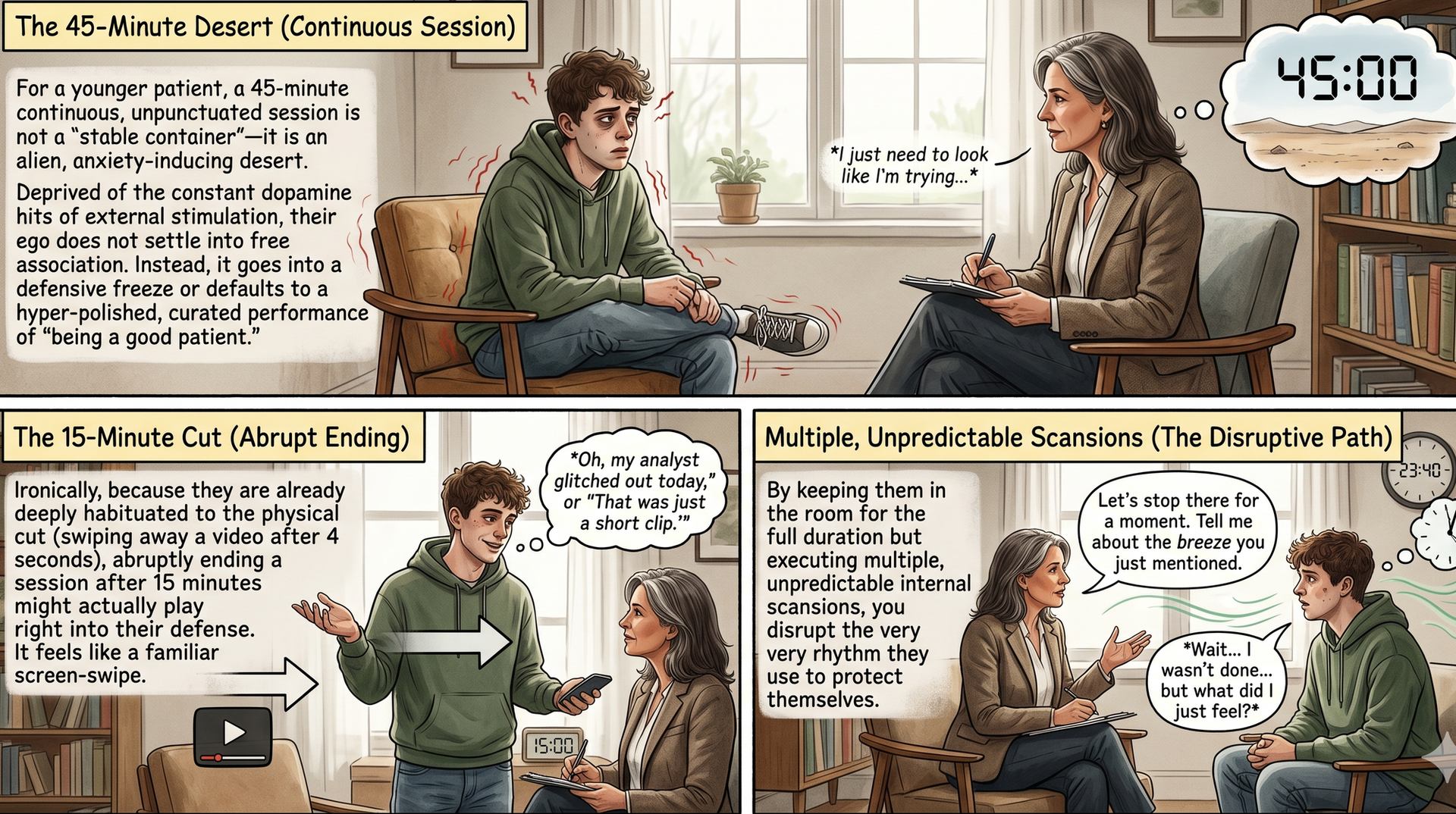
Dla młodszego pacjenta 45-minutowa, ciągła sesja pozbawiona interpunkcji nie jest „stabilnym naczyniem” – jest obcą, wywołującą lęk pustynią. Pozbawione nieustannych strzałów dopaminy płynących z zewnętrznej stymulacji, ich ego nie wchodzi w stan wolnych skojarzeń. Zamiast tego zapada w obronny paraliż lub uruchamia domyślny, doskonale wygładzony i wyreżyserowany spektakl pod tytułem „bycie dobrym pacjentem”.
Paradoksalnie, ponieważ są oni już głęboko przyzwyczajeni do fizycznego cięcia (odrzucenie wideo palcem po 4 sekundach), gwałtowne zakończenie sesji po 15 minutach może w rzeczywistości wpisać się w ich mechanizmy obronne. Poczują to jak znajome tąpnięcie na ekranie. Mogą to łatwo zbyć słowami: „O, mój analityk miał dzisiaj glitcha” albo „To był tylko krótki klip”.
Utrzymując ich w gabinecie przez pełen czas trwania sesji, ale wykonując wielokrotne, nieprzewidywalne wewnętrzne skandowania, rozbijasz dokładnie ten rytm, którego używają do ochrony samych siebie.
Techniki wewnętrznego skandowania (Cięcie przerywane)
Jeśli analityk nie może fizycznie zakończyć sesji, musi użyć swojego głosu, ciała i ciszy, aby zasymulować strukturalną prędkość cięcia wewnątrz samej godziny. Oto jak możemy sformalizować te interwencje:
1. „Wokalne przewijanie” (Skandowanie akustyczne)
Kiedy pacjent wpada w wyuczoną narrację – mówiąc wygładzonym, samoświadomym językiem pop-psychologicznych „trendów zdrowia psychicznego” – analityk wprowadza nagłą, drastyczną zmianę głosu. Nie jest to interpretacja; to akustyczne ostrze.
- Technika: Głośne powtórzenie pojedynczego, pękniętego znaczącego w środku zdania w celu całkowitego wykolejenia składni, po którym natychmiast następuje spadek głośności do absolutnej ciszy.
- Teoria: Naśladujesz cięcie algorytmiczne. Chwytasz słowo, wyrywasz je z obronnego potoku narracji i pozostawiasz w zawieszeniu. Przypomina to wizualny „glitch” lub pętlę 10-sekundowego wideo, zmuszając pacjenta do konfrontacji z surowym materiałem fonemu, a nie z jego gładką opowieścią.
2. Cięcie przestrzenne (Przesunięcie topologiczne)
W tradycyjnej sesji analityk siedzi w nieruchomej, stałej neutralności. Dla odbiorcy o orientacji silnie wizualnej, zapośredniczonej przez ekran, ta stałość może stać się po prostu częścią tapety w tle.
- Technika: Gwałtowna modulacja fizycznego dystansu lub postawy ciała w bezpośredniej odpowiedzi na przejęzyczenie z nieświadomości. Wstanie z fotela, by sięgnąć po książkę, lekkie przesunięcie krzesła lub nagła, dramatyczna zmiana spojrzenia dokładnie w momencie, gdy Realne przebija się na powierzchnię.
- Teoria: To jest fizyczne skandowanie. Zmieniając współrzędne przestrzenne gabinetu, rozbijasz wyobrażeniowe zwierciadło między pacjentem a analitykiem. Służy to jako wizualny znak interpunkcyjny, który mówi: Topologia tego pokoju właśnie się zmieniła z powodu tego, co przed chwilą powiedziałeś.
3. Matryca mikrosesji (Wielokrotne cięcie)
Zamiast jednego ciągłego, 45-minutowego łuku, sesję teoretyzuje się jako trzy lub cztery mikrosesje zszyte ze sobą radykalną ciszą.
- Technika: W 12. minucie pacjent uderza w głęboką granicę lub zalicza przejęzyczenie. Analityk mówi: „Zatrzymajmy się tutaj”. Ciężka, absolutna cisza zostaje utrzymana przez kolejne 4 do 5 minut. Analityk się nie rusza; pacjent zostaje sam, by gotować się w rezonansie tego ślepego zaułka. Następnie analityk mówi: „Zacznij od nowa”.
- Teoria: Wykonujesz wielokrotne coupures w ciągu jednej godziny. Każde „Zacznij od nowa” zmusza podmiot do zrodzenia nowej linii skojarzeń na zgliszczach poprzedniego załamania. To bezpośredni atak na krótką zdolność skupienia uwagi – traktujesz te 45 minut nie jak maraton, lecz jak serię intensywnych sprintów o wysoką stawkę w starciu z nieświadomością.
Uzasadnienie teoretyczne: Powrót do wstęgi Möbiusa
Ugruntujmy tę przygodę w geometrycznej fazie teorii Lacana. Przypomnijmy, że na wstędze Möbiusa cięcie wzdłuż linii środkowej nie daje dwóch osobnych kawałków; daje jedną, dłuższą, skręconą pętlę.
Jeśli cięcie nie dzieli powierzchni na pół, to fizyczny akt wyproszenia pacjenta za drzwi jest topologicznie nieistotny. Celem cięcia jest ujawnienie ekstymności obiektu – faktu, że najgłębsza wewnętrzność podmiotu znajduje się tak naprawdę na zewnątrz niego.
Poprzez zastosowanie wewnętrznego skandowania zamieniasz 45-minutową sesję we wstęgę Möbiusa. Pacjent myśli, że znajduje się po „bezpiecznej” stronie intelektualnej rozmowy, ale poprzez wewnętrzne cięcie nagle znajduje się po stronie odwrotnej – po stronie surowego, bezpośredniego popędu – i to bez opuszczania fotela.
Etyka „odważnej” kliniki
To właśnie w tym miejscu teoria musi wykazać się odwagą. Jeśli będziemy traktować psychoanalizę jak eksponat muzealny zamrożony w XIX-wiecznym Wiedniu czy Paryżu lat 60. XX wieku, skażemy ją na zapomnienie.
Jeśli współczesny podmiot jest bombardowany nieustannymi, bezsensownymi algorytmicznymi cięciami, zadaniem analityka nie jest zapewnienie mu przytulnego, nostalgicznego schronienia w postaci „długich pogaduszek”. To byłoby tylko karmieniem wyobrażeniowego ego. Naszym zadaniem jest wprowadzenie Cięcia Strukturalnego – takiego, które nie tylko zabawi go lub odwróci jego uwagę na 10 sekund, ale takiego, które trwale przebije jego fantazmat i zmusi go do wzięcia odpowiedzialności za własne pragnienie.
Ostateczna konkluzja: Hakowanie matrycy ekranu
Konsensus wśród tych współczesnych autorów w pełni popiera kliniczną intuicję: młodszego pokolenia nie trzeba ratować przed ich krótkim czasem skupienia uwagi; trzeba ich skonfrontować ze strukturalnymi konsekwencjami ich własnej mowy.
Kiedy używamy wewnętrznego skandowania, przyjmujemy zasadniczo postawę kogoś, kogo Clint Burnham nazywa „narcystycznym hakerem”. Bierzemy dokładnie tę samą gramatykę, której oni używają do obrony własnego ego (pętlę, glitch, nagłe przełamanie ram) i obracamy ją przeciwko temu ego. Dowodzimy w ten sposób, że cięcie analityczne jest jedynym, które nie zostaje po prostu przewinięte dalej, ale rzeczywiście zostawia trwałą bliznę na Realnym.
Bibliografia i materiały uzupełniające
Kliniczni buntownicy: Przeformułowanie ram (The Frame)
Webster, Jamieson – wybitna analityczka lakanowska z Nowego Jorku, autorka książki The Life and Death of Psychoanalysis.
- Nacisk na: Proces rozpadu tradycyjnej kliniki w zderzeniu ze współczesną podmiotowością. Webster szeroko opisuje, jak współczesne kryzysy uwagi, konwersje somatyczne i zdigitalizowany krajobraz zmieniają relację przeniesieniową. Twierdzi, że analityk musi znaleźć sposoby na wstrzyknięcie Realnego w godzinę kliniczną, która jest nieustannie zagrożona przez sterylną, wyreżyserowaną mowę pacjenta.
Nobus, Dany – czołowy lakanista, profesor, były przewodniczący Freud Museum w Londynie.
- Nacisk na: Nobus zorganizował słynne seminarium w erze pandemii pt. „Psychoanalytic Practice in Technological Space?”. Wprost pyta w nim, jak technologia komputerowa wpływa na pozycję analityka. Bada, co dzieje się, gdy fizyczna obecność analityka zostaje spłaszczona do formy ekranu i jak musi funkcjonować skandowanie, gdy cały świat pacjenta jest już zdefiniowany przez cyfrowe cięcia.
Awangarda teoretyczna: Ekran jako Wielki Inny
Johanssen, Jacob – autor książki Psychoanalysis and Digital Culture: Audiences, Social Media and Big Data.
- Nacisk na: Bezpośrednie ujęcie psychologii pokolenia „skrolującego/flickującego”. Johanssen używa lakanowskich pojęć do przeanalizowania tego, jak platformy społecznościowe funkcjonują jako wirtualny Wielki Inny. Twierdzi, że nasze smartfony działają niemal jak sztuczna strefa erogenna lub protetyczne rozszerzenie obiektu a, co oznacza, że analityk w gabinecie konkuruje bezpośrednio z algorytmem zaprojektowanym do nieustannego przechwytywania uwagi przez Porządek Wyobrażeniowy.
Burnham, Clint – autor monografii Fredric Jameson and The Wolf Wolf oraz współautor tomu After Lacan: Clinical, Theoretical and Critical Interventions, gdzie napisał rozdział „Lacan and New Media”.
- Nacisk na: Teoretyzowanie smartfona, selfie i cyfrowych pętli przy użyciu późnych logicznych formalizmów Lacana. Burnham bada, w jaki sposób „neurotyczne pstrykanie” podczas skrolowania jest bezpośrednią manifestacją popędu krążącego wokół cyfrowego braku oraz jak samo urządzenie działa jako totalizujące zwierciadło.
Strukturalni metapsycholodzy
Zupančič, Alenka & Szkoła Lublańska – podczas gdy Slavoj Žižek używa Lacana do analizy mediów w ogólności, jego bliska współpracowniczka Alenka Zupančič (What IS Sex?) skupia się na czystej metafizyce cięcia.
- Nacisk na: Cała Szkoła Lublańska stoi na stanowisku, że współczesna gospodarka cyfrowa próbuje utowarowić i urynkowić rozkosz (jouissance) za pośrednictwem krótkich form medialnych. Twierdzą oni, że zadaniem psychoanalizy dzisiaj nie jest wydłużanie czasu uwagi pacjenta, lecz obnażenie faktu, że cyfrowe „cięcie” 10-sekundowego reelsa jest fałszywym powtórzeniem zaprojektowanym po to, by ukryć prawdziwy, strukturalny brak podmiotu.
Lacan's deepest topological insight is this:
The cut is not a temporal duration; it is a structural relation.
If language itself has changed—and it has, mutated by algorithmic speed, constant connectivity, and the hyper-fragmentation of attention—then our clinical execution of the cut must adapt.
Let’s be adventurous and map out a theory of Internal Scansion tailored for a generation whose relationship to the Symbolic and the Real has been thoroughly rewired by the digital screen.
The Screen Matrix: The Mutated Ego of the "Reel" Generation
Before designing the internal cut, we must diagnose the specific subjective structure of a generation raised on short-form scrolling.
Classic Ego: Built on long, stable narratives (The Victorian Novel / The 50-Minute Hour).
Digital Ego: Built on rapid, disjointed cuts (The TikTok Reel / The Algorithmic Feed).
For a younger patient, a 45-minute continuous, unpunctuated session is not a "stable container"—it is an alien, anxiety-inducing desert. Deprived of the constant dopamine hits of external stimulation, their ego does not settle into free association. Instead, it goes into a defensive freeze or defaults to a hyper-polished, curated performance of "being a good patient."
Ironically, because they are already deeply habituated to the physical cut (swiping away a video after 4 seconds), abruptly ending a session after 15 minutes might actually play right into their defense. It feels like a familiar screen-swipe. They can easily dismiss it as: "Oh, my analyst glitched out today," or "That was just a short clip."
By keeping them in the room for the full duration but executing multiple, unpredictable internal scansions, you disrupt the very rhythm they use to protect themselves.
Techniques of Internal Scansion (The Intermittent Cut)
If the analyst cannot physically end the session, they must use their voice, body, and silence to simulate the structural velocity of the cut within the hour. Here is how we can theorize those interventions:
The "Vocal Swiping" (Acoustic Scansion)
When a patient drops into a rehearsed narrative—speaking in the glossy, self-aware language of "mental health trends"—the analyst introduces a sudden, jarring vocal shift. This is not an interpretation; it is an acoustic blade.
- The Technique: Loudly repeating a singular, fractured signifier mid-sentence to completely derail the syntax, followed by an immediate, drop in volume to absolute silence.
- The Theory: You are mimicking the algorithmic cut. You seize a word, extract it from their defensive narrative flow, and leave it suspended. It mimics the visual "glitch" or the loop of a 10-second video, forcing the patient to confront the raw material of the phoneme rather than their polished story.
The Spatial Cut (Topological Shifting)
In a traditional session, the analyst sits in fixed, immobile neutrality. For an audience with a highly visual, screen-mediated orientation, this fixity can become part of the background wallpaper.
- The Technique: Modulating physical distance or posture sharply in direct response to an unconscious slip. Standing up to pick up a book, moving the chair slightly, or a sudden, dramatic shift in gaze exactly when the Real breaks through.
- The Theory: This is a physical scansion. By altering the spatial coordinates of the room, you break the imaginary mirroring between the patient and the analyst. It serves as a visual punctuation mark that says: The topology of this room just changed because of what you just said.
The Micro-Session Matrix (The Multi-Cut)
Instead of one continuous 45-minute arc, the session is theorized as three or four micro-sessions stitched together by radical silence.
- The Technique: At minute 12, the patient hits a profound limit or a slip. The analyst says, "Let's stop there." A heavy, absolute silence is maintained for 4 to 5 minutes. The analyst does not move; the patient is left to stew in the resonance of that dead-end. Then, the analyst says, "Begin again."
- The Theory: You are executing multiple coupurres in a single hour. Each "Begin again" forces the subject to birth a new line of association from the ashes of the previous collapse. It directly attacks the short attention span by treating the 45 minutes not as a marathon, but as a series of intense, high-stakes sprints against the unconscious.
The Theoretical Justification: The Return to the Möbius Strip
Let's ground this adventure in Lacan's geometric phase. Recall that on a Möbius strip, a cut down the center line does not produce two separate pieces; it produces a single, longer, twisted loop.
If the cut does not divide the surface into two, then the physical act of sending the patient out the door is topologically irrelevant. The goal of the cut is to reveal the extimacy of the object—the fact that the subject's deepest interiority is actually outside them.
By utilizing internal scansion, you turn the 45-minute session into a Möbius strip. The patient thinks they are on the "safe" side of an intellectualized conversation, but through an internal cut, they suddenly find themselves on the reverse side—the side of the raw, unmediated drive—without ever having left the room.
The Ethics of the "Adventurous" Clinic
I absolutely agree that this is where theory must be courageous. If we treat psychoanalysis as a museum piece frozen in 19th-century Vienna or 1960s Paris, we doom it to obsolescence.
If today's subject is bombarded by non-stop, meaningless algorithmic cuts, the analyst’s job is not to provide a cozy, nostalgic refuge of "long-form chatting." That would just be feeding the imaginary ego. Our job is to introduce The Structural Cut—the one that doesn't just entertain or distract them for 10 seconds, but the one that permanently punctures their fantasy and forces them to take responsibility for their own desire.
The Ultimate Agreement: Hacking the Screen Matrix
The consensus among the contemporary writers support the clinical intuition: the younger generation does not need to be saved from their short attention span; they need to be introduced to the structural consequence of their speech.
When we use internal scansion, we are essentially adopting the posture of what Clint Burnham calls a "narcissistic hacker." We take the very grammar they use to defend themselves (the loop, the glitch, the sudden frame-break) and we turn it against their ego. We see that the analytic cut is the only one that doesn't just scroll past, but actually leaves an indelible scar on the Real.
Bibliography & Further Resources
The Clinical Mutineers: Reimagining the Frame:
Jamieson Webster: A prominent New York-based Lacanian analyst and author (The Life and Death of Psychoanalysis). Webster writes extensively on the breakdown of the traditional clinic in the face of contemporary subjectivity. She addresses how modern crises of attention, somatic conversion, and the digitized landscape alter the transferential relationship, arguing that the analyst must find ways to inject the Real into a clinical hour that is constantly threatened by the sterile, curated speech of the patient.
Dany Nobus: A leading Lacanian scholar, professor, and former chair of the Freud Museum London. Nobus famously organized the critical pandemic-era seminar, "Psychoanalytic Practice in Technological Space?" He explicitly interrogates how computer-mediated technology affects the position of the analyst. Nobus explores what happens when the physical presence of the analyst is flattened into a screen, and how scansion must function when the patient's entire world is already defined by digital cuts.
The Theoretical Avant-Garde / The Screen as the Big Other:
Jacob Johanssen: Author of Psychoanalysis and Digital Culture: Audiences, Social Media and Big Data. Johanssen directly addresses the psychology of the "flicking/scrolling" generation. He uses Lacanian concepts to dissect how social media platforms function as a virtual Big Other. He argues that our smartphones operate almost as an artificial erogenous zone or a prosthetic attachment to object a, meaning that the analyst inside the room is competing directly with an algorithm designed to execute continuous imaginary captures.
Clint Burnham: Author of Fredric Jameson and The Wolf Wolf and contributor to After Lacan: Clinical, Theoretical and Critical Interventions, where he specifically wrote the chapter "Lacan and New Media." Burnham theorizes the smartphone, the selfie, and digital loops using Lacan’s later logical formalisms. He explores how the "neurotic flicking" of scrolling is a direct manifestation of the drive circling a digital lack, and how the device itself acts as a totalizing mirror.
The Structural Metapsychologists:
Alenka Zupančič & The Ljubljana School: While Slavoj Žižek uses Lacan to look at media at large, his close colleague Alenka Zupančič (What IS Sex?) focuses on the pure metaphysics of the cut. The Ljubljana School as a whole maintains that the contemporary digital economy attempts to commodify and monetize jouissance via short-form media. They argue that the task of psychoanalysis today is not to lengthen the patient's attention span, but to expose the fact that the digital "cut" of a 10-second reel is a fake repetition designed to obscure the true, structural lack of the subject.
Written by
Subscribe for FREE to our Audience
Enter your email to access commenting, receive memos, logs, dispatches, and unfiltered fragments directly from the Theater.








Member discussion